


This story is part of our October 2026 issue. To read the print version, click here.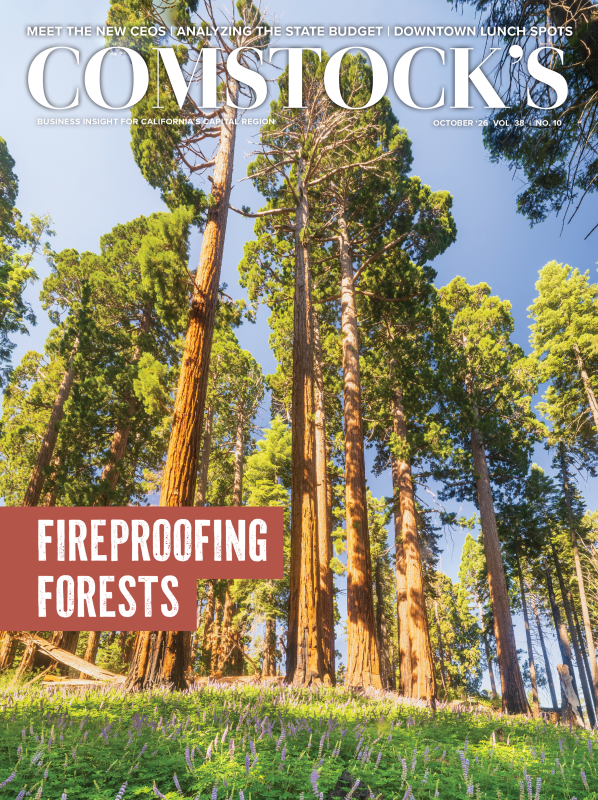
The most severe sequoia damage occurred on Redwood Mountain, which was recently reopened to the public and has warning signs about falling dead trees. Many of the dead giants have lost their distinctive thick red bark. The forest is crisscrossed with huge strips of bark the trees shed after dying. Because of their size and age, the dead sequoias seem like dinosaur fossils.
The KNP Complex Fire in 2021 and two other wildfires that burned to the south within the same year killed as many as 20 percent of all mature giant sequoia trees, raising serious concerns about the future of the world’s largest tree. Giant sequoias, which can live 3,000 years, once burned regularly without dying, but today’s fires burn far hotter and bigger.
The 2021 KNP Complex Fire caused severe giant sequoia losses.
(Photo by Brad Branan)

One of those fires led to the creation of the Giant Sequoia Lands Coalition, made up of 11 government agencies that manage sequoia groves and another nine nonprofit and government agencies involved in its conservation. The coalition has been conducting a research-based effort to save the sequoia, using a variety of conservation tools.
From 2022 through 2025, the coalition did restoration work on 44 of the 94 sequoia groves in existence. Coalition members have burned and trimmed excess brush and planted hundreds of thousands of trees. Coalition members say the outlook for the sequoia is better now, though they are quick to add that many tasks remain and the groves will likely always need periodic maintenance.
“I’m guardedly optimistic,” says Clay Jordan, superintendent of Sequoia and Kings Canyon national parks and one of the coalition’s co-founders. “We have more work to do. We could be back in this mess in 30 years if we just treat all these forests once and then consider it done.”
The coalition’s work has been so successful that agencies in Southern California have modeled the Joshua Tree Conservation Coalition after it, hoping to replicate its success in their work on the threatened Joshua tree in the Mojave Desert.
The giant sequoia is central to Sierra tourism. The trees are the main reason 2 million people each year from around the world visit Sequoia and Kings Canyon, which are 60 miles east of Fresno. Tourists spend an estimated $190 million a year in nearby communities. Yosemite’s three giant sequoia groves also draw many visitors, as do the two sequoia groves at Calaveras Big Trees State Park, the top tourist attraction in Calaveras County.
General Sherman in Sequoia National Park is the largest known
living single-stem tree on Earth by volume. (Photo by Brad
Branan)

Giant sequoias are important to state and national history, as they are the California state tree (along with the coast redwood) and were the main reason for the creation of Sequoia and General Grant national parks (General Grant was later incorporated into Kings Canyon) and one of the reasons for the creation of Yosemite National Park. The giant sequoia is the world’s largest tree by volume; its sister tree, the coast redwood, is the tallest. Jordan notes that the sequoia is featured prominently on the National Park Service emblem and that three of the first four national parks were created in part because of the giant sequoia.
The giant sequoia has long been considered endangered by conservation specialists because of its limited range, which starts in a small grove in Placer County and continues south 250 miles to a grove in Tulare County. Climate change and wildfire are further imperiling the tree.
Giant sequoias are adapted to low-intensity fire and rely on fire to release their seeds. By studying growth rings inside sequoias, researchers have been able to tell that the trees were exposed to fire about once every decade before modern fire suppression began. The giant sequoia’s thick bark helped the tree ward off fire and other threats like insects. The fire pattern changed dramatically after the federal government took over responsibility for many of the groves and implemented a policy of strict and rapid fire suppression. In the process, sequoia groves, like all other forests, became unnaturally dense with brush and susceptible to major wildfires, according to experts. Government agencies now agree.
Lupines bloom beneath surviving giant sequoias on Redwood
Mountain. These early colonizers help replenish soil nitrogen
after fire, supporting new plant growth as the forest recovers.
(Photo by Brad Branan)

For 104 years, until 2014, 24 percent of all sequoia groves had burned, according to “The state of the giant sequoias,” a report published in the science journal Fire Ecology this year. Nine years later, 82 percent of the groves had burned. Fires have also increased in severity, meaning far more trees died in the later fires. A history of aggressive fire suppression, higher temperatures and drought are the main reasons for the catastrophic blazes, the report’s coauthors found.
During the hottest and driest period in the history of the parks, the 2021 KNP Complex and Windy fires were started by lightning, killing thousands of sequoias, less than a year after the lightning-caused Castle Fire killed thousands of sequoias. A National Park Service report stated that “these fire impacts represent a significant threat to large sequoia persistence.” An early report by the Giant Sequoia Lands Coalition said the trees “face an existential threat.”
Jordan started working as superintendent at Sequoia and Kings Canyon National Parks during the Castle Fire in late 2020 — literally a trial by fire. Previously the superintendent at Great Smoky Mountains National Park, Jordan says the Castle Fire initially caught him off guard. When he interviewed for the job at Sequoia and Kings Canyon in August of that year, “Giant sequoia protection was not one of the issues that came up,” he says.
“I get the job, and the moving trucks arrive a few weeks later,” he says. “It was very clear that the conservation of sequoias was going to define my tenure here at the park. And so that is a pretty dramatic change for me, a shock.
“We are protecting about 40 percent of the giant sequoia acreage on the planet, so there’s probably nothing more important to our mission here at Sequoia-Kings Canyon,” Jordan says.
“It was a distressing time for us at the park,” he continues. “At the same time, it was a wake-up call. The outgoing superintendent even said, ‘It feels like we need a call to action.’ And that’s how the Giant Sequoia Lands Coalition was born.”
Jordan says he and Teresa Benson, then forest supervisor of the Sequoia National Forest and the Giant Sequoia National Monument, were the original co-founders, and later, co-chairs, of the coalition. Officials from Cal Fire, the Tule River Tribe and the Sierra National Forest now co-chair the coalition.
Sunlight filters through a charred opening in a giant sequoia’s
trunk. (Photo by Brad Branan)

After the KNP Complex Fire, Jordan and others were struck by the burn pattern on Redwood Mountain, site of the second-biggest sequoia grove in the world. “The lower canyon looked like Mordor, with just standing skeletons of hundreds and hundreds of dead standing sequoias,” Jordan says, referring to the “Black Land” in J.R.R. Tolkien’s fantasy novel “The Lord of the Rings.” “When you walked through the upper Redwood Canyon, same day, same fire conditions, same geography, almost no trees were lost.”
The different outcomes can be explained by which areas received prescribed fire on Redwood Mountain, according to a study co-authored by two UC Davis researchers and others, published in the journal Nature Communications in July. The co-authors used high-resolution satellite imagery and other data to examine how sequoias that had received prescribed fire within 10 years fared in the KNP Complex and Castle fires compared to those that did not. Sequoias that received prescribed fire within that timeframe were four times more likely to survive, meaning that prescribed fire saved almost 2,000 sequoias. While many studies have demonstrated the effectiveness of prescribed fire, this was the first one dedicated to its use on the giant sequoia, according to the report.
Native Americans conducted their own version of prescribed burns for many years before colonization to help the growth of certain plants, and clear forests of dense brush for easier movement for themselves and animals and to prevent dangerous accumulation of brush. The National Park Service and other members of the Giant Sequoia Lands Coalition now recognize the importance of that tradition and have allowed tribes to hold “cultural burns” on coalition grounds. Some sequoia groves are located on tribal land managed by the Tule River Tribe.
A prescribed fire requires firefighters and a pumper truck to start, monitor and potentially put out a prescribed fire, says Tony Caprio, a fire ecologist with the National Park Service at Sequoia and Kings Canyon. Weather conditions need to be right so the fire doesn’t get out of control — a rare occurrence but one that is always a primary consideration, he says.
A giant sequoia rises above the surrounding forest. Found
naturally only in California’s Sierra Nevada, the trees can live
for 3,000 years. (Photo by Brad Branan)

Sequoia, Kings Canyon and Yosemite National Parks have been called pioneers in the use of prescribed fire, using it for decades. But most prescribed fires in the past have been conducted at popular roadside groves, such as the Giant Forest in Sequoia National Park, Jordan says. The cost and difficulty of treating groves far from the road stopped more extensive work.
Now, with greater concern about the risk faced by sequoias, land managers in the Giant Sequoia Lands Coalition have agreed to prescribed fires in all but a handful of remote groves, says Kristin Shive, a fuels and fire specialist with the University of California Cooperative Extension Program in Berkeley. Shive is a member of the coalition and has contributed substantially to research on the risks facing giant sequoias and the benefits of prescribed fire.
In 2024, two nonprofit environmental organizations developed a risk assessment for the 94 giant sequoia groves, ranking them by wildfire threat. Groves that had not burned in a long time, either naturally or from prescribed fire, were considered at highest risk. The coalition made the assessment part of a five-year plan to treat the groves.
In the coalition’s annual report for 2025, the South Grove at Calaveras Big Trees State Park was identified as one of the top 10 priority groves in need of treatment. In October 2024, crews treated 1,145 acres with prescribed fire, but bad weather prevented further work, says Amber Sprock, a spokeswoman for California State Parks. Crews plan to treat another 600 acres this October, weather permitting, she says.
Sunlight streams past a giant sequoia. (Photo by Brad Branan)

“The state of the giant sequoias” report found that most sequoia groves have high or moderate resistance to severe wildfire due to previous wildfires or prescribed fire. About one-fifth of sequoia groves have little or no resistance because they haven’t been exposed to fire for a long time.
Shive, who was the report’s lead author, says researchers did not measure sequoia fire resistance before the work completed by the Giant Sequoia Lands Coalition. Yet the benefits of the coalition’s work are clear, she says.
“The sequoias are in vastly better shape because of the work that has been done,” she says. “If we had done that same analysis five years ago, a lot more trees would have been in the hazardous category … tremendous progress has been made.”
–
Stay up to date on business in the Capital Region: Subscribe to the Comstock’s newsletter today.
Recommended For You
There’s a Cool Cathedral of Trees Just a 2-Hour Drive From Sacramento
Sonoma County’s redwoods have survived over 1,000 years thanks to natural armor and other adaptations
There are some large, beautiful redwoods at parks closer to Sacramento, including Henry Cowell Redwoods State Park, near Santa Cruz, and Armstrong Redwoods.
How the National Weather Service Helps California Through Fire Season
Local offices in Sacramento and Hanford were critically understaffed, but pending legislation aims to prevent this from happening again
As California headed into fire season, two National Weather Service offices covering much of the Central Valley struggled with unprecedented vacancies — forcing service cutbacks and backup support from neighboring stations. What does this mean for the future of weather safety in California?
Winning the Fire Insurance Lottery Is Harder Than Ever
Getting a good homeowners policy was like hitting the lucky number. Then came the L.A. fires
Keeping a decent insurance plan has only gotten tougher. The re-insurers that backstop companies like State Farm and Farmers are remapping the Capital Region after L.A., say area insurance agents.
How Is California Fire-Proofing for the Future?
From flame-resistant building materials to increased defensible space, our future homes and neighborhoods may look vastly different
In an era of escalating fire disasters, with insurers fleeing large parts of the state and with builders desperate to find ways to construct houses that would better resist the flames, what can we do to defend our neighborhoods?