


This story is part of our June 2026 issue. To read the print version, click here.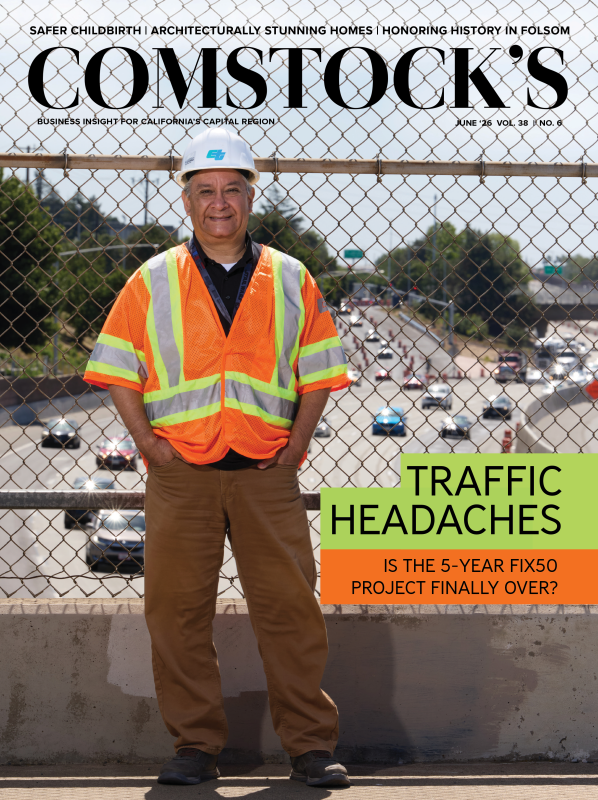
Underneath us, sensors are embedded in the asphalt every few feet on every lane, feeding real time traffic flow information into the Caltrans system.
It is an unseasonably cold, rainy day for May, and because of the weather, no construction work is taking place. But when Ochoa Sánchez parks on the Alhambra Boulevard overpass and stands by the high chain-link fencing looking down at the speeding cars, he almost becomes an over-protective father.
He “tsks” at the vehicles, many going far beyond the speed limit, their headlights off despite the dark storm clouds, and he points out the newly tarmacked HOV lanes, running in both directions, that will soon make the local commute easier. He talks fondly of the beautiful plants that will soon replace the scrubby, browned borders.
If you live and drive in the Capital Region, you can’t help but be aware of the huge road construction projects on the major highways. These projects are designed ultimately to improve traffic flow and safety on I-50, I-80 and I-5, as well as to make journeys more manageable for cyclists.
But commuters have seen on-again, off-again lane and ramp closures for the past several years, since the Fix50 project, running from Watt Avenue west to the I-5 connector, got underway in 2021 at the height of the pandemic. Some nights, so many lanes and off-ramps were closed for construction that unfortunate drivers had to crawl in traffic for additional miles until they found an open off-ramp and then made a circuitous way back home from there.
Caltrans Public Information Officer Sergio Ochoa Sánchez says the
5-year, Fix50 project on Highway 50 was one of the most complex
construction projects Caltrans has done in 50 years. (Photo by
Fred Greaves)

Along parts of the downtown highway maze, protected bicycle lanes are also being added.
Over the coming months, with a bit of luck, according to Caltrans, the traffic snarls should be easing as the rehabbed routes will become fully functional. The large construction sites under the downtown overpasses should be cleaned up and the heavy-duty work vehicles withdrawn. In time, the dust, grit and the grime of these hard-hat construction areas will dissipate; left in their wake, officials hope, will be a state-of-the-art highway system.
For years now, the Fix50 project has been scorned by the media and has served as a target for angry drivers caught up in its traffic snarls. Ochoa Sánchez says that he has fielded more than his fair share of unhappy callers. “Everyone’s an engineering and construction expert when it comes to closures,” he says, laughing. Now, though, he can see the metaphorical light at the end of the tunnel, and to his eyes even in the rain, it is a pleasing sight.
Projects around the region
The nearly complete Fix50 project is only one of several large highway investments in the Capital Region that have been worked on in the years since the pandemic.
First, there was the I-5 project, opening up additional lanes on the freeway from Elk Grove northward into Sacramento, and shaving up to ten minutes off an average commute. This one was completed some months back, although work on expanding the freeway on the stretch north to Natomas and the airport is ongoing.
Meanwhile, lane expansions on I-80 began last summer in the area from Davis to downtown Sacramento — squeezing in additional toll lanes on the causeway, eating into hard shoulder real estate, without physically expanding the size of the road itself. There’s also a long-overdue $269 million rehabilitation of the American River Bridge from Exposition Boulevard east across the river to 5th Street. Both are slated to be wrapped up by mid-autumn. Caltrans spokespeople hope that if the weather cooperates, most of the project will actually be finished before the end of the summer, leaving only some drainage and electrical work to be completed over the following months.
Smart traffic control
Adding smart sensors under the surface of the expanding freeways allows Caltrans to monitor traffic flow in real time and tweak the on-ramp metering systems to optimize the speed of traffic. The agency feeds that information to drivers through Caltrans’ Quick Map app to significantly reduce commute times. By extension, if cars aren’t sitting in traffic for as long, that ought to lower the amount of gas expended by each driver and thus the amount of greenhouse gas emissions from the region.
“When you’re talking about the downtown corridor, it’s notorious for delays; it’s always been like that.”
— Dennis Keaton, Caltrans PUBLIC INFORMATION OFFICER
Yet none of this comes cheap. Each of the big projects in the Capital Region, chosen because of the high use of those stretches of highway and the frequency of long traffic delays along their routes, costs hundreds of millions of dollars. That is money which has been made available by a combination of use-it-or-lose-it federal American Rescue Plan Act dollars, as well as state and local funding streams.
Caltrans argues that it is money well spent, and once the construction is over — along with the commuters’ pain that goes with lane closures — it will ultimately improve the lives of drivers and make the region’s highway infrastructure both safer and greener over the coming decades. Regarding the stretch of I-80 under construction, Public Information Officer Dennis Keaton explains that “It’s one of the busiest stretches of highway. When you’re talking about the downtown corridor, it’s notorious for delays; it’s always been like that.”
Why aren’t we funding alternate modes of transportation?
Not everyone is convinced, however, of the wisdom of these projects. Yes, in the short term it might reduce commute times. But ultimately, as those commute times are reduced, the goal is to allow more vehicles to use the roads without clogging them up. And that, says post-doctoral scholar Amy Lee at UC Davis’ Institute for Transportation Studies, is self-defeating. In the long run, it is going to be bad for the state’s goals for reducing greenhouse gas emissions, as well as for air quality mandates codified by the Clean Air Act.
Moreover, she argues, once all the additional drivers are drawn into commutes on the newly expanded highways, over the coming years the traffic snarl conditions will once again return — with the additional lanes simply being taken up by additional vehicles. “If you’re trying to minimize those things, widening highways is not the route I’d be taking,” Lee says.
Cones mark an area of road work near the Stockton Boulevard exit.
(Photo by Fred Greaves)

All of these projects have been discussed in planning meetings in the Capital Region; yet none of them, as yet, has been funded. As a result, they remain aspirational goals for if and when significantly more dollars one day start flowing to public transit in the Sacramento area.
Meanwhile, funds for large highway projects keep rolling in. When this round of highway improvements comes to a close, commuters may get to take a breather, and may have months — or even years — without major improvement-related traffic problems. But that respite is likely to only be temporary.
Already, there are proposals in Sacramento for a beltway, known as the Capital SouthEast Connector Expressway, that would convert small farm roads south and east of the city into a big highway connecting Elk Grove to El Dorado Hills or Folsom. (With this project under discussion, real estate developers have already started planning new housing hubs along the route.) There are ongoing discussions around a $250 million project to extend Broadway with a bridge going over the Sacramento River to West Sacramento.
Post-doctoral scholar Amy Lee at UC Davis’ Institute for
Transportation Studies says the funds used for highway projects
would have been more efficiently spent on improving public
transport options such as light rail. (Shutterstock photo)

In addition to these large-scale construction works, there are smaller fixes slated for I-5 in the Woodland area; several bridges in the Delta are due for retrofits; and some work is being done along State Route 12. In neighboring Yolo County, parts of State Route 16 are being spruced up. And in the Bay Area to the west, Gov. Gavin Newsom has fast-tracked a $500 million project to widen Highway 37, which funnels commuters from relatively affordable cities such as Vacaville and Fairfield north to Marin County and the wine country region.
It seems a truism in the politics of big road building projects: If use-it-or-lose-it money is made available, big projects that have languished for decades will suddenly become necessities. There is, says Lee, hay to be made from politicians rolling up their sleeves and showing how serious they are about short-term reductions in traffic congestion. “It’s your tax dollars at work,” she says, that politicians can claim of the region’s massive, traffic-snarling, road-improvement projects. “It (the I-80 project) got legs when it won a federal grant.”
Despite all of the commuter road rage about the time these projects have taken and the commuter headaches they have caused, and despite the questions Lee raises about the funding priorities, now that the highway fixes are wrapping up, Ochoa Sánchez is confident they will come to be seen as a plus for the region.
“I do believe it’s going to be worth it, yes,” he says. “And with the I-80 rehabilitation project also slated to be completed by summer, it’s going to be a smooth commute.” Drive times to and from the Bay Area and to and from Lake Tahoe will, he argues, fall, and the route itself will become more pleasant. “It’s going to be very nice when it’s complete,” he says. I feel a sense of pride and ownership. It’s going to be very good for the area.”
–
Stay up to date on business in the Capital Region: Subscribe to the Comstock’s newsletter today.
Recommended For You
Will the Central Valley Ever Get High-Speed Rail?
Funding cuts and environmental issues are both holding up the long-stalled project
We looked into the recent history of California’s high-speed rail to understand some of the obstacles preventing it from staying on track.
When Streetcars Roamed the Capital Region
The classic car system predated light rail by almost a century
While many of us believe that Sacramento’s light rail trains were innovative when they began tooting their way throughout the Capital Region in the 1980s, the current system is actually the reboot of a suburban trolley that slid, wended and awoke its way through the area many decades before.
What’s Holding Up Valley Rail?
The need and the plan are there, but bureaucracy once again slows progress
The project has been caught in spiraling delays, and launch dates have been pushed back to 2030. The San Jose Regional Rail Commission broke ground on just one of the half dozen proposed new stations as of late summer 2024.
Are We Ready for the Electric Revolution?
The Capital Region is leading the charge to make California EV compliant in the next decade
These days, there is a sense of possibility in Sacramento when it comes to zero emissions technology. Sacramento may not have the population numbers of New York or Los Angeles, but when it comes to EV infrastructure the California capital plays second fiddle to no city in America.