


This story is part of our November 2026 issue. To read the print version, click here.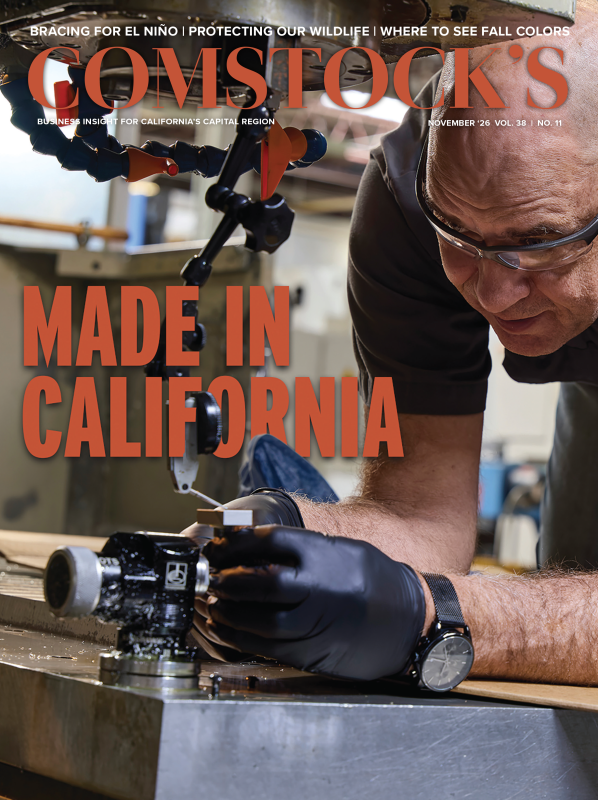
Chris Belle, a 45-year-old CEO and engineer, has a fondness for good coffee and conversation. He looks unassuming — he’s thin with a graying beard, and the most notable things in his airy office are a golf club, a ball and a green mobile putting hole next to his desk. But when he describes the work done by his more than 100 staff members at Tri Tool Technologies — a precision machining company in Rancho Cordova that makes high-end pipe-cutting tools — his enthusiasm shines through.
Tri Tool specializes in custom engineering, allowing pieces of machinery to be welded securely together so that potentially dangerous gases or liquids can’t leak out. Its tools are individually designed for building everything from semiconductors to SpaceX rockets.
Belle explains how his company makes cold-cutting tools that slice through metal with blades rather than with plasma. As he walks through the corridors of the administrative wing of the building, he passes by photos of massive industrial plants around the world that have cut their pipes down to size using Tri Tool Technologies machines. We head onto the factory floor, and he shows me computer-controlled systems that puncture holes for rivets at regular intervals.
He explains how machine operators use complex mathematical formulas to work out the best techniques, angles and pressure points for creating the needed industrial pieces. There are also huge machines for grinding down rough edges to an accuracy of a few ten-thousandths of an inch and 3-D printers and machines that rotate metal pieces while streams of coolants continually flow as they are shaped into usable parts. In an area hidden from casual observers by a high black tarp, engineers work on proprietary parts for various government contractors.
“We build those machines here that will help rockets launch, submarines submerge, oil refineries stay safe,” Belle explains.
According to the California Manufacturers & Technology Association, small-sized firms are the lifeblood of California’s manufacturing sector.
Tri Tool Technologies is a precision machine company in Rancho
Cordova. (Photo by Fred Greaves)

“We have more than 45,000 manufacturers in the state, and nearly nine in 10 of them are small businesses, so you’ll find them in just about every city and town,” says Lance Hastings, CMTA CEO and president. “Those smaller manufacturers make finished products that consumers demand, and they also make the components that go into nearly everything else you can imagine, including the fasteners that hold airplanes together. Companies like Tri Tool Technologies are the unsung heroes of our economy. They work behind the scenes, but so much of what we rely on starts with what they make.”
A diverse workforce
Some Tri Tool employees are fresh out of high school, where they took shop classes. Starter employees earn salaries in the $60,000 range. Others went through technical programs, such as welding, at Sierra College and American River College; still others are engineers with degrees from prestigious universities. Salaries for these men and women can top out at over $150,000 per year.
“The challenge is making something the best I can,” says Logen Mussmann, a young man with a mullet haircut and a baseball cap, who heads up a seven-member team that grinds down the interior of pipe pieces so that they can be welded together. The accuracy needed is extreme — they have specs that detail outcomes to within five ten-thousandths of an inch, which is thinner than a human hair. “I get to spec out all the new machines for the department,” Mussmann says. “I get a lot of freedom in where we’re moving and how we’re going to produce things. I enjoy what I do.”
Tri Tool has a diverse workforce that includes recent high school
graduates and highly skilled engineers. Sean Klinger, Louis
Frazier and Brandon Brown test machines in the research and
development department. (Photo by Fred Greaves)

The head of maintenance is a motorcycle-riding South African immigrant named Adrian Jansen Van Vuuren, who has a degree in electromechanical engineering. Van Vuuren grew up in a suburb of Johannesburg and migrated to California in 2002, where he ended up working for Tri Tool fixing the machines that make machines.
“It’s electronics, mechanical, pneumatics. Everything’s involved. It’s challenging, satisfying,” he says. “I’m responsible for all the equipment as well as the facilities. I manage the hazardous waste. When a key machine goes down, in my mind I’m like, ‘This machine is $500 an hour.’ This is what it’s costing the company. It’s impacting the big picture. It’s a good amount of pressure. The higher the challenge, the greater the reward when you actually get it done.”
The international sales team includes a welder named Melissa Spencer, who is the third generation in her family to make her living from welding. She recalls selling parts to companies including Rolls-Royce and SpaceX, and — until the work got too much — also teaching welding classes in the evenings at American River College. “I’ve dealt with every country you can ship to without sanctions,” she says, laughing. “I love it. My dad and I can sit and talk about it for hours. He thinks it’s so cool what we do.”
Small but essential
Because Tri Tool Technologies is a relatively small company with teams of versatile specialists who do tooling work that few others are capable of, Belle has a degree of flexibility in implementing changes. There isn’t the bureaucracy of a larger company.
“Here, if you want to make a change, you can make a decision at 9 a.m., and at 9:01 a.m. you can go implement,” Belle says. “We build tools — portable machining equipment geared toward highly regulated industries. We’re building confidence for those who lead the world forward.” It’s something of a sea change for the CEO, who spent much of his career before he landed at Tri Tool working for large engineering firms.
Belle was born in Michigan, raised in Florida, and spent much of his early adulthood working as an engineer for Siemens in the city of Essen in Germany, where his son and daughter were born.
Months into the COVID pandemic, Siemens tried to convince Belle to head up its unit running mobile COVID hospitals, but Belle had absolutely no desire to do such work. Tri Tool also reached out to him, but he had never heard of it. It turned out that Air Force surgeon George Wernette had started the firm in 1972 after two of his patients, a machinist and a welder, approached him with an idea for a company that would save lives by making welding safer and improving the surgical process of welding. But by 2020, Tri Tool had fallen on hard times, and George’s son Joe Wernette, who had taken over the company alongside his mother, Jerri, wanted to recruit Belle as CEO to turn it around.
CEO Chris Belle, who formerly worked for Siemens, turned the
company around after the pandemic into a global enterprise.
(Photo by Fred Greaves)

“My experience had been in turnarounds. I’d take a problem and go fix it. When something’s broken, you’ve got a lot of freedom to make it work,” Belle explains. In North Carolina, he had worked with Siemens to retrofit non-functional power plants and get them back on their feet. Now, the Wernette family was asking him to leave a big, multinational company with good benefits to take a chance on a small, struggling company that operated out of a small factory in an industrial park east of Sacramento. On the surface, the idea seemed absurd; yet Belle was intrigued.
His arrival didn’t go smoothly. The day he and his family flew in, George Wernette, the company’s patriarch, died. Yet, true to form, his son, Joe, kept his date with the Belle family and, over a meal at a nearby restaurant, explained to them what he was looking for in a CEO.
Joe Wernette can pitch his company well. He explains how the pipes that Tri Tool works on “are in the background of almost every person’s everyday activities. We do touch so much; we really do make people’s lives better.” He says that pipes welded by his family company’s skilled employees help power hospitals, get drinkable water to remote locations and build communications infrastructure that is instrumental to the pharmaceutical manufacturing process. Tri Tool equipment has been used to do emergency pipe repairs on huge hydroelectric turbines run by the New York Power Authority. And he details a can-do mindset in which his engineers and machinists “go into these hard, difficult situations and we solve the problem — and we leave, and the customer’s happy.”
Even with that knowledge, Belle knew that righting a company suffering a financial slide in the middle of a once-in-a-century pandemic would be a challenge. The first thing he had to do was downsize the workforce in order to keep the company, which was reeling from pandemic stay-at-home measures, solvent over the coming months. After that unpleasant opening act, he had to work out new ways to interact with clients during a period when public health mandates limited his sales team’s ability to go indoors to demonstrate products. They had to set up a series of outdoor demonstrations instead, oftentimes in parking lots, to showcase their new technologies.
During those first months, Gov. Gavin Newsom descended on the company to hold a press conference on the theme “Made in California.” It was a mark of recognition for the business and signified the beginning of a true turnaround for Tri Tool Technologies.
“Over the last decade, small and medium manufacturers have had to deal with rising energy costs, a global pandemic, and now the uncertainty of tariffs on many of the materials they rely on,” says Hastings of CMTA. “And those pressures hit harder in California. We see it in the affordability crisis facing businesses and families who are working hard all day just to keep up. Without any relief or support to keep those manufacturers in California, our economy could suffer if they leave the state.”
Over the months that followed, Belle managed to stop the financial bleed and reboot the company. Now, six years later, Tri Tool is thriving, with contracts coming in from companies and governments worldwide. Recent projects include helping construct the piping for a solar panel plant in Tennessee, working on huge horizontal pipes for a number of oil and gas rigs and building some of the pipes used in fighter planes. Perhaps in a nod to that latter project, the company has whimsically named one of its most advanced pipe-cutting machines “The Spitfire,” also the name of the Royal Air Force’s most iconic fighter plane during World War II.
“I love manufacturing,” Belle says, an impish smile on his face, his eyes shining behind their protective plastic glasses. “It doesn’t matter what skill set you have; you can get a job in manufacturing.”
–
Stay up to date on business in the Capital Region: Subscribe to the Comstock’s newsletter today.
Recommended For You
Manufacturing a New Vision for Stockton
Stockton manufacturers look to capitalize while operating in the historic region
In the late 19th and early 20th centuries, Stockton was a manufacturing powerhouse, helping to send items to market like America’s first mass-produced tractors. Stockton’s manufacturing sector declined over many decades, though there are now local leaders working to strengthen it again.

Behind the Doors of Sacramento’s Small Food Factories
Three beloved local businesses prove that old-school flavors never go out of style
Deep inside the belly of Corti Brothers in East Sacramento, past the double doors marked “employees only,” past the walk-ins and shelves of goods and hustling employees, a piercing klaxon is sounding in the kitchen. Is it a fire alarm? Has a miscreant entered through a back door to burgle a jar of vintage marmalade? Much more dire: The cheese ravioli filling in the ravioli machine hopper is getting low.
Trump’s Tariffs Hurt Some Local Businesses, but Prompt Others to Shift Gears
What impact are tariffs having on the economy of California's Capital Region?
Conversations with Sacramento-area business owners show tariffs aren’t affecting all companies the same way. At least one is expanding fast because of them. But almost everyone is seeing some effect.

101 Years of Hustle
Family business spotlight: The Gini family of Collins Electrical Company look to the future
Collins’ first major project was a state hospital in Stockton in 1929, followed by another in Mendocino. More recent projects include the Monterey Bay Aquarium, Fresno Chaffee Zoo, Candlestick and Sutter Health parks, and many casinos.