


Giant sequoias evolved to survive fire. As wildfires grow more destructive, carefully managed burns could help safeguard their future.
Part of my first job as a reporter was covering wildfires in and around Calaveras County, where most housing developments meet vast grasslands or swaths of pine forest. Some nights, I’d stay up relaying Cal Fire updates so those under threat — occasionally including me — would know when and where to go.
In 2015, the giant sequoias that had inspired awe in me since childhood were in the line of fire. The Butte Fire ignited 25 miles away but jumped the Mokelumne River on its second day, forcing staff to evacuate Calaveras Big Trees State Park. The park’s namesake trees, however, could not evacuate, so firefighters dug firebreaks and dropped retardant in an effort to save trees that had towered over the landscape for thousands of years. As the Calaveras Big Trees Association puts it, it was a massive effort — and it worked, alongside a fortuitous change of wind.
It’s strange to think that human intervention is needed to protect ancient organisms that are indifferent to us and our fondness for them. Yet experts say it is human activity — the burning of fossil fuels and our tendency to suppress or employ fire according to our own needs — that has allowed wildfires to burn more destructively.
Wildfires burn 10 times as much acreage annually as they did 40 years ago, according to research led by UCLA. A 2026 study from the same university cites climate change as the primary driver, but researchers have also found that forest management can make a meaningful difference.
Just last month, Gov. Gavin Newsom signed legislation that further reduced barriers to prescribed burning, adding to the momentum behind changing attitudes toward forest management over the past decade.
For October’s cover story, we explored how methods developed by Indigenous peoples are being deployed to protect some of the state’s greatest natural wonders.
– Dakota Morlan, managing editor
Other stories you may have missed: Mark S. Allen Is Not Just That Silly Guy You See on TV

What may surprise his many longtime fans throughout the region is that Allen, who has won eight Emmy awards, also spends a great deal of time behind the camera.
Sacramento-Area Founder Builds Recovery Startup After Watching Her Mother Lose Mobility

In the fitness world, training remains a priority, but recovery lags behind, according to Amy Brown, founder and CEO of Rollgevity.
Treasure Island Is Changing, but Its Breathtaking Bay Views Remain

Treasure Island is in the middle of a massive housing and retail redevelopment boom that has already seen over 1,200 waterfront residential high-rises and townhomes built in the past decade.
Elections Should Be Far Easier | Opinion

The way we vote has changed. Has our connection to the process changed with it? Comstock’s President and Publisher Winnie Comstock-Carlson reflects.
Some recommendations from our editors
Judy: The fall social season is in full swing. Last Wednesday, I attended a dinner at the Sutter Club put on by CREDA (Commercial Real Estate Development Association) to honor Dave Lucchetti, retired president and CEO of Pacific Coast Building Products. The next day I was at the Golden 1 Center for one of my favorite food events — tasting the new food offerings at the arena for the Sacramento Kings upcoming season. Some of the new items include poke nachos, a rotisserie chicken sandwich, a black bean sandwich and a crispy cheese quesadilla smothered in fresh guacamole. The week was topped off by a farm-to-fork dinner to raise money for the Orangevale-Fair Oaks Food Bank. Dinner was served under the lights in the food bank’s adjacent farm.
Jennifer: This week I read “The Marrow of Tradition” by African American writer Charles W. Chestnutt, a novel written in part as a response to the 1898 Wilmington massacre. Much of the dialogue is written in dialect, which can be a little difficult to get through — not to mention all the historically accurate slurs — but it’s still an engaging, suspenseful novel that serves as a reminder of a dark period in American history.
Odds and ends
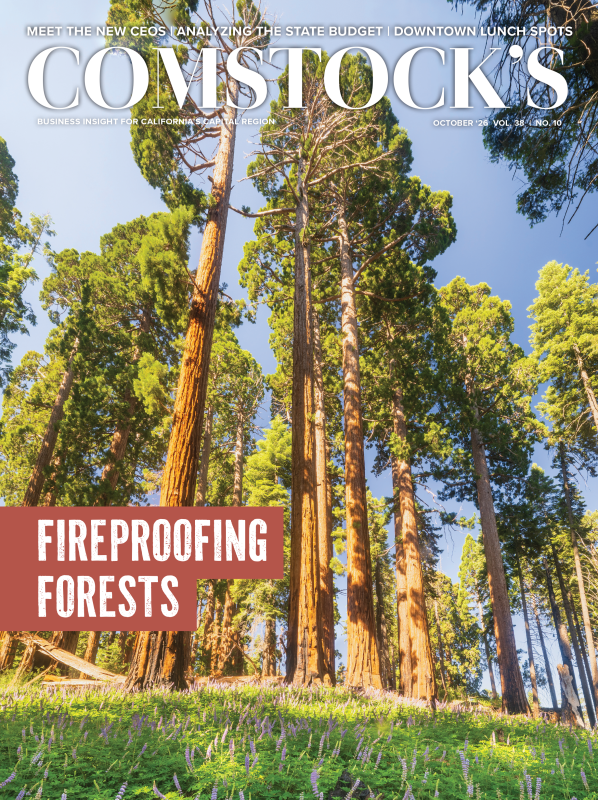
Our October issue explores controversial forest management methods, Sacramento’s new suite of CEOs, the elusive downtown rebound and more. Read it now on your computer, phone or tablet.
Follow us on Instagram, Facebook, X and LinkedIn for daily stories and extras.