


As even the most devout historic preservationists admit, just because a building is very old doesn’t mean it was built well in the first place. This was the case of the Cathedral of the Blessed Sacrament, built in 1889. It’s an elegant landmark in downtown Sacramento, just one block north of the state Capitol and two blocks east of Sacramento City Hall. Like those other venerable structures, the cathedral has history and prestige on its side — but not time.
It’s an important building and symbol, the centerpiece of the Catholic Diocese of Sacramento, an almost 55,000-square-mile sphere of influence in the Capital Region and another 38,00-plus square miles in Nevada, serving more than a million worshippers. Presided over by Bishop Jaime Soto since 2007, the Diocese has more than 140 parishes and missions, 36 elementary schools, six high schools, six hospitals and three Newman Centers (Catholic campus ministry centers).
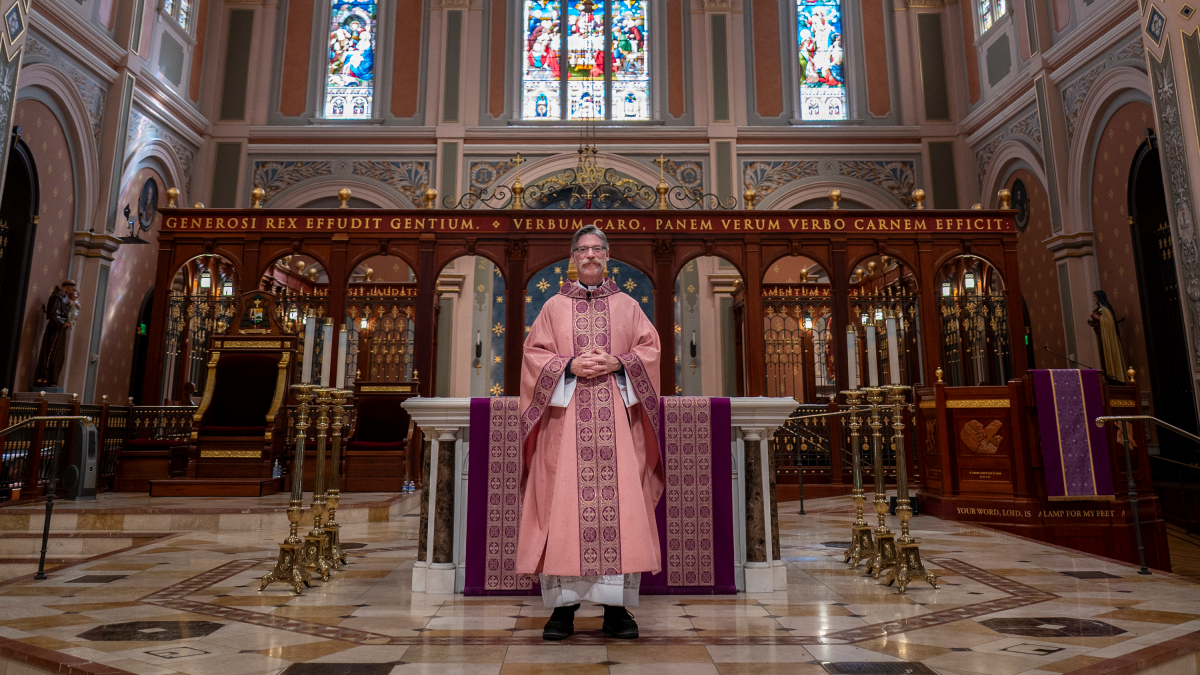
The Cathedral of the Blessed Sacrament operates seven days a week, with daily masses in English and weekend masses in English, Spanish and Chinese. “I conduct the English and Spanish masses,” says Father Michael O’Reilly, who’s served as the rector and pastor of the cathedral for 14 years. It holds a special meaning for him: “I was ordained in the building in 1996, nine years before its restoration.”
I wrote about that restoration project in 2005 and watched the gravity-defying efforts to restore the 45,000-square-foot cathedral. While the building’s exterior is strictly Italian Renaissance, its interior decor, reflecting the era in which it was built, is Victorian(ish). It took two years to build (1887-1889). San Francisco architect Bryan J. Klinch, the Irish immigrant who designed the structure, created more than 30 Catholic churches in his distinguished career.
Michael O’Reilly stands near the altar of Cathedral of the
Blessed Sacrament.
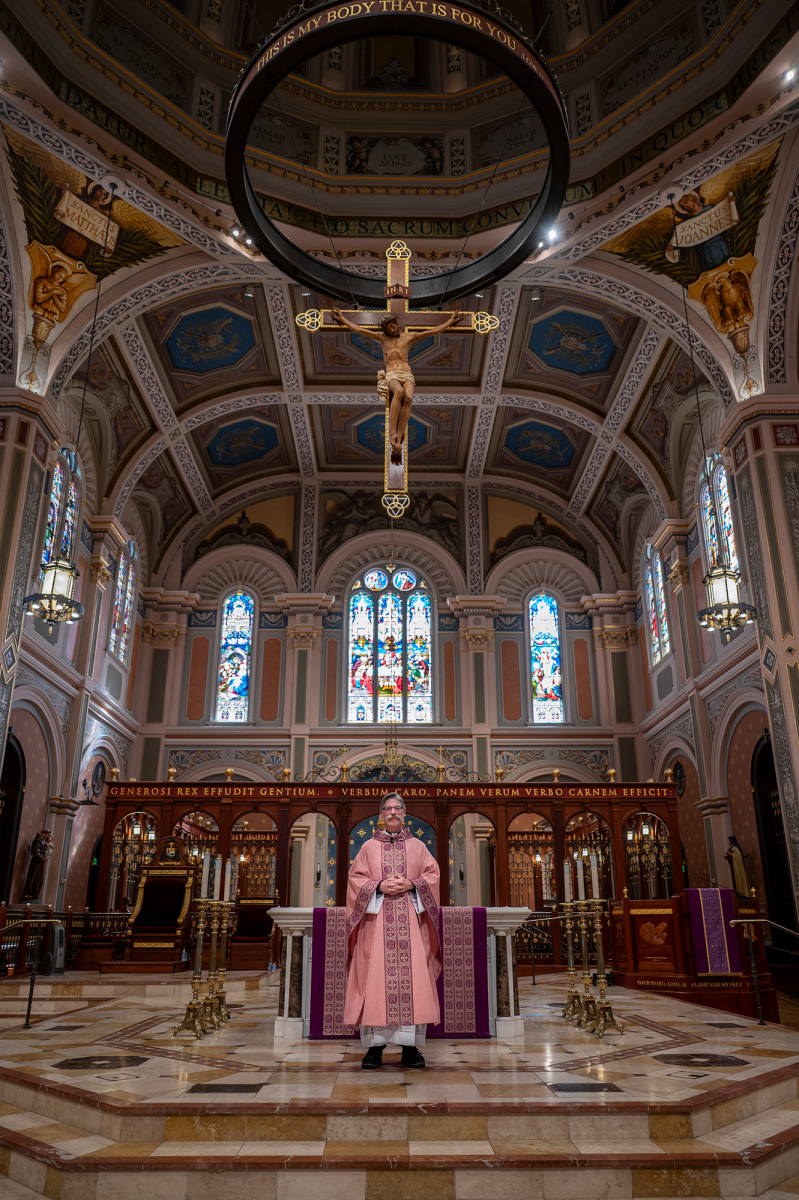
The cathedral outlived its original structural integrity of reinforced brick by the turn of the 21st century. While it had always loomed as an unshakable presence in a city that embraces change and growth, it was far from “unshakable” should Sacramento experience an earthquake. And so, for safety’s sake, to satisfy contemporary building codes and regulations (including the Americans with Disabilities Act) — and to help ensure its survival for another century — it needed some serious face- and body-lifting.
The entire cathedral would require a mechanical, electrical and plumbing upgrade. The cathedral’s identifying dome, which had already served as a beacon to parishioners and the community at large for more than a century, desperately required restoration; it had been closed off from the rest of the interior for more than seven decades. To be strengthened, the dome would need to be lifted during the project, with the utmost care and precision.
For months, the project attracted lunchtime and weekend gawkers, especially when the dome work was being done. To temporarily support the 100-ton central dome structure — while seismically reinforcing the dome’s un-reinforced masonry support columns — a complex massive shoring system was put in place. It required the installation of four 10,000-pound, 36-inch by 60-foot long wide-flange beams, long enough to span the building’s transepts (the lateral arms of a cruciform church).
The beams, which were hydraulically lifted into position on top of four 50-foot high shoring towers, first needed to make their way through the front doors of the cathedral — horizontally, of course.
With brittle plaster and century-old stained-glass windows only a few feet away, it was mandatory that any movement — of the building or in the building — be closely monitored and kept in check. A project superintendent at the time likened the exercise to “fitting an entire building with a pair of crutches to relieve the weight on an injured body part — in this case, the dome’s structural support columns.”
Once the shoring was in place, the existing brick support columns, each of which weighed in at 600,000 pounds, had roughly 25 percent of their mass removed, then replaced with a new integral, reinforced concrete moment frame.
The restoration of the cathedral’s dome required a complex
shoring system.
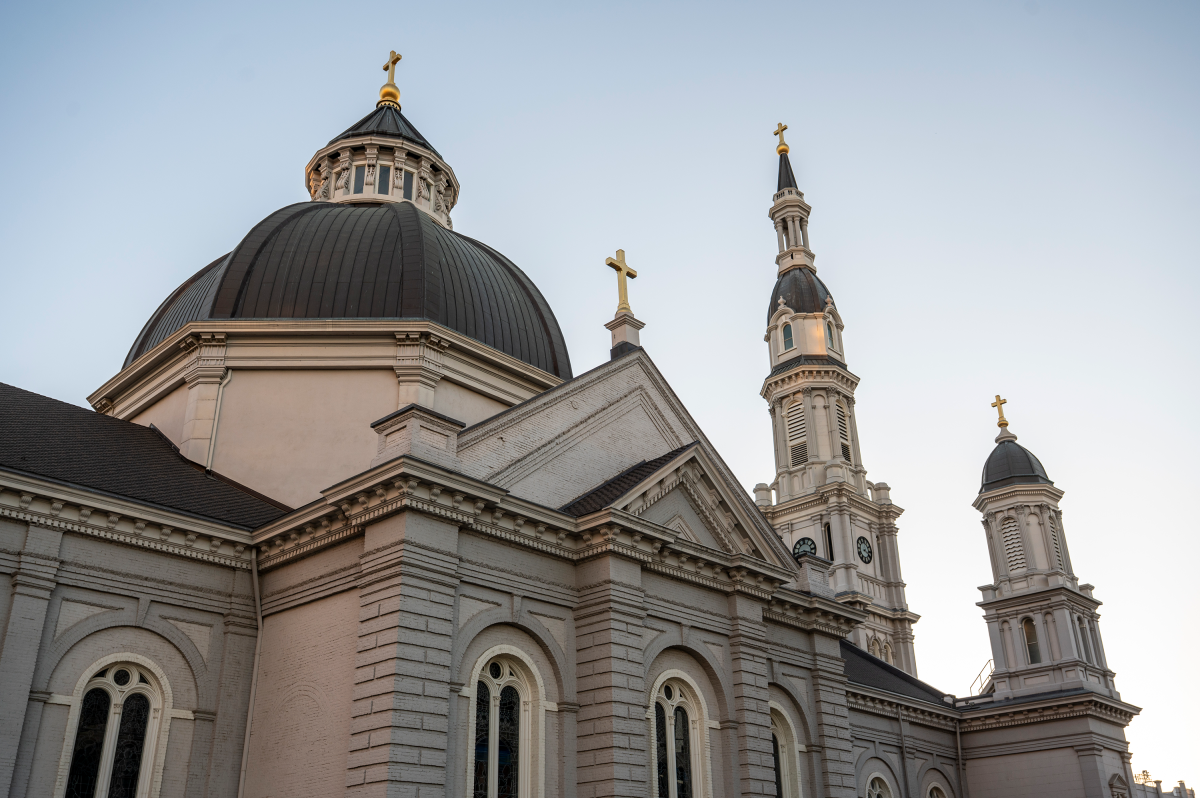
The dome work gave a whole new meaning to the term “topping off.” The Cathedral’s top spire, which perches 217 feet above the sidewalk, needed a great deal of attention, both decorative and restorative. But the contractor, Harbison Mahony Higgins (now closed) — which would go on to win the Contractor of the Year Award from the Associated General Contractors of California in 2005 — calculated that building a scaffold that high could induce more than nosebleeds: It could also cause the project to hemorrhage red ink (and not incidentally, increased safety concerns).
HMH decided that the fastest, most economical and efficient answer was to employ steeplejacks: high-wire artisans and tradespeople, most of whom are also mountain- and rock-climbing enthusiasts. The use of the steeplejacks enabled two major elements of the project to continue simultaneously.
The ground crew took the scaffolding up to 135 feet while the steeplejacks soared above. They’d get as high up as possible, rig themselves, glide down the sides of the walls and do their magic — painting, plastering, sheet-metal work while sitting in boatswains’ chairs. They even gilded the crosses.
“This is a magnificent building,” says Father O’Reilly, “though not without its challenges.” The cathedral’s assets are “its terrific beauty, inside and outside, its historical significance and its undeniable message of speaking to the glory of God. It also attracts people.” He pauses, then says, partially in jest, “And I think we like being just down the block from the state Capitol so we can keep an eye on things.”
The only drawback is its size. “It’s challenging to lead an intimate service in a room that can hold up to 1,200 worshippers.” What surprises him to this day, the pastor says, “is how many people working downtown have walked by the cathedral without even knowing it’s here or what it is. They must be too busy looking at their cellphones.”
–
Stay up to date on business in the Capital Region: Subscribe to the Comstock’s newsletter today.