


It all started a month ago when I received an email from a potential advertising client, the CEO of a local company, who said, “Budgets are tight right now, and our industry is going through an inflection point.” I guess I knew that might be the case, and I thought about how my own industry has been going through that same inflection point — as are many businesses.
Then I had an epiphany — I could even call it a revelation. Whatever it was, it took me back mentally to my younger days — May and June 1976 to be exact, when I’d just left a 12-year stint with the California Legislature. I’d begun in the typing pool and, by the time I left, worked as a special assistant for Speaker Leo McCarthy (a job I loved). A series of events had me change courses, leading me to work in advertising sales for Sacramento Magazine, which was still a very new magazine at the time.
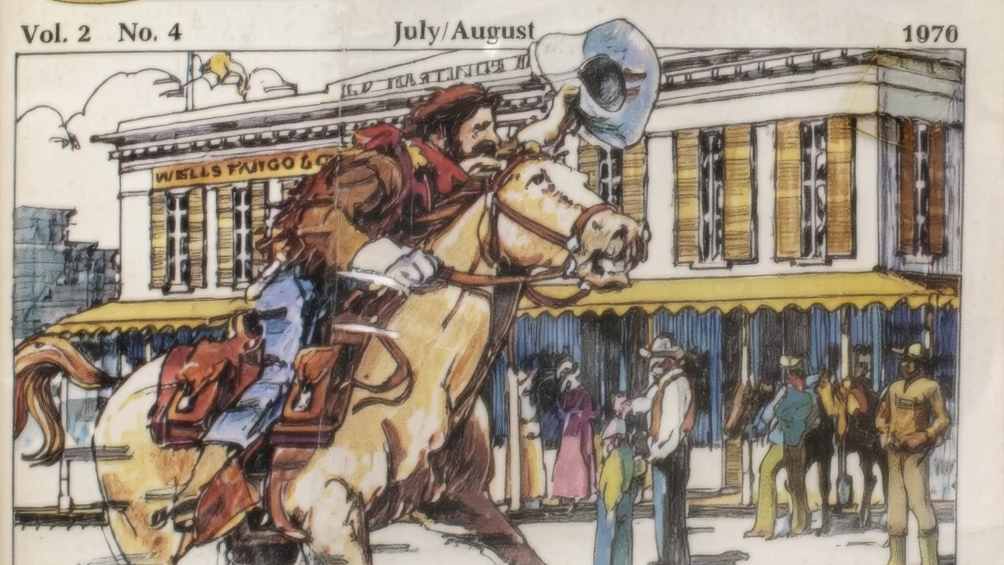
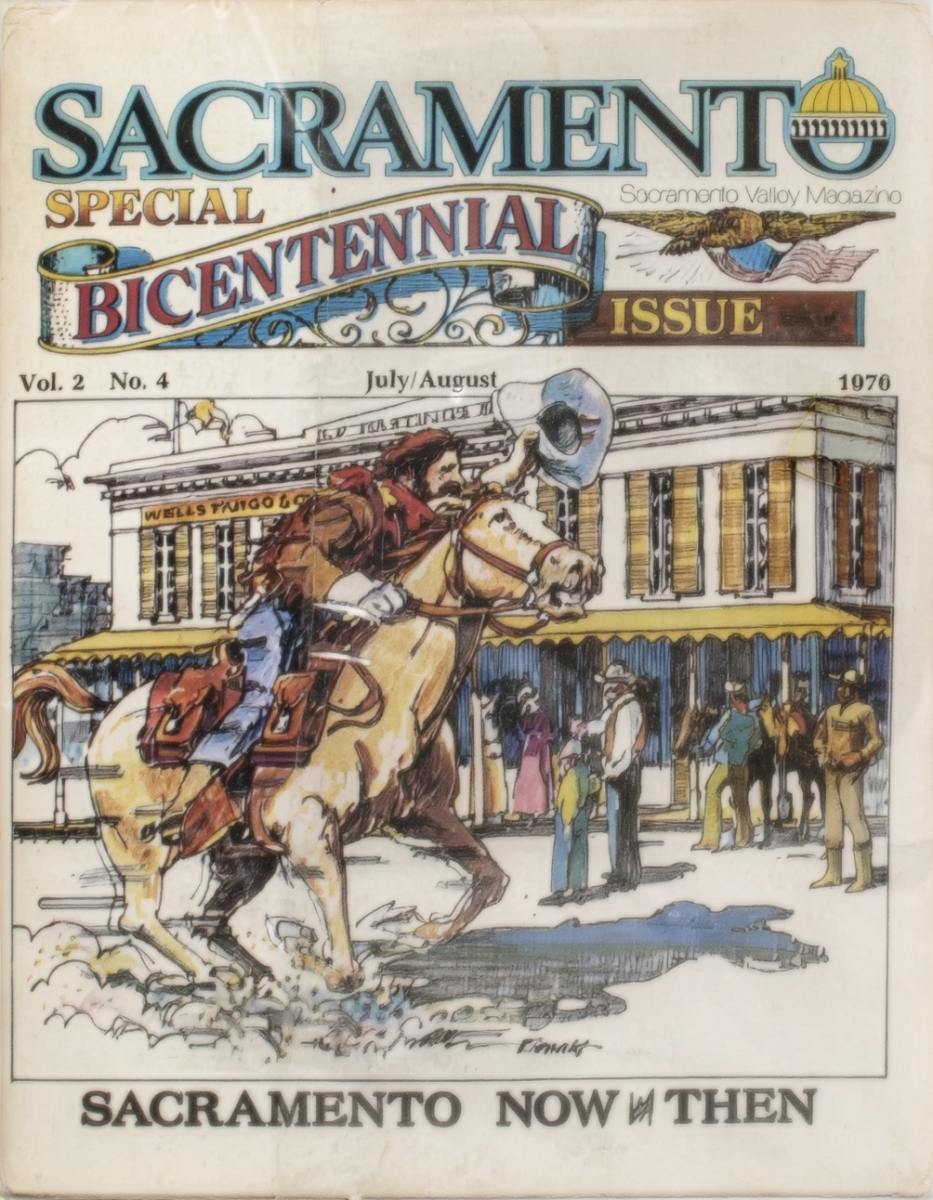
My first assignment was to sell advertising for its July 1976 bicentennial edition. When I sold an ad for its back cover, which was a major “get,” I realized I may have found my new calling. The bicentennial issue was quite handsome with the graphic cover of a Pony Express rider charging into Old Sacramento, delivering the mail and waving hello to the crowd. Looking back, I believe I saw myself as that rider, charging into my new career on my trusty real-life steed, Casey. I had no idea at the time that I’d be good in sales, but the job literally started me out in my publishing career. For the next 14 years — two cycles of seven years, which I’ll explain in a moment — I worked for other magazines. Then, in 1989, I started my own.
The 1976 bicentennial edition of Sacramento Magazine featured an
illustration of a Pony Express rider racing into Old Sacramento.
(Courtesy image)
The epiphany came when I realized that I’ve now been in the publishing business for 50 years, almost to the day. This made it kind of eerie because 50 years comprises a “jubilee” in the Bible (Leviticus 25).
A jubilee has always had many aspects to it, as a time when debts are forgiven, when something is ending, and something new begins. It’s a time for spiritual and economic reset. That resonates for me. After all, I did start the magazine as the result of a vision I had in the middle of the night, when I was suddenly awakened by a dazzlingly bright graphic of a magazine cover called Comstock’s on my bedroom wall.
It was a huge cover — maybe 10 to 15 feet tall. And it had a giant “15” on the cover as the main graphic (the “15” is another story in itself). “Am I to start a magazine,” I asked the Lord out loud, “with my name on it?” No response. But a sleepless night followed, and the rudiments of a business plan developed in my head as if dictated by the Lord himself.
I had that vision 37 years ago. And here we still are today. But I digress.
As you know, this month marks the 250th anniversary of the Declaration of Independence, issued on July 4, 1776. People are calling this cross-country celebration a “jubilee,” which it certainly is — five jubilees, in fact.
This is where the “seven years” come in. Every seven years, the Bible says, people should allow their land to lie fallow — to rest from being plowed and planted. If you do the math, that means that there are seven seven-year cycles in a period of 50 years, totaling 49 years. And in the 50th year, the resetting begins.
The seven-year cycles continued to have meaning in my life and career — and in many forms. In the seventh year of Comstock’s magazine, for example, I married John Carlson, the love of my life, and he joined the magazine as its general manager and later its executive editor. He and I were married for seven years when he died from cancer (a Vietnam casualty). I mourned for seven years thereafter before I really came back to being somewhat whole again.
Looking back, I realize that when I left the Legislature, I was declaring my own independence. Though I worked for the owners of magazines, when you’re in advertising sales, your success is largely dictated by your own autonomy. Working on commission is like working for yourself. You may be issued desirable milestones and rewards by the publisher, but it’s when you self-start and plot your own course and strategies that you have the best chance of succeeding.
A friend recently told me that for some time in the 1980s, the Sacramento Bee’s advertising salespeople were salaried, not on commission. I can’t think of a more disincentivizing business model. If you have no motivation to work harder because you’re going to get a check regardless, how can you possibly think you’ll reach star quality? Most don’t. But, also, many need financial stability and aren’t cut out for commissioned sales. I get that.
Neither the founders nor the citizens of this new and great country had a safety net. They had their own vision; they made their own work, and they succeeded on their own terms. When I think about the energy they must have summoned up every day and brought to bear on the tasks at hand, it makes me that much more proud to be an American citizen, resident, booster and businessperson.
You know by now — from the Ralph Waldo Emerson quote I use to accompany every one of these Publisher’s Letters, (and if we’ve met, from the absolute delight I take in meeting and talking to people, regardless of their backgrounds or interests) — that a rather huge quality of enthusiasm has figured well into my own history.
I am not pretending for a moment that dreaming up a nation and starting a magazine are equivalent in scale (though there are still some days I think my task was harder! After all, I wasn’t surrounded by people like Thomas Jefferson, Benjamin Franklin, George Washington and John Adams, who’d have made one heck of an editorial board).
But as every business owner knows, no matter how strong your vision is for the company you’re creating, there are always blind spots and obstacles that can prove daunting and can stop you in your tracks.
For the gentlemen who started the United States of America, the hurdles were multifold. They included defeating Great Britain’s legendary military (it was what today we’d call a global superpower). They had to find a way to bring together competing ideologies (including slavery). They needed working capital to pay their soldiers (as we all know today, war isn’t inexpensive), and that required building an economic infrastructure with what could charitably be called zero-based budgeting.
These men argued with one another, sometimes eloquently, sometimes not so much. But they knew that the only way to achieve the common goal — a new nation — was to compromise and cooperate. And so they did, and so we must today.
In starting a business, you may not find yourself debating the greatest minds of the century in which you’re living, if you do any debating at all. But it’s still incumbent on you, just as it was on our country’s founders, to “sell” your idea — to investors, to bankers and, eventually, to your targeted customers. And just as with the establishment of a country, to continue to promote the business — to have the lack of vanity to see when it needs tweaking or refreshing … maybe even a new leader … and to realize that most of your critics are actually on your side and just trying to help you realize your vision.
Above all, elected officials should learn from the owners of successful businesses that their enthusiasm for their company, or that “more perfect nation,” must never diminish.
A jubilee is finishing for me — I know not yet what that might mean — and a jubilee is finishing for our country. As we begin our next jubilee, let’s count our blessings and see what happens next. Or what we make happen next.
You’ll see that in this issue, we honor young professionals, as we do each year. This new generation is going to be carrying the torch of growing our region, our state and our nation to the excellence it was always meant to be. I’m so proud of them.
May God bless America and each of you. What do you think?
Winnie Comstock-Carlson
President and Publisher

–
Stay up to date on business in the Capital Region: Subscribe to the Comstock’s newsletter today.
Recommended For You
Meet the Candidates in California’s Wide-Open Governor Race
Former Congressman Eric Swalwell’s abrupt departure created a major shift in the race
It’s a race for the California governorship unlike any other in recent memory. While several candidates sit near the top, no dominant frontrunner has emerged among the crowd.
In an Era of Doubt, Local Journalism Builds Trust | Opinion
FROM THE PUBLISHER: Comstock’s president and publisher considers trust in today’s media landscape
Even the staunchest defenders of the press have to admit that seeing isn’t always believing any longer.

Are Capital Region Leaders Awake at the Switch? | Opinion
FROM THE PUBLISHER: Comstock's president and publisher considers the importance of paying attention
Leadership often comes down to one simple question: Who’s truly paying attention when it matters most?

Let’s Keep the Main Thing the Main Thing | Opinion
FROM THE PUBLISHER: What is Sacramento's 'main thing'?
Sometimes it’s not a bad idea for an entire region to get in touch with itself — and for that, I turn to a favorite quote from the late educator and writer Stephen Covey, whose simple but direct point for businesses and individuals was to focus on “the main thing.”