


This story is part of our January 2026 issue. To read the print version, click here.
For as long as people have collected stories, we’ve been building places to keep them. The earliest libraries were less about curiosity and learning and more about preserving knowledge for the wealthy and connected. Over time, libraries shifted from places reserved for the few to welcoming spaces for the many.
“They’re like the world’s coolest community centers now,” says California State Librarian Greg Lucas.
America’s public libraries took off in the 19th century, with Benjamin Franklin typically getting the early credit. But his library was more of a private book club; the real community libraries were often founded by women’s clubs — groups of determined female volunteers who raised money, collected books and created free learning spaces. In the early 1900s, grants from philanthropist Andrew Carnegie seeded more than 1,600 libraries across the country, many of them compact, modest brick buildings that became the architectural heart of their small towns.
Today, California has more public libraries than any other state — 1,127 branches and counting. Half of these buildings are over 50 years old, yet they now host 21st-century resources: digitized collections, tool-lending libraries, creator spaces, literacy programs, seed libraries, job-search hubs and even audio animatronic labs.
No two libraries are the same, and architects have been charged with the task of designing spaces that meet the specific needs of each community. “The name of the game in designing libraries is flexibility,” notes Lucas. In the last five years, $489 million has been added to the California state budget for library infrastructure and improvements.
Here we profile several libraries in the Capital Region and the architects who designed them to reveal just how radically these institutions have changed — and why they matter more than ever in a digital age.
Truckee Regional Library
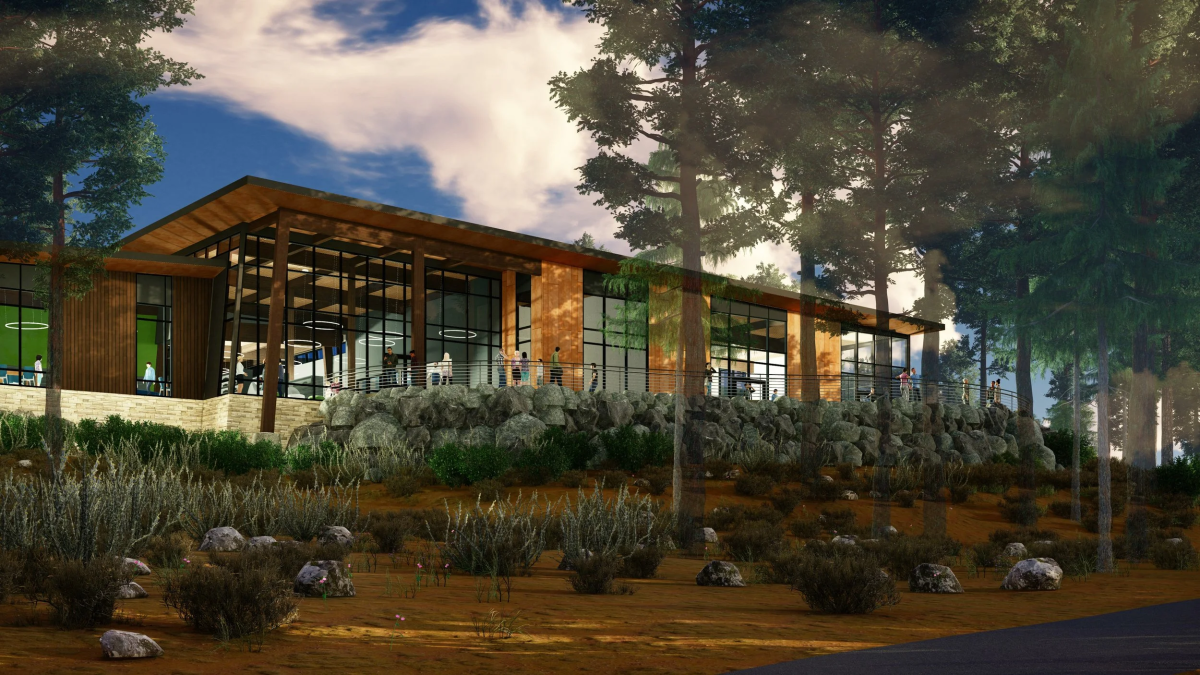
The Truckee Regional Library is being designed to reflect the
environment in Lake Tahoe — from forests to meadows and scenic
views. (Rendering courtesy of JKAE)
- Location: Truckee
- Architect: JKAE, Auburn, and Group 4 Architecture, South San Francisco
- Groundbreaking: 2027
- Size: 20,000 square feet
- Cost: $38-$40 million
Sited within Truckee Regional Park, the new Truckee Regional Library is designed to engage all four orientations — from meadow and forest to roadway and river views. “We want our buildings to be able to react to the environment around them,” says Ted Felix, associate project architect for JKAE. “And we have this unique opportunity with this really magical site.”
The project was born out of a deeply collaborative process spearheaded by the Friends of the Truckee Library, in collaboration with the architects, Auburn-based JKAE and South San Francisco firm Group 4 Architecture. “Group 4 has extensive knowledge within the library project type, and our knowledge of the Sierra Nevada region and the local environment made this partnership a great match,” says Felix.
Community input has been central to the design direction. The Friends of the Truckee Library organized extensive outreach — surveys, booths at local events and working sessions with civic groups — to identify priorities for a facility that will replace the town’s undersized library, built in 1975. According to Felix, this early engagement helped clarify what Truckee valued most: children’s programs, arts and culture, and flexible community space.
An expansive great hall anchors adult collections, while
children’s and teenage literature and a create lab occupy key
program zones. (Rendering courtesy of JKAE)
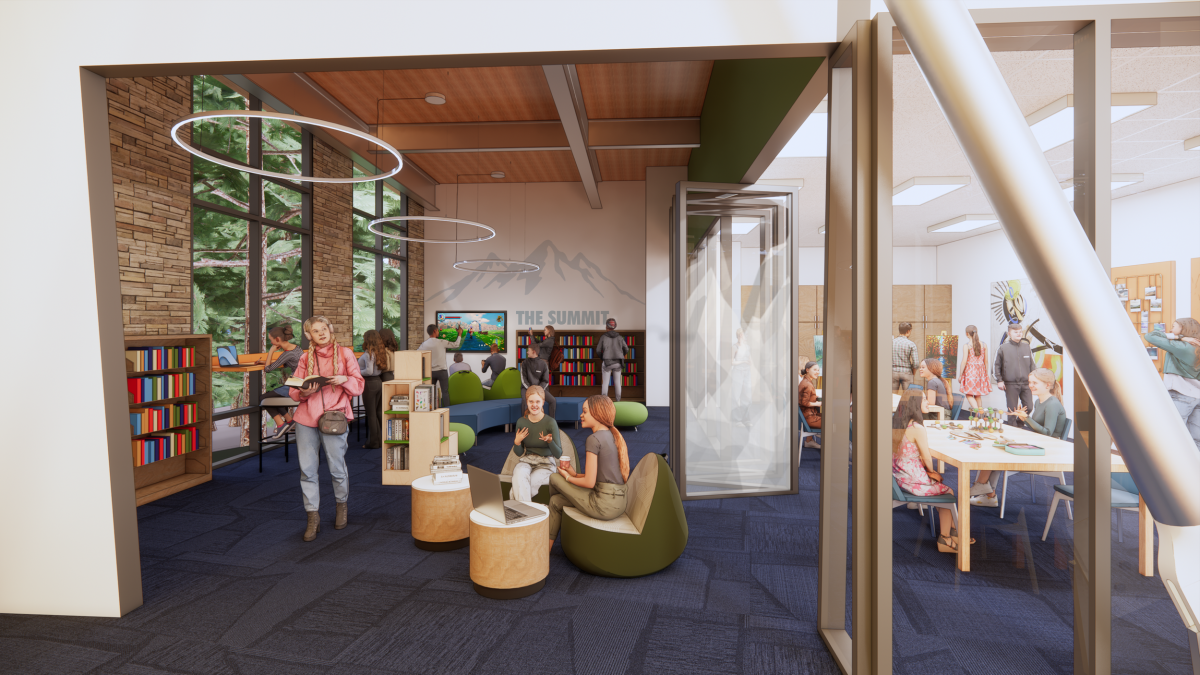
The resulting design emphasizes adaptability, connection to nature and a distinctly Truckee identity. Felix explains that the team sought an aesthetic aligned with what planners call “Truckee funk,” a blend of honest, timeless architecture rooted in local history but expressed with clean, modern lines. Natural materials and earth-toned palettes will reflect the region, while addressing wildfire-related risks. Inside, an expansive great hall anchors adult collections, while children’s and teenage literature and a create lab occupy key program zones. Individual learning classrooms for tutoring and learning programs will also be added.
“What has really stood out throughout this process is just how passionate the Truckee community is about its new library. It’s been an inspiring partnership, and we’re excited to carry that momentum forward as we bring this next chapter of the Truckee Library to life,” says Felix.
Yolo Branch Library
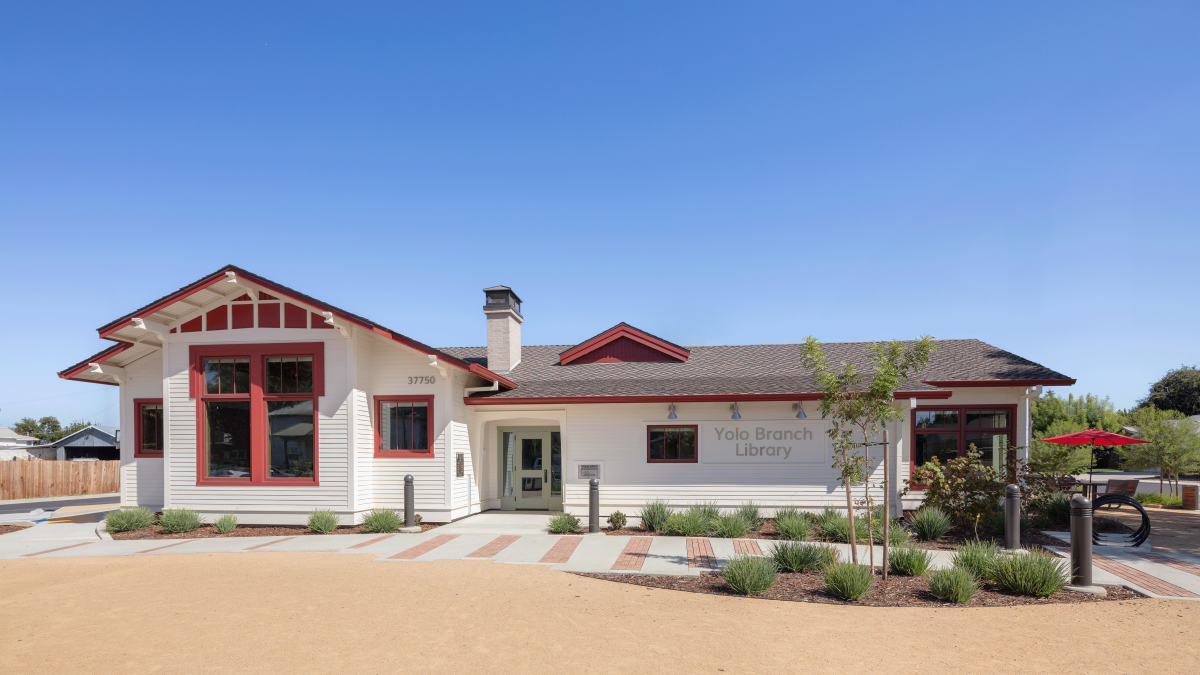
The Yolo Branch Library, once an original Carnegie Library, was
built with elements — such as the brick, mantel and exterior
pieces — from the original historic building. (Rendering courtesy
of WMB Architects)
- Location: Yolo
- Architect: WMB Architects, Stockton
- Completed: 2022
- Size: 3,900 square feet
- Cost: $5.4 million
When WMB Architects first received the assignment for the Yolo Branch Library, principal architect Doug Davis quickly realized the gravity of the assignment. The tiny town of Yolo, with less than 300 people, relied on its aging 1918 Carnegie library as its only civic center. The structure was under 1,000 square feet and in serious disrepair, but its cultural weight was immense. “It actually serves a much broader rural community,” Davis explains, “so the need was far greater than the building could support. But the structure was beloved.”
Early studies considered adding onto the historic library or converting an abandoned lodge hall, but neither option could meet accessibility, floodplain or program requirements. When the county acquired an adjacent parcel, the design team developed two viable paths: expand or rebuild. The community chose to start fresh.
That decision sparked one of the project’s most sensitive conversations: how to honor the historic Carnegie library while building anew. “One of our goals was to create a warm, comfortable feeling that was reminiscent of the old library,” says Meg Sheldon, member of Friends of the Yolo Branch Library, who took the lead in gathering community input and helping to raise $150,000 for the project. “The old library was really precious to the community.”
WMB worked with the Friends of the Library and a historical
memories committee to create a salvage-and-reinterpretation plan.
(Photo courtesy of WMB Architects)
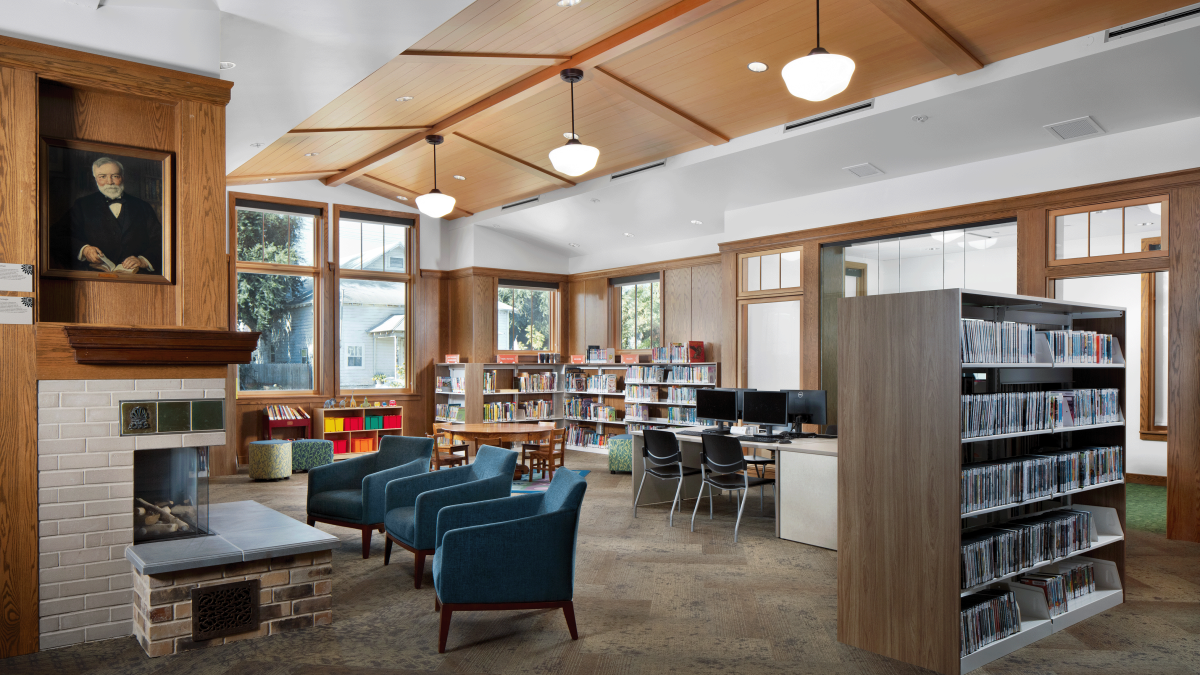
WMB worked with the Friends of the Library and a historical memories committee to create a salvage-and-reinterpretation plan. Elements such as the original front door, fireplace brick, mantel, decorative grills and exterior corbels were gently woven into the new design.
The new library features flexible community space, a covered outdoor activity area, distinct teen and children’s zones and warm materials that echo the original structure’s character — flooring patterned like cut wood, acoustical wood-veneered ceilings and historically influenced lighting.
For Davis, the project’s meaning transcended architecture. “It was a seven-year project, and I really got to know the community,” he reflects. Their gratitude culminated in an unexpected gift: a handmade quilt created in the same spirit and style as the building.
Valley Hi-North Laguna Branch Library
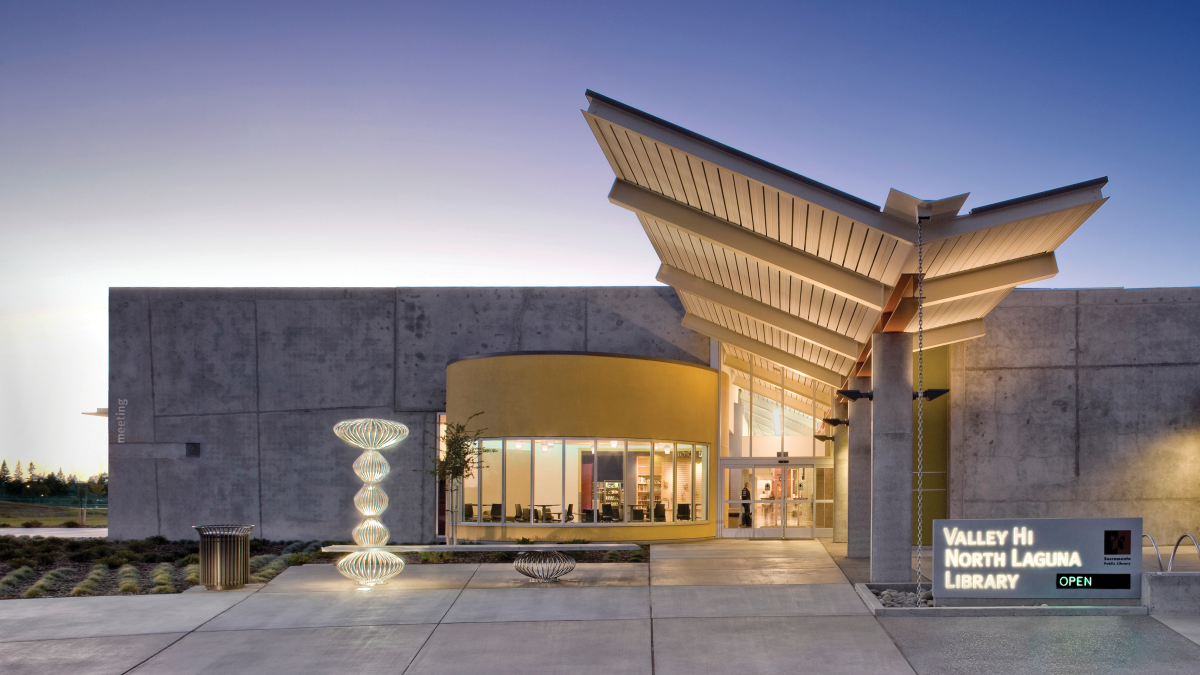
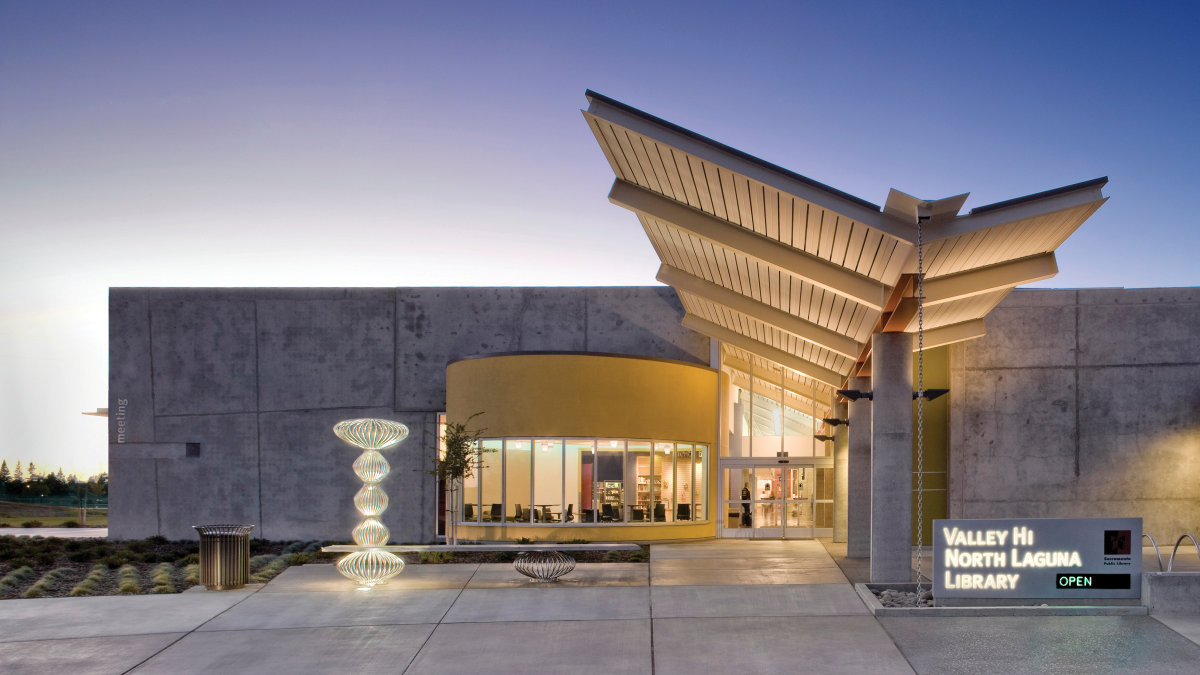
Valley Hi-North Laguna Library’s defining form grew from a simple
sketch: an asymmetrical, wing-like roofline that captures
abundant daylight while shielding the interior from heat.
(Rendering courtesy of Noll & Tam)
- Location: Sacramento
- Architect: Noll & Tam, Berkeley
- Completed: 2009
- Size: 20,500 square feet
- Cost: $13.4 million
- LEED Gold-certified
Designing the Valley Hi-North Laguna Library was as much a conversation with its community as it was an exercise in forward-thinking architecture. Early outreach gave the design team a clear sense of the neighborhood’s aspirations. Residents wanted a library that felt modern, inviting and capable of becoming a true civic anchor next to an existing 21-acre park and new housing and transit options.
Working closely with Sacramento’s central library administration, the team paired these community insights with a strong sustainability goal. An early eco-charrette (when all the stakeholders involved in a project work together to integrate sustainability objectives into the project’s vision, design and planning) with SMUD helped shape the project’s high-performance goals. “Right from the start, we wanted this to be the highest energy-performing building we could make,” says Chris Noll, principal with Noll & Tam.
The library achieved LEED Gold certification and ultimately exceeded Title 24 requirements by 34 percent — an impressive achievement for its time. (LEED Gold certification is a green building rating system awarded by the U.S. Green Building Council to a building that meets strong environmental and energy-performance standards.)
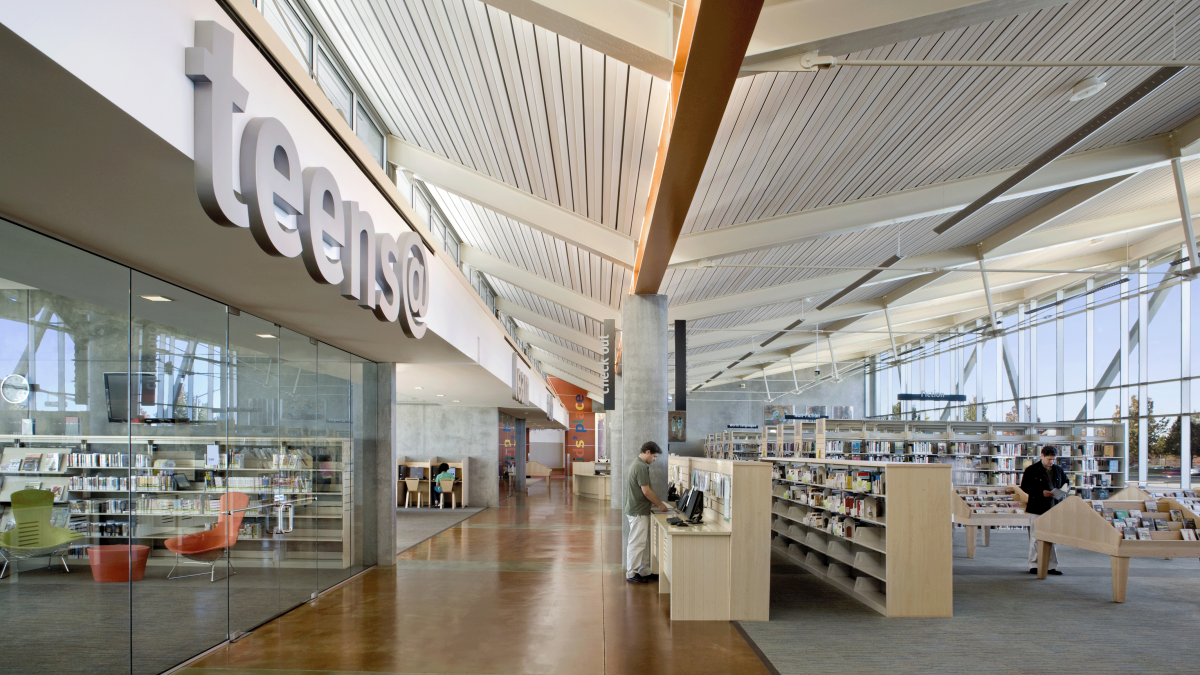
Inside, a generous central reading room anchors the plan, with
distinct children’s, teen, technology and community spaces
branching from it. (Rendering courtesy of Noll & Tam)
The library’s defining form grew from a simple sketch: an asymmetrical, wing-like roofline that captures abundant daylight while shielding the interior from heat. High north-facing windows, generous overhangs, concrete tilt-up walls and a dramatic ventilation tower together create a structure that stays naturally cool, even in Sacramento’s hot summers.
Inside, a generous central reading room anchors the plan, with distinct children’s, teen, technology and community spaces branching from it. Bold wayfinding and clear sightlines support intuitive navigation.
Materials were selected for durability and performance — carpet for acoustics without compromising thermal mass, stained concrete floors and a perforated acoustic ceiling that hides building systems while reflecting daylight.
“At its core, this project was about giving the community a place that was innovative, comfortable and genuinely theirs. Seeing how people use it — and how the building still holds up — reminds me why libraries are such powerful anchors in their neighborhoods,” says Noll.
Elk Grove Branch Library
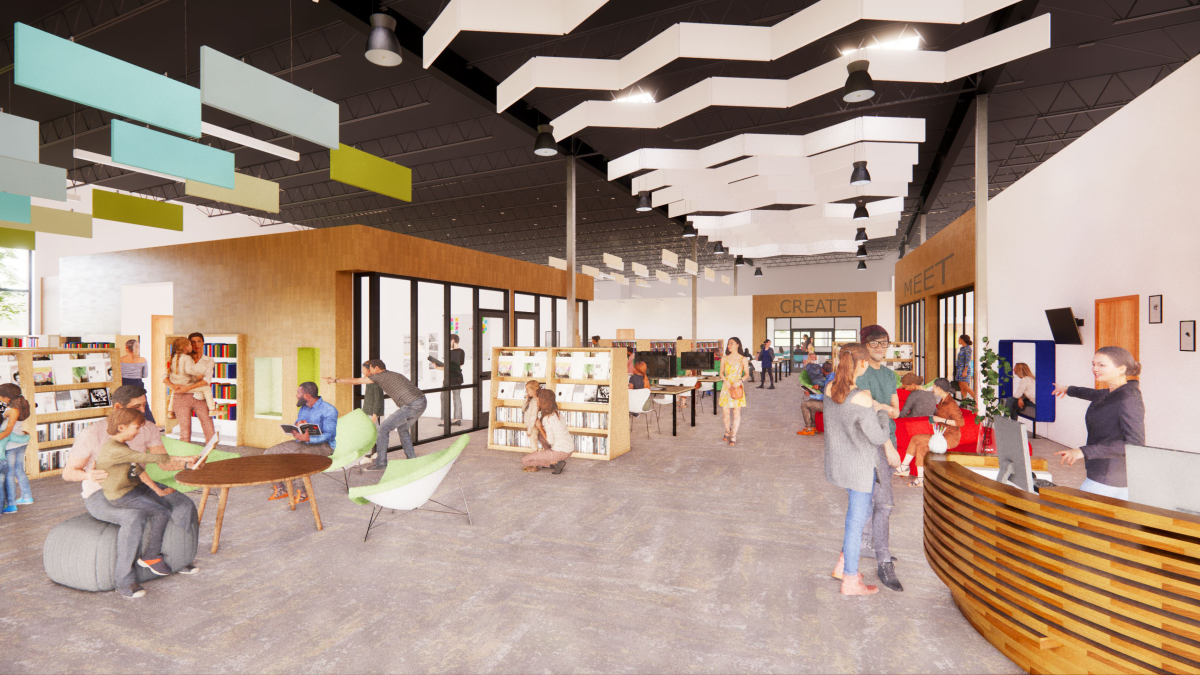
Group 4 Architecture is transforming an abandoned Rite Aid into a
new public library in Elk Grove. (Rendering courtesy of Group 4
Architecture)
- Location: Elk Grove
- Architect: Group 4 Architecture, South San Francisco
- Expected Completion: Fall 2026
- Size: 18,000 square feet
- Cost: $15.3 million
In Elk Grove’s Old Town district, an abandoned Rite Aid is transforming into a new civic landmark — a public library shaped by community input and an architectural team steeped in decades of library design. Group 4 Architecture’s 51 years of library design — spanning everything from tiny 500-square-foot libraries to immense 500,000-square-foot spaces — has positioned the firm to respond to the shifting role of libraries.
“They’re really evolving to meet the needs of the community, and not just a place for books and resources,” explains Carolyn Carlberg, associate principal architect with Group 4. This evolution has helped inform the design of the Elk Grove Library, which will include a studio space and community room that can be accessed after hours, flexible gathering spaces and an expansive children’s environment envisioned with Luci Creative. An outdoor children’s discovery patio will be added, along with magnet walls, reading nooks and a special area for the community’s littlest learners.
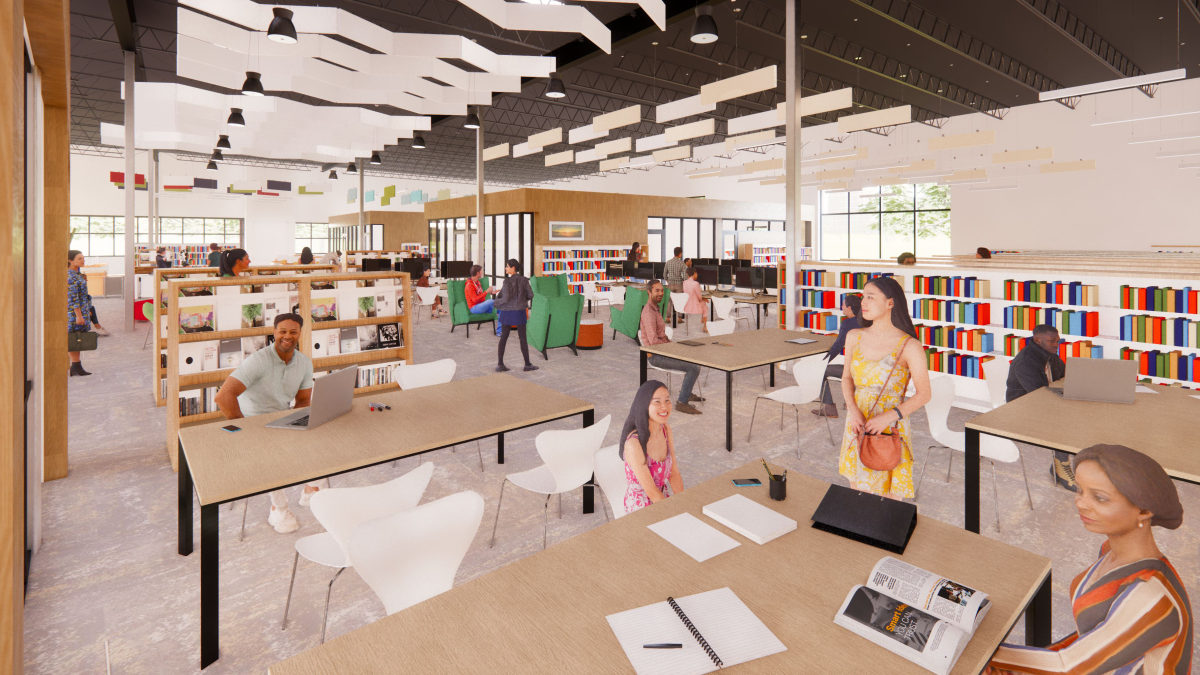
The design of the library draws from the character of Old Town,
with the exterior retaining its brick and warm neutrals.
(Rendering courtesy of Group 4 Architecture)
The decision to repurpose a retail shell was both practical and challenging. “There are so many stores that are going out of business in these core, urban downtown areas that are really the perfect place for a community asset like a library,” Carlberg notes, citing sustainability benefits and the inherent flexibility of a retail floor plate. However, challenges did surface — particularly structural load limits on the roof — but the team found a careful balance to accommodate new mechanical systems and future photovoltaics without exceeding the weight limits.
The design of the library draws from the character of Old Town, with the exterior retaining its brick and warm neutrals, and the interior introducing maple, natural wood panels and bold colors. Interior storefronts or boxes with varied program elements echo the eclectic charm of nearby historic shops.
“What has made this project so meaningful is the level of collaboration. It really did take the whole village, and watching that collective energy shape the new library has been remarkable,” says Carlberg.
Walnut Park Library, branch of Yolo County Library
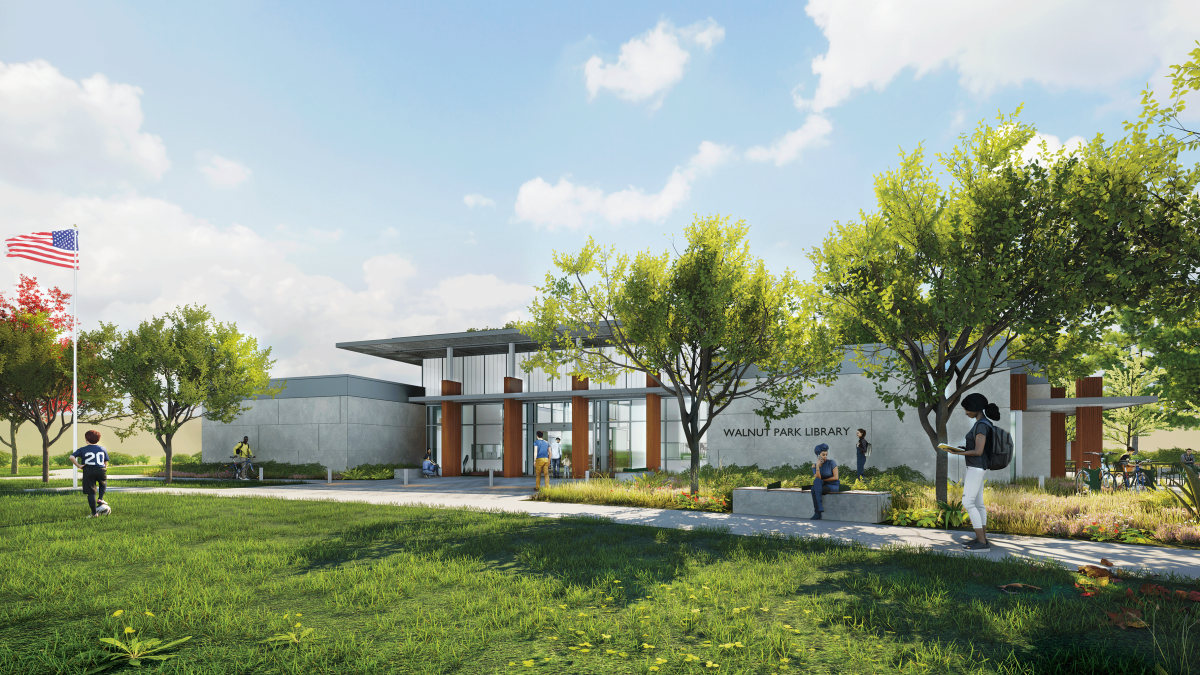
The Walnut Park Library in Davis was designed to have the front
entrance face a park to draw in the tree canopy outside.
(Rendering courtesy of WMB Architects)
- Location: Davis
- Architect: WMB Architects, Stockton
- Expected Completion: Fall 2026
- Size: 12,500 square feet
- Cost: $14 million
In the Walnut Park community of Davis, a new 12,500-square-foot library is taking shape that is both approachable and deeply rooted in its landscape. The project grew out of early county planning efforts and a later design commission that required trimming several thousand square feet from the original program. That reduction prompted a fundamental rethinking of the building’s orientation and relationship to the site.
The design team ultimately rotated the structure 90 degrees so the main entry faces the park, rather than the street. The open playfields now form the library’s welcoming front yard, while a mature tree canopy frames what the architects call the building’s backyard. Between the two sits the project’s signature outdoor element: an intentionally planned focal garden. “The garden was designed to pull your eyes through the library and let them rest on the mature tree canopy beyond,” explains Sam Harper, associate architect with WMB Architects.
Stabilized aluminum foam panels around the perimeter of the
library create a dappled light effect on the side of the
building, while high-performance concrete panels reference paper
and tree bark through subtle textures. (Rendering courtesy of WMB
Architects)
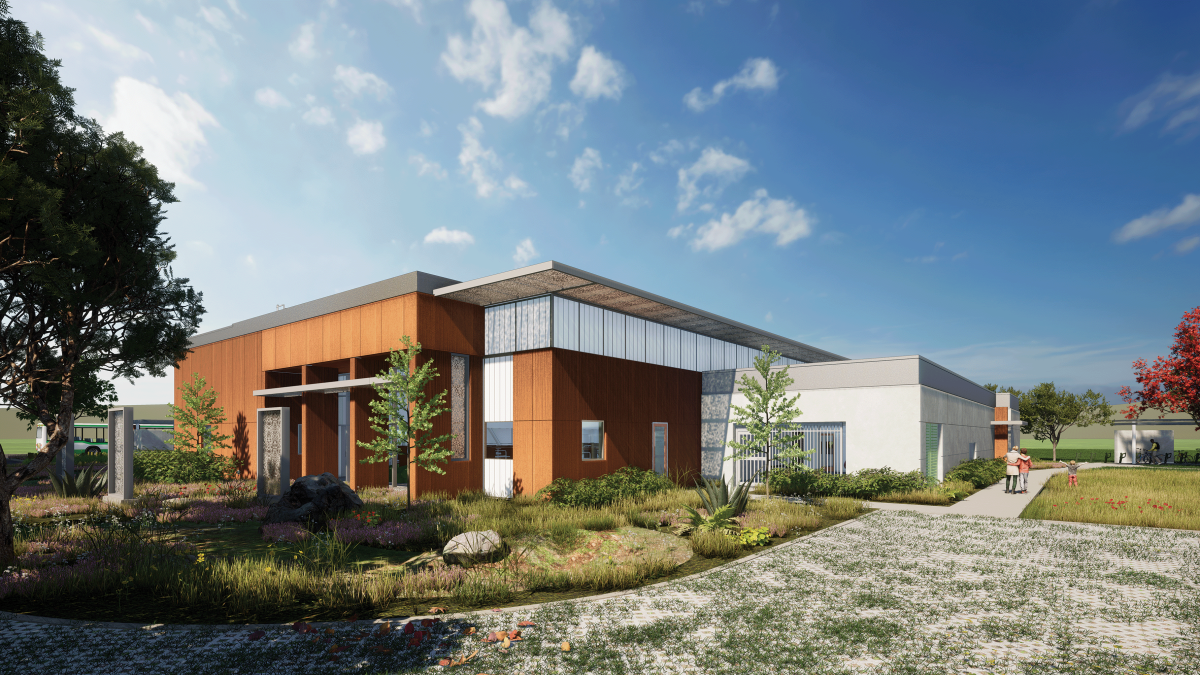
The facade amplifies this dialogue with nature. Stabilized aluminum foam panels around the perimeter of the library create a dappled light effect on the side of the building, while high-performance concrete panels reference paper and tree bark through subtle textures. Inside, fiberglass translucent panels wash the collection space with diffused daylight, and walnut ceilings pay homage to the site’s origins as a walnut grove. Bright colors of teal, aquamarine and salmon animate study rooms, teen areas and children’s spaces.
A sizable community room with after-hours access supports evolving public use, while sustainability features, including solar PV and an energy storage system, make the building 85 percent self-sufficient year-round.
An anticipated installation of exterior and interior public art is also planned and will be funded through the project budget.
“This is an important building — libraries don’t go away,” says Harper. “They’re here for years to come, and so this library needs to carry with it a certain gravitas, but at the same time, be open and welcoming to all.”
–
Stay up to date on business in the Capital Region: Subscribe to the Comstock’s newsletter today.
Recommended For You
This Architectural Treasure in Nevada County Was Nearly Lost to Time
Now volunteers are restoring it to its former glory — and sharing its pioneering history with the world
North Star House, designed by renowned 20th-century architect Julia Morgan and owned by North Star Historic Conservancy, has undergone a painstaking transformation.
This Quaint California Town Is Getting a $23M Amphitheater Renovation — and More
Fair Oaks Village is dreaming big in the Capital Region
Recently developed amenities, including an amphitheater and a variety of restaurants, complement Fair Oaks Village’s small town vibe and unique access to the American River. Will it all come together as the buzzy tourist destination many locals desire?
Will AI Replace Architects?
As artificial intelligence evolves, architects and designers grapple with how the technology can enhance, but not replace, creativity
Architects are recognizing the advantages of using highly accessible generative AI apps like Midjourney, Claude.ai and Microsoft Copilot to test their design limits for the built environment, but they’re also taking a measured approach on integration and adoption into existing processes.
Architect’s NorCal ‘Dream Home’ Embraces the Mediterranean Climate
The high-tech house in the hills is a playground for entertaining, car collecting and relaxation
“It’s a pretty spectacular home that emulates the juxtaposition of modern and traditional design in a Northern California style,” Brian Whitmore describes his house located in the Sierra de Montserrat development in Loomis.