


This story is part of our December 2025 issue. To read the print version, click here.
UC Davis researchers have made important findings about farming in recent years, providing insight into how to grow almonds with less groundwater and fewer pesticides, among other discoveries. Now, agricultural research is about to get supercharged at the school, thanks to a $50 million donation from the co-owners of one of the biggest names in almonds, The Wonderful Company.
The gift, the largest ever from individual donors to UC Davis, will go toward construction of the Lynda and Stewart Resnick Center for Agricultural Innovation and fund annual competitive research grants. The center’s research will address “today’s most pressing challenges in agriculture and environmental sustainability,” the university says, and focus on agricultural byproducts, water and energy efficiency, technology development, crop resiliency and sustainability, and access to nutritious food.
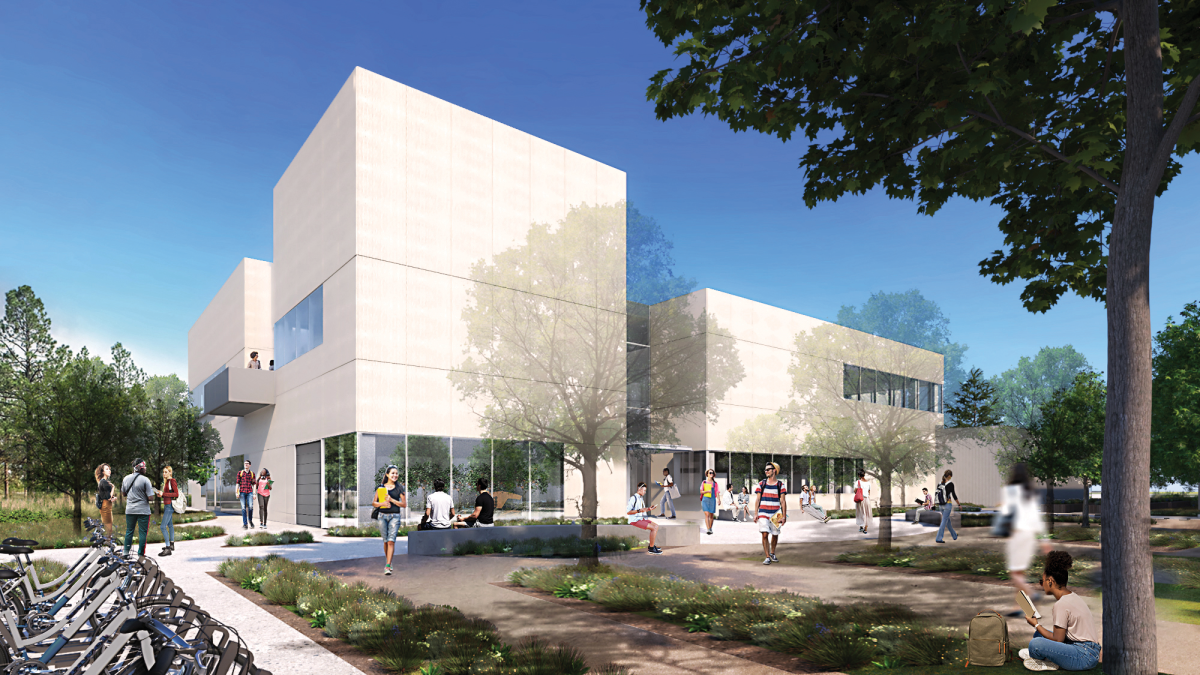
Construction of the 34,000-square-foot center is expected to be complete next year and will include classrooms, research and lab space, state-of-the-art research tools like robotics, remote sensing and data science.
California has the leading agricultural economy in the country, and officials at UC Davis — which has one of the top agricultural schools in the country — say the university plays a central role by providing research and a well-trained workforce of future leaders. The Resnick Center will help with the mission.
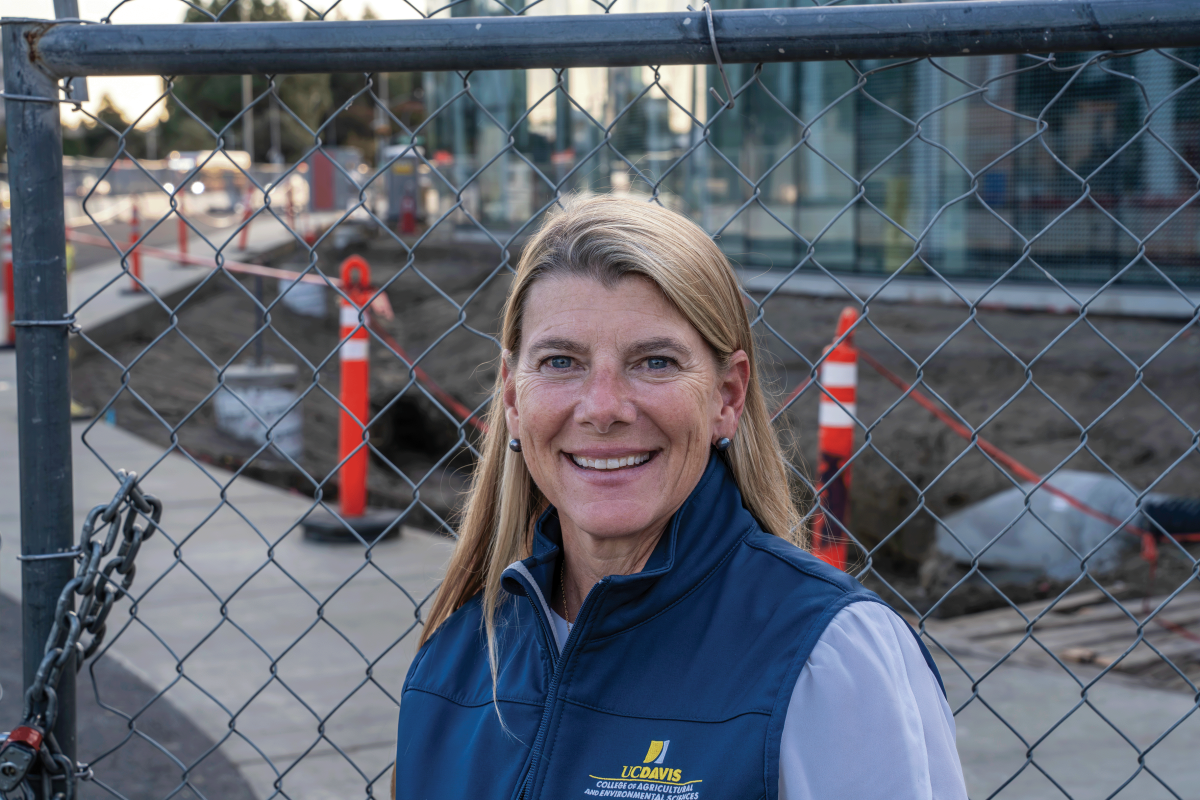
Ashley Stokes, dean of the UC Davis College of Agricultural and
Environmental Sciences, says the new Resnick Center for
Agricultural Innovation will foster creativity and help the
university to provide solutions for major farming challenges.
(Photo by Brad Branan)
“It will be a space that fosters so much creativity,” says Ashley Stokes, who became dean of the College of Agricultural and Environmental Sciences this year. “The center will play an exciting role as we think through tough questions about how California can continue to feed the world and be stewards of the land.”
Research about almond production is important because almonds are the top cash crop in California — $5.66 billion in revenue in the 2024 crop year. The challenge for growers is to continue that success while addressing the need to reduce groundwater and pesticide use.
Eight of the nine projects funded by the Resnick gift last year are looking at how to reuse the hulls and shells of almonds and other nuts. One of the research teams is developing a database that shows the byproducts of some of California’s leading farm commodities, including almonds, pistachios and tomatoes. The byproducts contain useful material, and reusing them eliminates waste.
Another research project funded by the Resnick gift examines how almond byproducts can be used as a replacement for chemical pesticides. Christopher Simmons, professor and chair of the Department of Food Science and Technology at UC Davis, explains that the shell and hull of an almond contain sugars that can be used in a natural pesticide process called “biosolarization.”
“The center will play an exciting role as we think through tough questions about how California can continue to feed the world and be stewards of the land.”
Ashley Stokes, Dean, UC Davis College of Agricultural and Environmental Sciences
The core process, putting plastic over soil in hot summer months, has been used to kill pests naturally for a long time. Adding the shells and hulls to the soil introduces another active ingredient to the process, potentially killing pests deeper in the ground, where the process has failed in the past, Simmons says.
In a 2022 study published in the journal Applied Soil Ecology, Simmons and other researchers found that biosolarization with nut byproducts was 100 percent effective at killing pests up to one foot underground.
Simmons and others on his team have collaborated with Rory Crowley of NicNut Farms in Chico to develop the idea. “Any thoughtful producer in the Central Valley, whether organic or conventional, understands that we simply cannot continue farming the way we are, especially as it relates to traditional chemical fumigation,” Crowley said in an article published in a trade publication.
The Resnick Center will have facilities for similar research, including intake centers where agricultural products can be taken in for processing, then dried and tested, Simmons says.
Irrigation
Hydrology professor Isaya Kisekka says he sees great potential for the Resnick Center to elevate the work of the UC Davis Agricultural Water Center, where he is the director. The Agricultural Water Center was created with a $10 million grant from the U.S. Department of Agriculture to address groundwater overdraft, which is causing land to sink in the Central Valley in a process called subsidence. Under the state’s Sustainable Groundwater Management Act, regional boards must develop plans to achieve groundwater stability within 20 years. Growers have relied heavily on groundwater in drought years, but the state has deemed the practice unsustainable.
The Agricultural Water Center is developing tools to help farmers meet the law’s requirements, Kisekka says. One of the ways is through education, including a program for young people delivered through local 4-H councils and a smartphone application that estimates water and other needs for nut crops.
The center’s researchers have found that almond growers need significantly less water than they have been using. To use less water, they need the right tools and knowledge, Kisekka says. “The main thing is to use irrigation scheduling,” he says. “They need to make a decision on when to apply water instead of going with a gut feeling.”
Ashley Stokes, dean of the UC Davis College of Agricultural and
Environmental Sciences, says the new Resnick Center for
Agricultural Innovation will foster creativity and help the
university to provide solutions for major farming challenges.
(Photo by Brad Branan)
To that end, the center encourages growers to check soil moisture and oxygen levels, which influence how much water is needed. The Agricultural Water Center is using advanced technology to collect and analyze data about water management, hoping to come up with more sophisticated models and tools that growers can use. “Improvement in crop water productivity (WP) has become imperative for sustainability,” Kisekka and two other researchers wrote in a study published in the journal Agricultural Water Management. “In many cases, crop WP is below optimal levels, and thus farmers have substantial opportunities to improve.”
Robotics
The Resnick Center will provide improved technology to use in the development of models for water management, Kisekka says. The center’s remote-sensing tools — which gather information from an area electronically — can help farmers better track water use. The center’s robotics can devise ways to automate irrigation work.
Fadi A. Fathallah, professor and chair of the Department of Biological and Agricultural Engineering, is leading the effort in robotics. “We envision the center as a catalyst for developing and testing field autonomous platforms and robotic systems equipped with advanced sensors, cameras and AI-driven controls, to assist with harvesting, pruning and precision spraying,” he says. “These robots will not be futuristic showpieces, but rather, they will be practical, research-grade systems co-developed with growers and technology companies to solve pressing problems in labor, efficiency, and sustainability.”
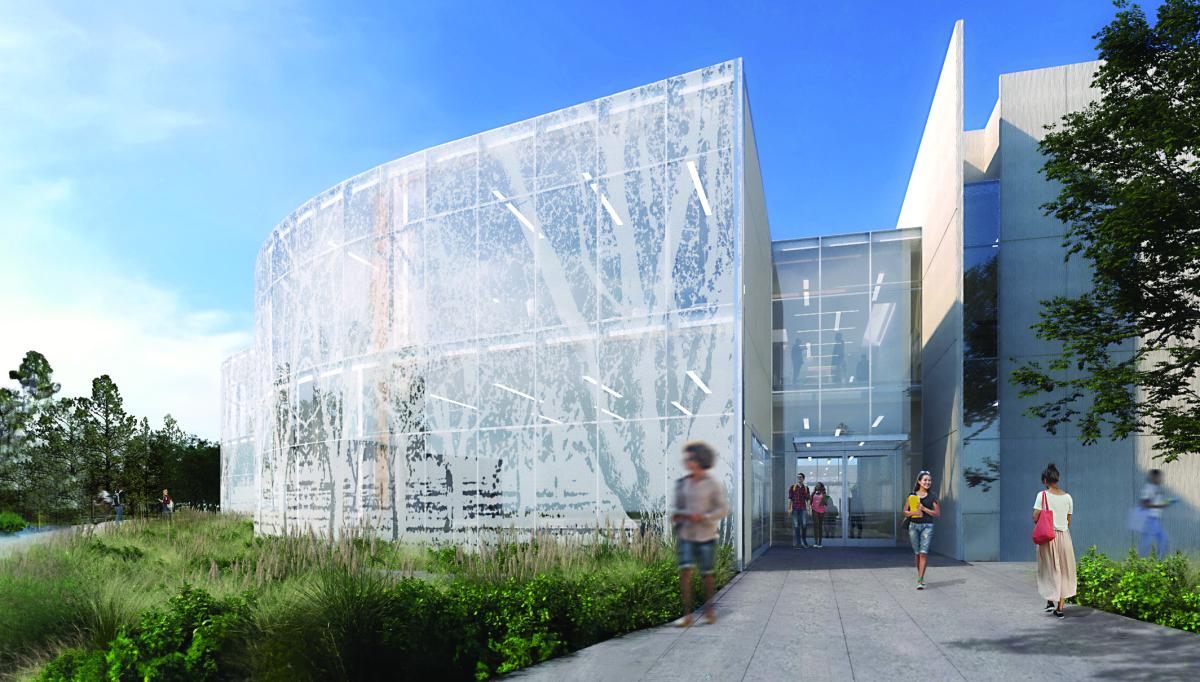
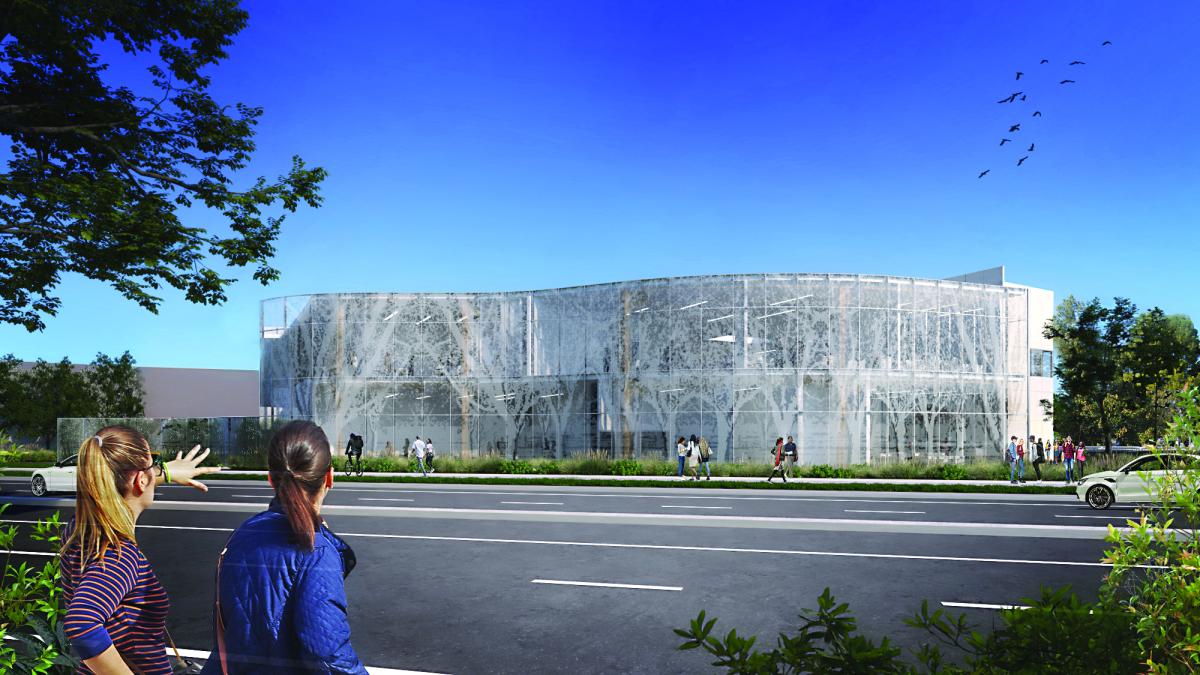
Construction of the Resnick Center for Agricultural Innovation at
UC Davis is more than half complete and scheduled to be done next
year. (Rendering by Yazdani Studio of Cannon Design)
UC Davis has used robotics in agriculture for more than 20 years. The Resnick Center will centralize the efforts of the different departments using the technology. “What’s new with the Resnick Center is the scale, integration and visibility” of robotics, Fathallah says in an email. “The center will unify these efforts under one umbrella, bringing together engineering, plant science and management expertise, while providing dedicated space and equipment for field and lab robotics.”
The Resnick Center will have a fabrication shop “for designing, building, and testing prototypes, such as robotic grippers, drone frames, and custom sensors and test rigs,” he adds.
Interdisciplinary progress
Christine Diepenbrock, an associate professor of plant sciences, says she is looking forward to working with colleagues who study agricultural issues in different departments at UC Davis. They will be brought together under one roof at the Resnick Center.
Diepenbrock co-leads Project Gemini, a research project funded by the Gates Foundation that develops tools for farmers in sub-Saharan Africa. The goal is to improve food production in developing countries while also addressing the challenges created by climate change. The work is heavily dependent on technology, using tools such as 3D modeling, artificial intelligence and crop genetics.
The Resnick Center will provide improved technology to use in the
development of models for water management. (Rendering by Yazdani
Studio of Cannon Design)
She hopes to do similar work at the Resnick Center. “It sounds like an array of technologies will be available for testing, which is exciting from the perspective of being able to test the utility of certain sensor types in measuring or predicting the properties of interest before buying more of them for use in a given project,” she says. “Having a common physical space for sensor and data science work is also exciting and valuable from a community science perspective, as it brings a chance to learn from each other across projects and potentially identify efficiencies.”
–
Stay up to date on business in the Capital Region: Subscribe to the Comstock’s newsletter today.
Recommended For You

Aggie Square Becomes a Reality for the Capital Region
A grand opening celebration was held for the $1.1 billion UC Davis innovation center
A festive grand opening celebration and ribbon cutting was held
May 2 for Aggie Square, the $1.1 billion innovation center for UC
Davis that has been eight years in the making.

From Baker’s Stats to Stanzas: Jim Franks’ ‘Existential Bread’ Launches in Davis
Picking apart the stuff (seeds, stories, hoaxes) that go into what we think we know about bread
Baker and poet Jim Franks launched his experimental cookbook “Existential Bread” in Davis this week in collaboration with Student Collaborative Organic Plant Breeding Education, an interdisciplinary approach that offers a new way to consider our relationship with food and the complex processes and economics behind it.
Scientists Attest to Value of UC Davis Smelt Lab
Federal funding has been imperiled for facility near Byron
The San Francisco Chronicle reported on Feb. 6 that the federal government was looking to not renew funding for the UC Davis Fish Conservation and Culture Laboratory after its current round expires on Friday. While sources close to UC Davis are confident of a new contract being signed with the U.S. Bureau of Reclamation, that hadn’t happened as of press time, and some are worried about what comes next.

A Quarter Century of Startups: Big Bang! Finalists Share $100K in Milestone Year
Checking in with past honorees of the UC Davis competition — some who’ve gone public, others who’ve pivoted careers
Today, the UC Davis Big Bang! awards ceremony honors 19 finalist teams with $100,000 in grants. For every founder that participates in the Big Bang, several of which have been spotlighted in Comstock’s Startup of the Month column and other stories, no path forward looks the same.