


This story is part of our December 2025 issue. To read the print version, click here.
Motivated by the pioneering 49ers, I went searching for gold — Gold Rush history, that is.
My search led me to Nevada City, the Sierra Nevada foothills community that is often the subject of glowing profiles in the national media and labeled a “Gold Rush-era town.” So what exactly does Nevada City tell us about that unusual and relatively brief time in history?
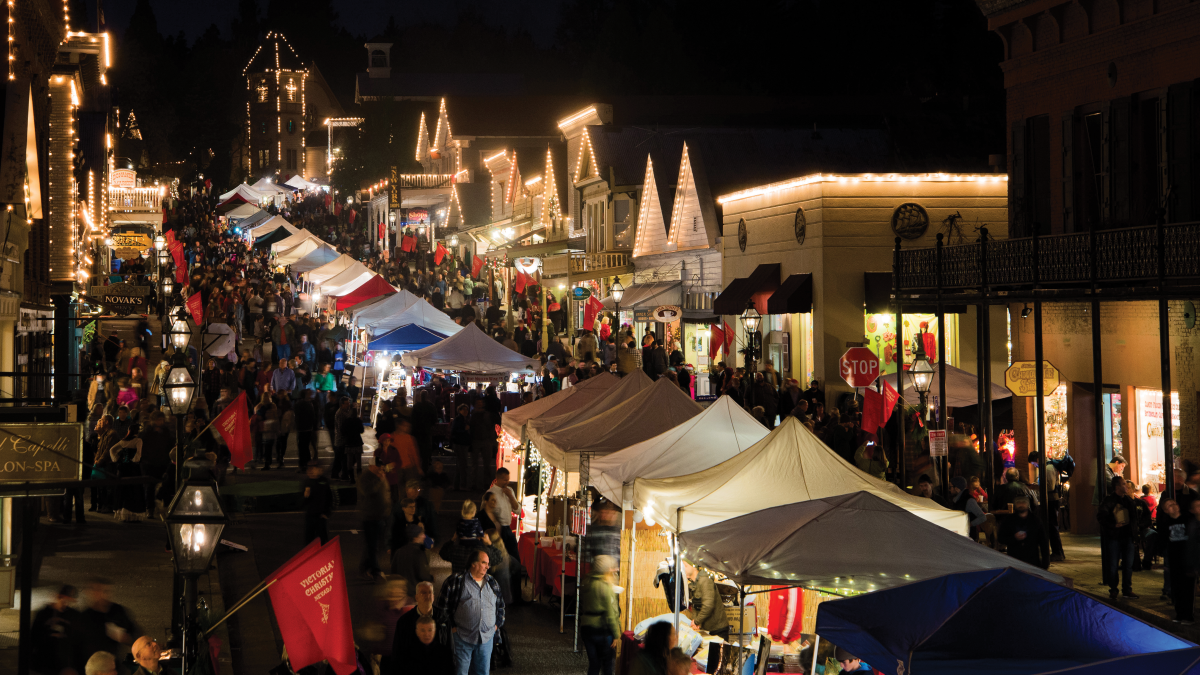
December is a great time to visit because it coincides with Nevada City’s famed Victorian Christmas, an annual celebration of the city and the holiday. Gas lamps bathe the hilly streets in a golden light, their warmth mixing with the scent of roasting chestnuts. Carolers in Victorian dress fill the air with song while vendors hawk their seasonal goods. It’s a festive and well-attended event that takes place downtown on Wednesdays, Dec. 10 and 17, and on Sundays, Dec. 7, 14 and 21. Take the shuttle from the Nevada County Rood Center — 950 Maidu Avenue, Nevada City — because parking is very limited. However, there’s lots more to see while you’re there.
What you won’t find in downtown Nevada City is much mining history. For that, I recommend visiting Empire Mine State Historic Park. What you will find downtown is a charming community filled with Victorian-era architectural gems, built with the riches earned in the mines. In a recent New York Times article, a real estate agent who was born and raised in the area said Grass Valley is where the miners lived, and Nevada City is where the mine owners entertained their guests.
Related: This Architectural Treasure in Nevada County Was Nearly Lost to Time
On my recent visit, I took an audio tour created by the Nevada County Historical Society and other groups. The tour covers 12 stops throughout downtown and takes about an hour and a half to complete. All of downtown is listed on the National Register of Historic Places. It includes “commercial buildings, churches, fraternal halls, and civic buildings, which remain as a collection of historically and architecturally significant buildings that typify a mining town environment as it would have existed in the period extending from 1864 to 1917,” according to the nomination that secured its place on the register.
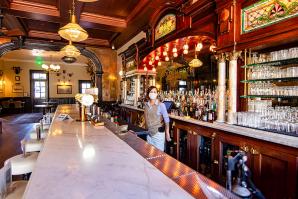
The National Exchange Hotel is a refined basecamp for wintertime
visits. It sumptuously gilded (yet contemporary) restaurant, bar
and lounge are a nod to its gold-dusted past. (Photo courtesy of
the Nevada City Chamber of Commerce)
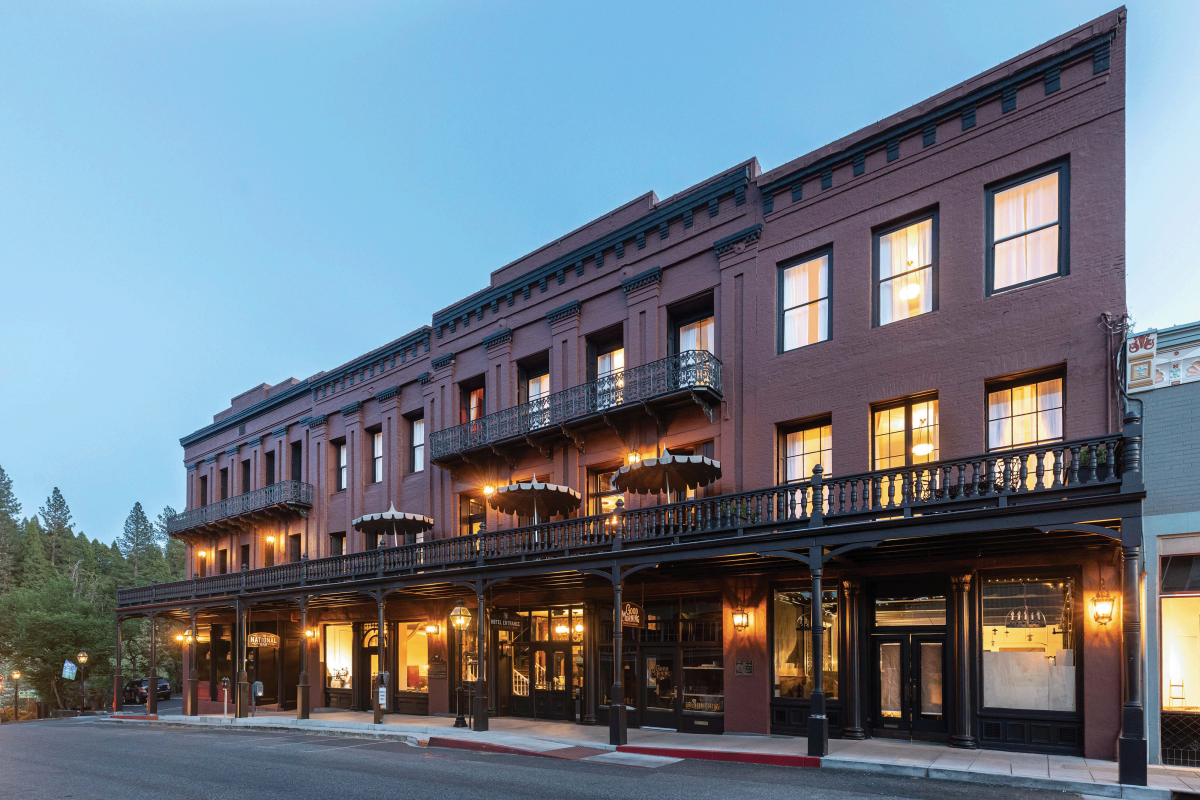
Downtown Nevada City is lined with jewels of Victorian-era architecture. My favorite is the National Exchange Hotel, which has long served as a sort of center for Nevada City due to its size, impressiveness and location on downtown’s main thoroughfare, Broad Street. Opened in 1856, it is one of the oldest continuously operated hotels in the West. I walked inside to look at the lobby and the restaurant called Lola — named after Lola Montez, who was known for her infamous “Spider Dance” — as well as the hotel bar. I was struck by the opulence of dark wood, brass fixtures and other period decor.
Related: Two Gold Rush Era Hotels Return to Glitz and Glamour
Heading up Broad Street, the Nevada Theatre is worth a stop. It is considered the oldest continuously running theater in the Western United States. Built in 1865, the building has a brick facade and iron doors. Lola Montez performed here, and in 1866, author Mark Twain delivered an address on his travels to the Hawaiian Islands. The theater continues to host live performances and movies.
Across the street is Firehouse No. 2, another two-story brick building that tells an important story about Nevada City. In 1851, a great fire destroyed 125 buildings — about half the town, according to the audio tour. This and other fires led the town to finally create a fire department, including its first station on Broad Street. (Firehouse No. 2, completed in 1861, was actually erected before Firehouse No. 1 in another part of town.)
There’s a bit of mining history to be seen, too. Across the street from the National Exchange Hotel, on the corner of Broad Street and Union Street, Calanan Park has some instructive mining relics, including one of the water cannons — called monitors — used for hydraulic mining. One block north on Union Street, Harmony Books is in the old assay office, where people brought gold for valuation. The bookstore has the office’s original vault and carries a wide range of books on California history and other topics.
I love reading about California history, but spending the day steeped in it is more enlightening and fun.
–
Stay up to date on business in the Capital Region: Subscribe to the Comstock’s newsletter today.
Recommended For You
Why Are Big-Name Bands Playing at These Mountain Town Venues?
Venues in Nevada City and Grass Valley attract name acts, and the scene could be growing
Quietly, a robust live music scene has emerged in the foothills, with several venues able to draw in well-known acts. And if the changes in Grass Valley are emblematic of another thing, it’s that this sector is growing.

How Cornish Pasties Got to California
Grass Valley’s Cornish pasties are a remnant of the town’s mining history
Cornish pasties are an edible trace of the gold rush, connecting
Grass Valley to a global history of migration and
extraction.
Two Gold Rush Era Hotels Return to Glitz and Glamour
The 169-year-old Holbrooke Hotel in Grass Valley and the 165-year-old National Exchange Hotel in Nevada City are fully restored and experiencing a rebirth.
The Best Way to Explore Lake Tahoe Is On Foot
Those visiting Lake Tahoe shouldn't overlook its alpine trails — a great way to beat the crowds during the warmer months
For our new Out of Office column, reporter and photographer Brad
Branan takes us on a journey to some of his favorite hikes around
Lake Tahoe.