


This story is part of our July 2026 Young Professionals issue. To read the print version, click here.
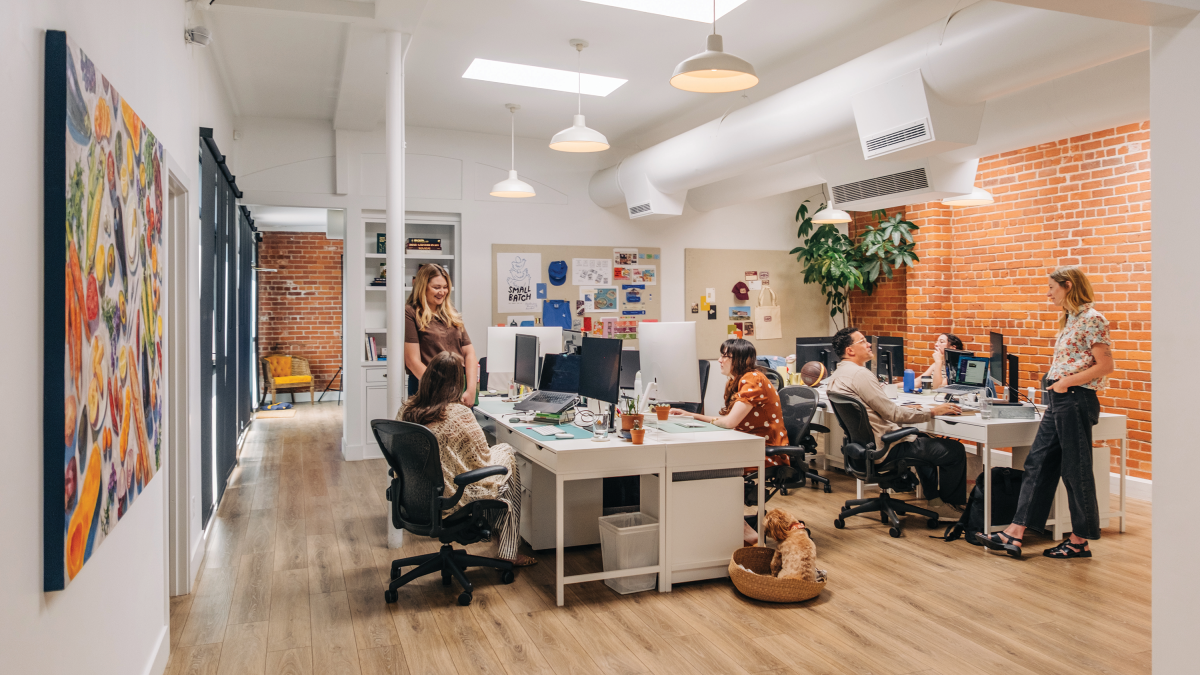
It’s an in-office day at Honey, a design and marketing studio. Team members are gathered in the airy, exposed-brick workspace just across the street from Temple Coffee and the Sacramento Natural Foods Co-op.
The building used to be a print shop, but these days it’s been given over fully to design. There are wine bottles on the shelves, as well as elegant art pieces, mainly bought from local artists, with some having a Japanese motif. There is also a small photography studio off to one side, where clients can have headshots taken, along with a private lactation room for new mothers.
Ash Rodseth and Maggie Giordanengo, the creative director and president, respectively, of Honey, have gathered the team here. Rodseth used this room a few years ago after her daughter was born. Out back is a huge patio, furnished with lush outdoor sofas, seats and sun umbrellas, the back wall covered with climbing ivy.
The majority of Honey’s staff work remotely on Wednesdays and Fridays, coming into the office the other three days of the workweek to brainstorm and collaborate. They sit around desk consoles — multiple white-painted desks placed together side-to-side and back-to-back, so that the mainly young staff can easily collaborate both conversationally and see what is going on on the numerous computer screens atop these desks. It’s called, jokingly, “the fishbowl” by employees. In the mornings, there are always plates filled with pastries for employees to enjoy.
In an age of remote work and of AI snapping at the heels of creatives such as these young designers, Honey works assiduously to build new teamwork rituals. Their environment is a core part of this strategy. The company hosts client events, along with local vendors, on their patio. In late May, they brought in a new client, an egg vendor, to sell eggs to Sacramentans, and added to the mix an array of other vendors and their wares.
They have found new ways to collaborate over Slack; and on a regular basis they make sure to “hop on huddles,” in Rodseth’s words, where they can talk about new design projects. As these projects develop, Honey’s crew do what they call “proof-point check-ins” to make sure that the key players are all on the same page, even if some of them now live as far afield as Los Angeles and do most of their work remotely, flying in every so often for vital in-person meetings.
It’s a carefully choreographed effort to nurture stronger communal bonds, even in an era of Zoom, Google Meet and Teams.
“Our industry is changing so much every day,” Rodseth says, explaining how, since COVID, office culture has evolved at warp speed. Giordanengo agrees. “During COVID, there was just fatigue,” she remembers. “There’s more energy and creativity about how it’s done today. What is beautiful about Honey is we do have that in-person culture, and it’s very strong. The team enjoys coming together.”
Keeping office rituals alive
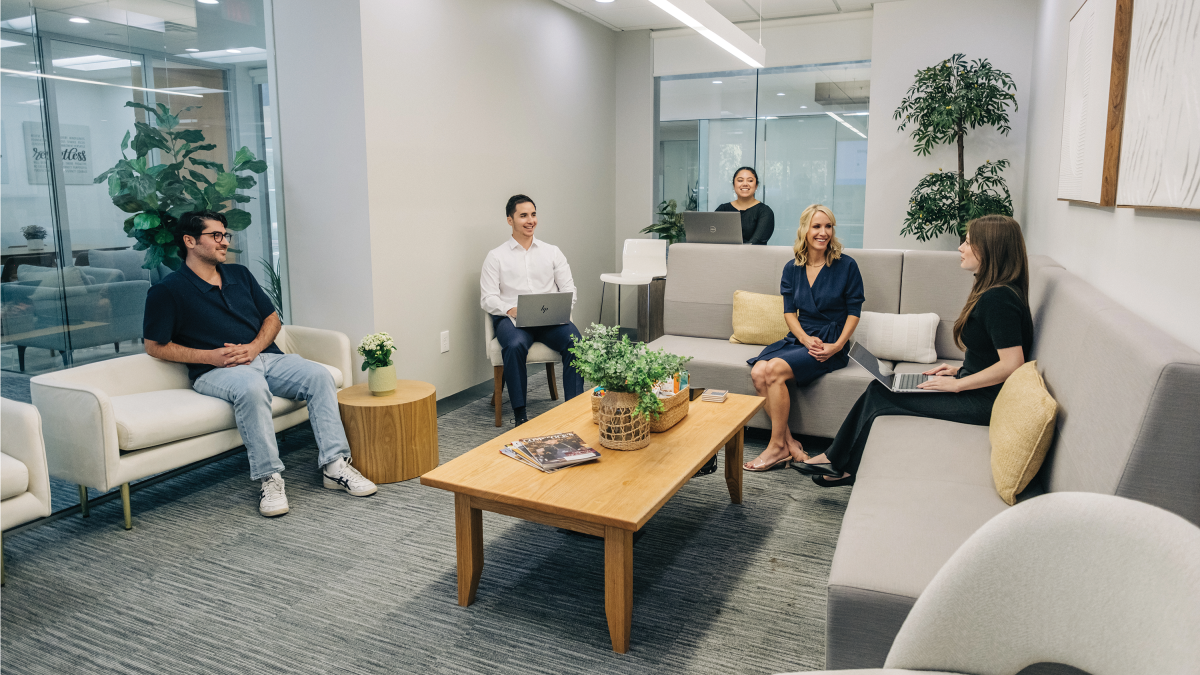
Randle Communications turned its formal conference room into a
more casual meeting space for the team to collaborate. (Photo by
Francisco Chavira)
Jeff Randle runs a communications company out of an office on Fair Oaks Boulevard. Like Honey, Randle’s team has reinvented its work practices since the onset of the pandemic. “We took for granted what the workplace was like before COVID,” he recalls. “You were there every day.”
Nowadays, his employees are in the office only two days out of the week, meaning that when they are together, they have to make an extra effort to develop camaraderie. “So we give it a lot of thought,” Randle explains. “How are we going to maximize our two days in the office?” It’s a challenge faced by employers throughout the region as virtual technology upends decades, perhaps even centuries, of workplace practices.
First off, Randle says, they have decided to keep as many old rituals alive as possible. Every Tuesday, like clockwork, they hold an in-person staff meeting — as they have done every week for the past 25 years — half an hour talking about everyone’s weekends and their family news and half an hour discussing work priorities and highlights from the previous week.
“We really are intentional about using those two days to get as much time together as possible. We’ve always been focused on the team. I’ve always believed the team will drive to go to places you want to go. … It’s something you have to think about every day — to make sure your team is engaged and they are getting direct feedback.”
— Jeff Randle, founder and CEO, Randle Communications
“We do as many team meetings in the office as possible — client meetings happening all the time in person,” Randle says.
He has turned his formal conference room into a more casual meeting space, complete with deep sofas that his staff can lounge on. They hold regular mentoring meetings with young employees and what they call “lunch and learns” at least once a month — bringing in guest speakers or holding professional development sessions while they eat.
“We really are intentional about using those two days to get as much time together as possible,” he says. “We’ve always been focused on the team. I’ve always believed the team will drive to go to places you want to go.” He adds that when they’re deciding on who to hire, they look for team builders rather than lone wolves. “It’s something you have to think about every day — to make sure your team is engaged and they are getting direct feedback,” he says.
Building culture post pandemic
Sacramento Metro Chamber of Commerce President and CEO Robert Heidt spends much of his work time these days strategizing around how the companies under the chamber’s umbrella can build teamwork among employees who have grown up in an increasingly atomized, virtual world. For him, too, the pandemic represents a great divide. There is the “before” era, and there is the “after” era, and the ways workplaces operated then are, in many ways, utterly different from how they function now.
“Culture is tough today,” he says. “Pre-pandemic, there were a lot more rituals and patterns, ebbs and flows in the workplace.” Today, he says, for younger workers in particular, the priorities are different. “They are looking at different things in terms of how they view mentorship, goals and so on. Flexibility is a big one for them. Team building, camaraderie, it looks different from how it did a decade ago.”
Consequently, companies belonging to the chamber of commerce are experimenting with new workplace models. Many have embraced volunteerism — everything from stints bagging food at the food bank to working in animal shelters — as a way to generate a sense of shared values and experiences.
Some have encouraged workers to go on walks together as a way to rebuild shattered teamwork rituals. The Chamber of Commerce encourages its own employees to visit the Downtown Farmers’ Market every Wednesday. It has also implemented an unwritten rule that whenever the temperature hits 100 degrees, the staff will decamp together to go get ice cream.
In late May, the chamber hosted an all-day Emerge Summit, with more than 300 young professionals from around the city brought together to discuss leadership techniques. The keynote speaker was a Southwest Airlines executive who talked about innovation and ways of taking the initiative in the workplace. Later in the day, the young men and women were broken down into smaller subgroups, each of whom were assigned their own restaurant at which to dine and talk.
This comes in the wake of a host of “Executive Insights” presentations, in which well-known regional figures — CEOs, college presidents and the like — have been invited to the chamber to field questions from young workers. “Some of these folks will be the next leaders of companies in the region,” Heidt says. “We are the catalyst. We want them to feel that they’re part of something larger. Not just attending meetings and not just a spoke in the wheel.”
Other businesses around the Capital Region are also getting creative to build a collaborative workforce in the age of remote work. Members of Comstock’s Editorial Advisory Board shared what their teams do. Naaz Alikhan, principal with Williams + Paddon |19six, says her architecture firm has a “summer soiree” each year where they gather the team together for a day. The president talks about the state of the company and then holds breakout sessions. The rest of the day is spent socializing. Alikhan says the younger generation really wants to get to know the other people at the firm.
Erica Manuel, CEO and executive director of the Institute for Local Government, says her office does quarterly full-day meetings in the office that combine business and socializing. Once a year, they have a full day off campus, maybe visiting a winery. Meanwhile, Darrell Teat, CEO of CxORE, says his company does “rolling board meetings” — holding board meetings at various locations instead of in the office.
“I think socialization is just so important right now and getting face-to-face with people. And that’s why they’re really in demand, I would say,” Alikhan says.
Back at Honey, Giordanengo reflects on the importance of team building in an era of seemingly unstoppable technological advances. Sure, AI can now take notes and conjure up summaries of meetings far faster than a human being can, but, she says, that doesn’t mean that the human spark is no longer needed; rather, it frees up mental space for employees to devote their time and energy to new ways of navigating the workplace.
“A core tenet of Honey is team-building culture,” she says. “It’s the heartbeat of who we are. One of our values is familial. Creating that sense of connection and relationship within your team. To celebrate each other’s wins and push ourselves to a shared goal. Connection happens in big moments and small, whether you are in the office or not.”
In the past few years, much has been written about young people reaching back to earlier digital and even analogue eras as they develop their sense of self. Vinyl records are hip again. Consumers leery of relying entirely on downloaded music and streaming systems are scouring eBay for Apple iPods. Some are even reaching back to the golden age of the Sony Walkman and the stand-alone cassettes.
Ash Rodseth has seen hints of an equivalent movement in the workplace, as well. “Meeting fatigue is very real,” she says of eight-hour Zoom days. “The amount of people over the past year and a half or so, compared to prior, who seem to be yearning for connections has been more apparent. People want to feel connections and have conversations and have a glass of wine together after work.” She stops and thinks a bit more about how to articulate her sense that young workers are rebelling against Big Tech’s atomizing tendencies.
“Let’s make sure we’re slowing down and enjoying the moments of connections,” she says. “I’ve been noticing that among my own personal connections and networks, but also in the broader community and speaking with colleagues.”
–
Stay up to date on business in the Capital Region: Subscribe to the Comstock’s newsletter today.
Recommended For You
What is Job Hugging — and Are You Doing It?
More workers are staying in their jobs amid a tight economy and fewer work options
Today, the Great Resignation has been replaced by what economists
are starting to label the “job hugging” era.
How Capital Region Schools Are Training Students for Technical Skills Careers
Community colleges, high schools and private institutions offer pathways to jobs in the trades
Around the Capital Region, technical and trade programs in high schools, in community colleges such as Cosumnes River, American River, Sac City and Sierra, and in stand-alone entities such as UTI, are flourishing.
How Leaders Can Learn to Listen
Emotional intelligence and aligned purpose can transform the way teams communicate and get results
Navigating communication in the workplace can be tricky. But experts agree the most effective way to improve communication is by first gaining self-awareness — understanding your own personality traits, behaviors and listening preferences — then learning to recognize and appreciate those in others.
Inside California’s Return-to-Office Battle
Five years after getting WFH orders, workers are rebelling against resuming cubicle life
Earlier this spring, Gov. Gavin Newsom signed an executive order
mandating that most of California’s 224,000 full-time state
workers should return to working in the office four days per week
starting July 1. The executive order has stirred passionate
debate, with local businesses in favor of the change and
organizations representing state employees adamantly opposed.