



This story is part of our January 2026 issue. To read the print version, click here.
Thirty-eight-year-old accountant Ash Singh finally found a job she enjoys. After years working for, and sometimes being laid off by, a slew of startups in New York, and after years of long daily commutes from the suburbs into the city, she still felt expendable at her job. Singh moved to California in early 2025 and sent her resume to Preet Kuar of Pacific Staffing, a local job recruiter in the Sacramento region. Singh began interviewing for new positions while continuing to work remotely for a New York company.
Singh, who has two young children, wanted work that would allow her to retain a hybrid schedule. She also wanted a boss who would recognize that she needed a degree of flexibility in case she needed to attend a child’s school function or medical visit.
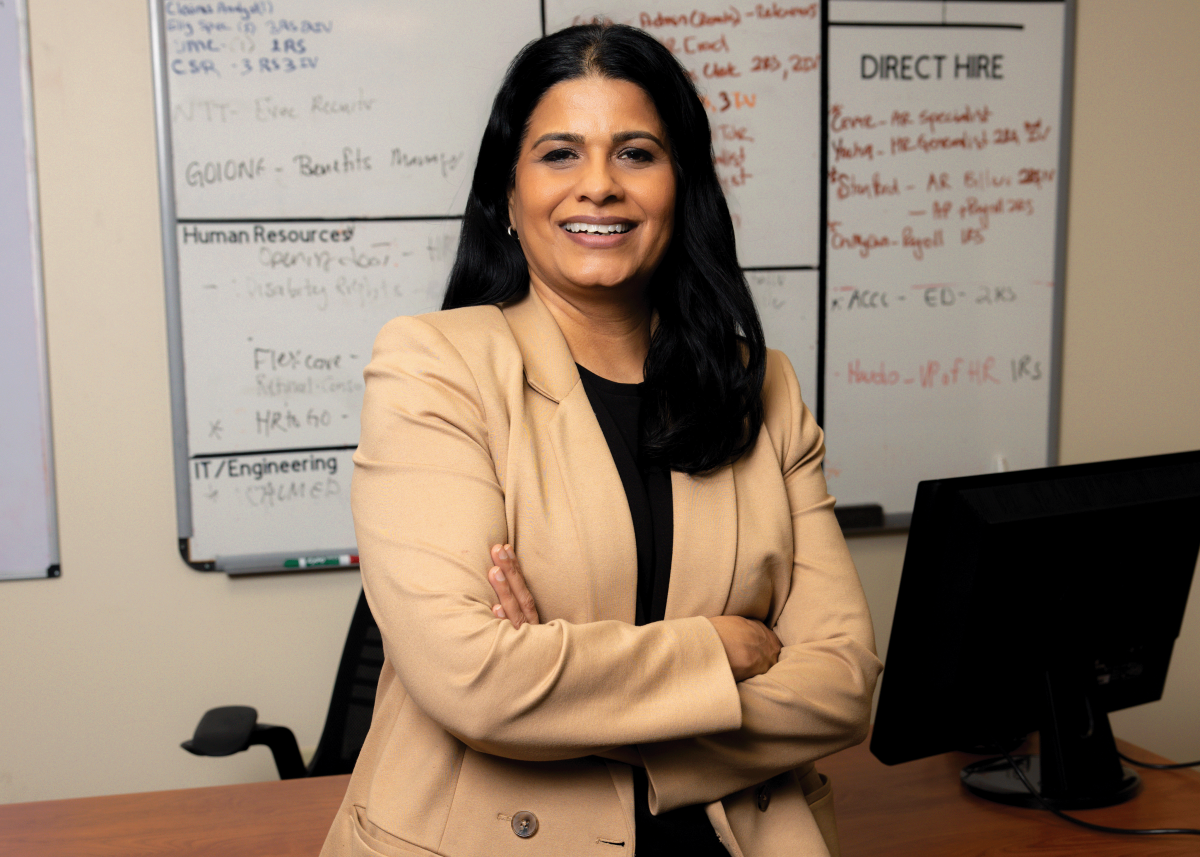
Thirty-eight-year-old accountant Ash Singh finally found a job
she enjoys. (Photo by Katy Karns)

Soon after she moved to California, Kuar telephoned her and said she had found the perfect job. It was a position at the League of California Cities. Within the first five minutes of her interview with them, Singh was sold.
“I knew this was the place for me,” she says. “It ended up being the best decision I made. It’s a nonprofit. It’s 180 degrees from where I was, company-wise. I’ve gone from job to job and always been unhappy in those roles. Finally, I’ve found a job where the culture’s a fit.”
Happy in her new role, which divides her week between two days of in-person and three of remote work, Singh intends to hold onto it for dear life. She worries that if she hits the job market again, she’ll lose what she has and won’t be able to replicate the benefits of her current workplace.
Singh’s approach is increasingly common among employees in the workforce. From 2015 to 2020, the economy was on a job creation spree. When the COVID-19 lockdowns first went into effect in March 2020, the economy went into a brief tailspin, and unemployment soared. A vast infusion of federal dollars stabilized the economy, and the huge increase of jobs in sectors such as tech and order fulfillment like Amazon and DoorDash created a bonanza.
As a result, in a phenomenon economists labeled the Great Resignation, millions of workers hopped from one job to the next, leaving for better pay, better opportunities and benefits. There was a sense that jobs were plentiful and that it was an employee’s market. They left for jobs that allowed them to work remotely or part time. Paradoxically, out of the tragedy and heartbreak of the pandemic, America experienced a temporary surge in social mobility. To keep employees, companies had to offer an array of bonuses, and hourly pay rates in many industries rose rapidly.
Today, the Great Resignation has been replaced by what economists are starting to label the “job hugging” era. According to a 2025 job hugging study by Monster, a leading job search website, 75 percent of employees expect to remain in the same job for at least two more years, while 48 percent plan to stay in their roles longer than they otherwise might.
Employees are fearful of ending up unemployed in a softening labor market or of only finding jobs that pay less and offer fewer benefits. They worry, too, about the dislocations generated by the AI revolution — which is both automating many jobs and using AI technology to filter candidates when jobs do open up. That means employees are holding on to jobs they like, as is the case with Ash Singh, and also ones they don’t like but offer stability and a regular paycheck.
“If I leave, I don’t know if I’ll find a job, because the economy is uncertain, with tariffs and so on. Right now, I don’t plan on leaving anytime soon,” says Singh.
Kuar, the recruiter who found Singh her job, can sympathize. “There were a lot of jobs in ’21 and ’22; we couldn’t keep up with the demand,” she says. “It was very competitive. We were offering sign-up bonuses. Clients (employers) were very open and flexible, because there was so much demand.”
Since 2024, however, Kuar has noticed far fewer jobs coming online and a greater premium on employees who are willing to stick it out in the same job for longer periods. Employers are taking longer to fill vacancies, and they are being more careful to screen out candidates they suspect are going to quickly leave for new opportunities. “’25 has been a correction year,” Kuar says.
Preet Kuar, CEO of Pacific Staffing in Sacramento, says fewer
jobs are coming online so employees are electing to stay in their
jobs longer. (Photo by Katy Karns)
Giuliana Gabriel, senior human resources compliance director at the California Employers Association, understands that approach all too well. The CEA’s membership mainly consists of small and midsize businesses, and members have been telling the CEA about the turmoil they are seeing in the economy.
“We are hearing there is a lot of uncertainty because of AI, tech layoffs, economic uncertainty,” Gabriel explains. “Employees are clinging to their jobs. And employers are being more cautious. It’s grown a little stale. There’s not as much movement, and employers are taking more time to consider candidates. Midsize employers have budgetary concerns, thinking about laying off employees, angst about AI and tariffs. The uncertainty about those are going to impact business, the cost of goods and whether they can be passed onto consumers. That’s why things have grown stale in the labor market.”
As a result, employees are staying put — even when they feel disengaged from the work they are doing. “They’re understanding the grass isn’t greener on the other side,” says Kuar.
A Gallup Survey, based on 2024 economic data, found that only 31 percent of employees felt engaged with and enthusiastic about the work that they are doing, a reality that has profound impacts on the way the economy functions. “Disengaged employees are less motivated, less enthusiastic and feeling burnt out,” Gabriel says. “And when that happens, productivity suffers.”
“We are hearing there is a lot of uncertainty because of AI, tech layoffs, economic uncertainty. Employees are clinging to their jobs. And employers are being more cautious. It’s grown a little stale. There’s not as much movement, and employers are taking more time to consider candidates.”
― Giuliana Gabriel, senior human resources compliance director, California Employees Association
In many ways, this is a similar labor market situation to that in the recessionary years following the financial crash of 2008. Then, too, there was a general feeling of anger about how the system was or wasn’t working. Those with jobs held onto them, even if those jobs made them resentful, fearful that the alternative would be even worse.
Last August, the Sacramento region unemployment rate was 5.3 percent, roughly 1 percent above the national average. We don’t know exactly how the labor market may have shifted in the months that followed due to a variety of factors, including a government shutdown, which impacted data collection. However, a large number of workers, especially in the tech sector, were laid off, and those who haven’t been are hunkering down, hoping to ride out the AI storm.
We know that, nationally, the number of jobs added in August virtually stalled out. Tariffs have put pressure on prices, but we don’t know how many jobs have been put at risk as a result. Sacramento State macroeconomics professor Hannah Gabriel says tariffs have led to price spikes in the metal and lumber markets, but we don’t yet know if construction workers in the Capital Region have been affected.
Meanwhile, remote workers fear return-to-office mandates. However, amidst all the fog of uncertainty, we can conclude that this is “not creating a lot of positive sentiments about the labor market as a whole,” says Hannah Gabriel.
“After COVID, things became more flexible. People were hiring remotely. You could find jobs anywhere,” Singh recalls. You could leave a job one day and pick up new work, with better pay, the next. “Now things have changed, and finding a job is much harder than it was during the COVID time. We don’t know if there will be layoffs. We have to feed our kids. We work with what we have.”
–
Stay up to date on business in the Capital Region: Subscribe to the Comstock’s newsletter today.
Recommended For You

Follow Her Lead: Preet Kuar
As the country celebrates the 100th anniversary of the 19th Amendment, we profile 19 leaders in the Capital Region
If Preet Kuar, CEO and executive recruiter of Pacific Staffing and Pacific ExecSearch, had thought as a college student that one day she would love a job as the CEO of an executive recruitment company, she would have laughed.

Waiting for Workers
Staffing agencies are ready to fill jobs as soon as companies begin rehiring
The combined region of Sacramento, Placer, El Dorado and Yolo counties lost 800 professional and business services jobs between February and March. Those job losses have affected local staffing agencies.

The Need for Nurses
The Capital Region has a nursing shortage. Here’s what health care systems, schools and others are doing about it
National Center for Health Workforce Analysis figures from November 2022 show there could be a shortage of over 78,000 full-time registered nurses in the U.S. by next year, and that the shortage could last several years. CalMatters reported in July 2023 that California was short around 36,000 licensed nurses, citing figures from UC San Francisco, which studies the nursing workforce.

Women in Leadership 2025: Helen Pierson
Our annual salute to the women who lead the Capital Region
When Helen Pierson took a new job in the billing department at her family’s ambulance business in 1988, she couldn’t have predicted that she’d one day lead the team — alongside her three adult children.