


This story is part of our November 2026 issue. To read the print version, click here.
Ann Bryant has recovered many black bear carcasses from Tahoe-area highways since founding the BEAR League 30 years ago. Finding Polaris, a cub killed by a vehicle on Highway 89 this year, was particularly difficult for her. The cub was born in the crawl space of a vacation home, and the BEAR League had installed a camera there to monitor him, his sibling, Arcturus, and his mother, Ursula. Bryant watched Polaris grow up.
But then she saw his lifeless body on the highway near Ed Z’berg Sugar Pine Point State Park after responding to a call from a concerned resident. “I immediately recognized him,” says Bryant, executive director of the animal welfare organization in Homewood. “It was devastating.”
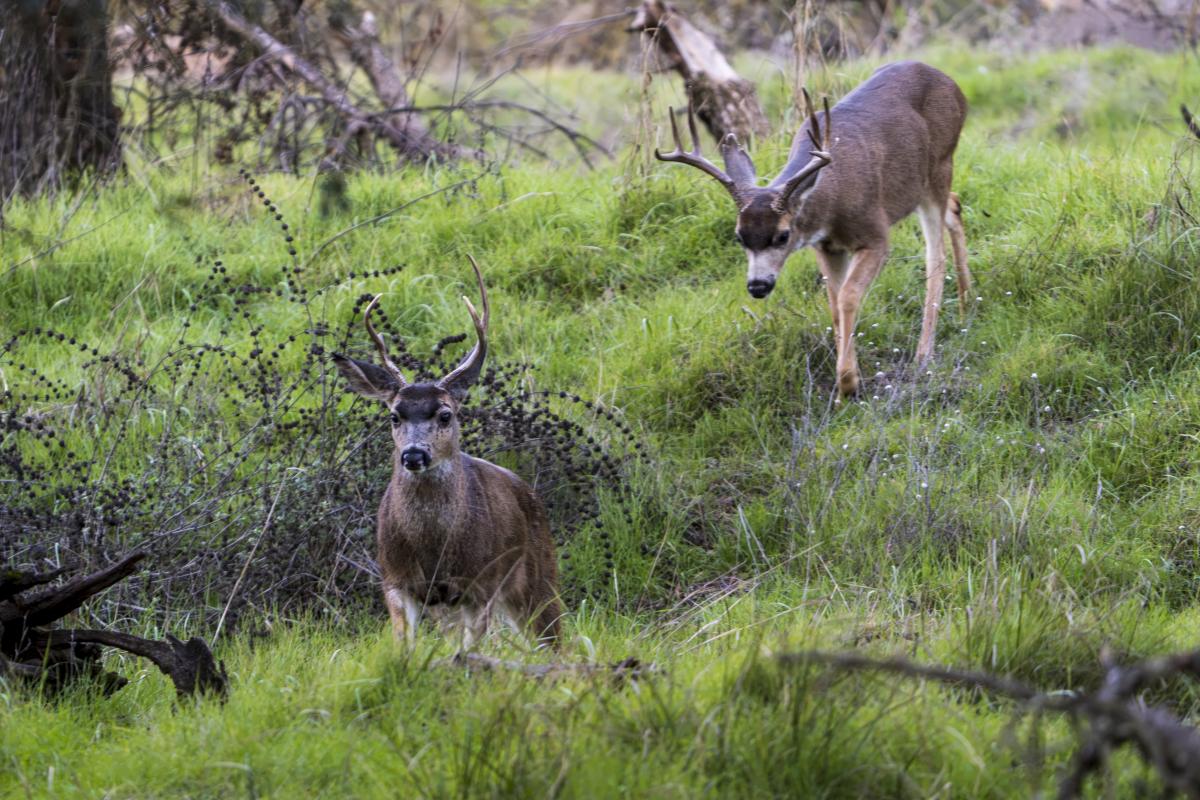
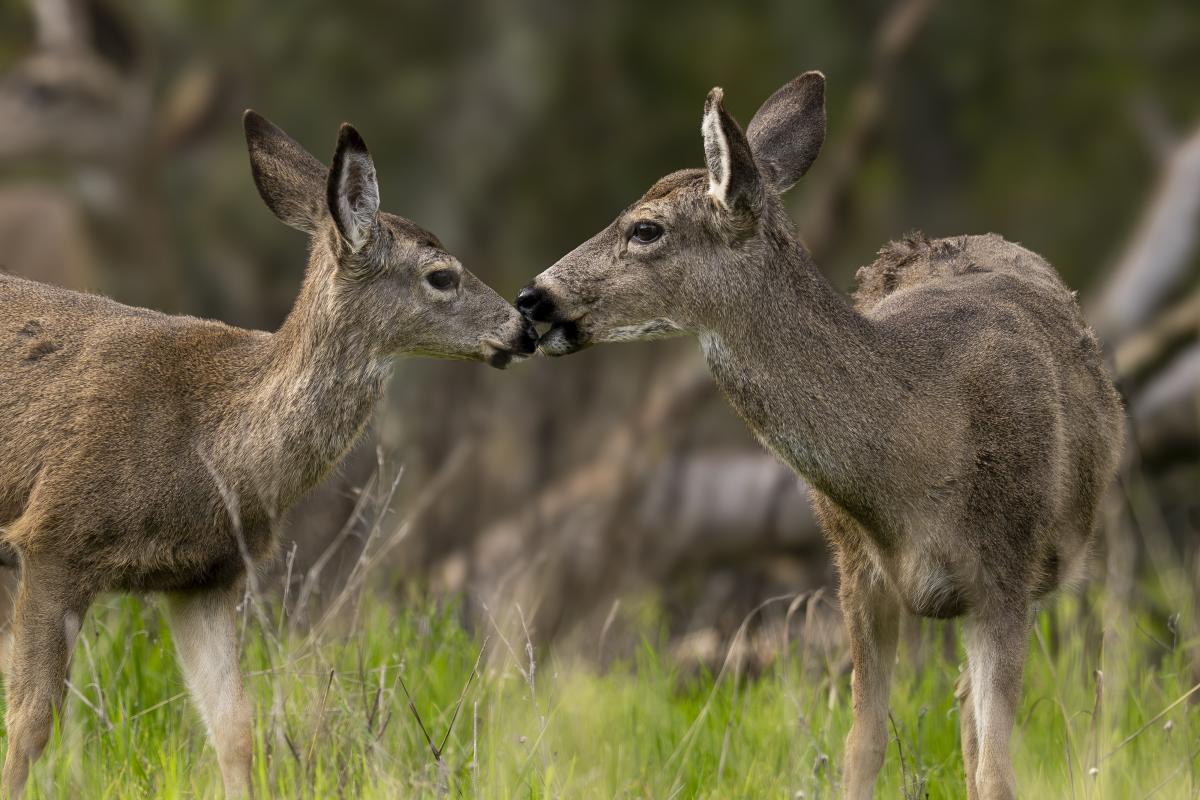
48,000 mule deer are killed by collisions in California each
year, which is roughly 10 percent of the population and twice as
many as are killed by hunting. (Photo by Brad Branan)
Bryant needed to remove Polaris from the road because he might attract coyotes in search of food. Ursula, apparently not understanding that her cub was dead, kept moving toward Bryant to keep her away from him. Bryant says she had to chase off Ursula before putting Polaris’ bleeding body in the trunk of her car.
California’s highways present one of the greatest threats to its wildlife. Tens of thousands of animals are killed in collisions each year, enough to outpace hunting as a leading cause of death for some species. Highways also restrict habitat size and keep animals from finding food, water, shelter and potential mates, creating extinction risks for some animals.
People face risks too: Known animal-vehicle collisions cost the state an estimated $250 million a year due to injuries and property damage, although the estimate is much higher when considering unreported incidents. Several people are killed each year in animal-vehicle collisions in California, according to the UC Davis Road Ecology Center.
The problem is especially bad in the Sierra Nevada foothills, where heavy traffic and large animal populations have led to one of the highest rates of animal-vehicle collisions in the state, according to Fraser Shilling, director of the UC Davis Road Ecology Center.
The solution isn’t complicated — build underpasses, overpasses and fencing on highways to keep animals from traveling across traffic. Shilling calls animal-vehicle collisions a “preventable natural disaster.” Animal crossings can pay for themselves by reducing the financial costs of crashes, Shilling says.
The state has received a lot of media coverage for its construction of “the world’s largest animal overpass,” a bridge over 10 lanes of traffic on Highway 101 in Los Angeles County that has cost $114 million. Yet the state has struggled to finish the project on time or build animal crossings in other parts of the state. Environmental advocates have pushed for legislation to make Caltrans more actively consider wildlife crossings in its transportation plans, including AB 2344, the “Safe Roads and Wildlife Protection Act,” passed in 2022.
“That’s not happening,” Shilling says. “There’s a fundamental problem with the implementation of the law.” Caltrans’ own reports confirm Shilling’s interpretation. Caltrans’ headquarters did not respond to multiple requests for an interview for this story.
Shilling’s Road Ecology Center collects reports on vehicle-animal collisions from the California Highway Patrol, the California Department of Fish and Wildlife, other public agencies and the general public. The center regularly publishes reports on where the most accidents happen and the impact on specific species.
The Bay Area and the Sierra Nevada foothills near Sacramento have the highest rates of animal-vehicle collisions in the state, Shilling says. In the foothills, the highest rates are on Highway 50 from El Dorado Hills to Pollock Pines, Highway 49 from Placerville to Grass Valley, and Interstate 80 from Rocklin to Colfax.
A 2024 study by the Road Ecology Center found that a section of the Sierra Nevada foothills, from Tuolumne County north to Nevada County, had almost 6,000 reports of large mammals killed on state highways over the seven previous years. That was the third-highest total of any region in the state. The figure could be six times as high — roughly 36,000 large mammals — after accounting for underreporting, Shilling says.
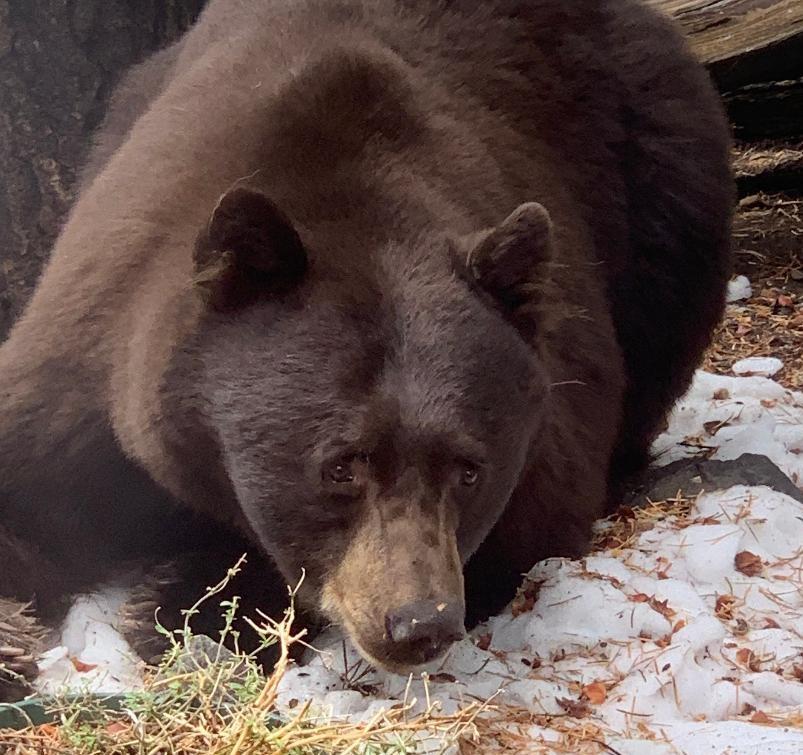
About 250 bears are killed by vehicle collisions in California
each year, according to a 2024 report from the Road Ecology
Center. (Photo credit Kathi Zollinger/BEAR League)
Deer are by far the most common victims of vehicle collisions. The center estimates that 48,000 mule deer are killed by collisions in California each year, which is roughly 10 percent of the population and twice as many as are killed by hunting.
Vehicle collisions may explain California’s deer decline, Shilling says. The state lost more than 150,000 deer from its overall population over a 15-year period ending in 2017, the last year state wildlife officials completed an estimate. The state is updating its deer management plan, including its process for population estimates.
Black bears have also suffered losses. A 2024 report by the Road Ecology Center found that reported bear fatalities from vehicle collisions had increased over an eight-year period, from under 150 to 250 a year. Bears range widely for food and are known to cross roads often.
Motorists speed past a deer warning sign on Highway 50 in Shingle
Springs, a hotspot for wildlife-vehicle collisions. (Photo by
Brad Branan)
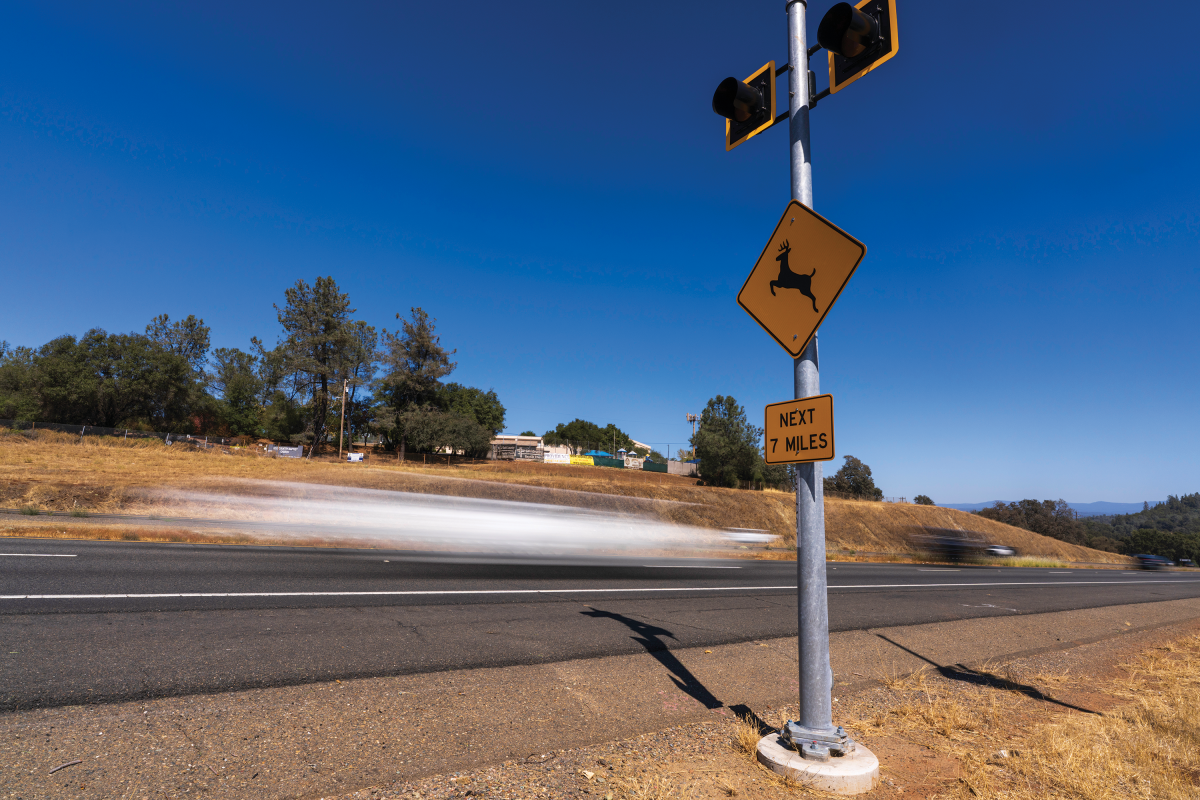
According to Bryant of the BEAR League, her organization responded to nine cubs that were killed on Tahoe-area roads in six weeks this year. She believes the increase in fatalities is due to Caltrans raising the speed limits on area roads. Caltrans generally sets speed limits using the 85 percent rule, meaning the limit is set at or below the speed 85 percent of motorists drive — though documented safety conditions can justify a lower limit. The Caltrans district public relations office serving the Tahoe Basin did not return multiple messages seeking comment.
Bear activity increases in the fall, as bears prepare to hibernate, and they end up getting hit by cars more often at that time of year as a result. When Ursula lost Polaris on Highway 89 this year, Bryant says the BEAR League had to keep an eye on her. “She was howling and crying for six hours,” Bryant says, adding that it isn’t just the bears who get upset. “It’s devastating to the volunteers. It’s devastating to the drivers. Some of them take off. Some of them stay, and they are in tears and will have nightmares.”
Melissa McCartney, executive director of Gold Country Wildlife Rescue in Auburn, reports that her staff, who treat injured animals, share a similar emotional burden. Animals brought to the center come from good Samaritans, state wildlife officers and local animal control officers, among others.
“We receive these good Samaritans scooping these animals out of the road, putting, you know, this bloody screaming animal into their car, driving to us. They’re in tears. And it’s the same for our staff. You can have multiple animals come in in one day and as well-meaning as everyone is, if there’s spine damage or something like that, we have no option; we have to euthanize them,” McCartney says.
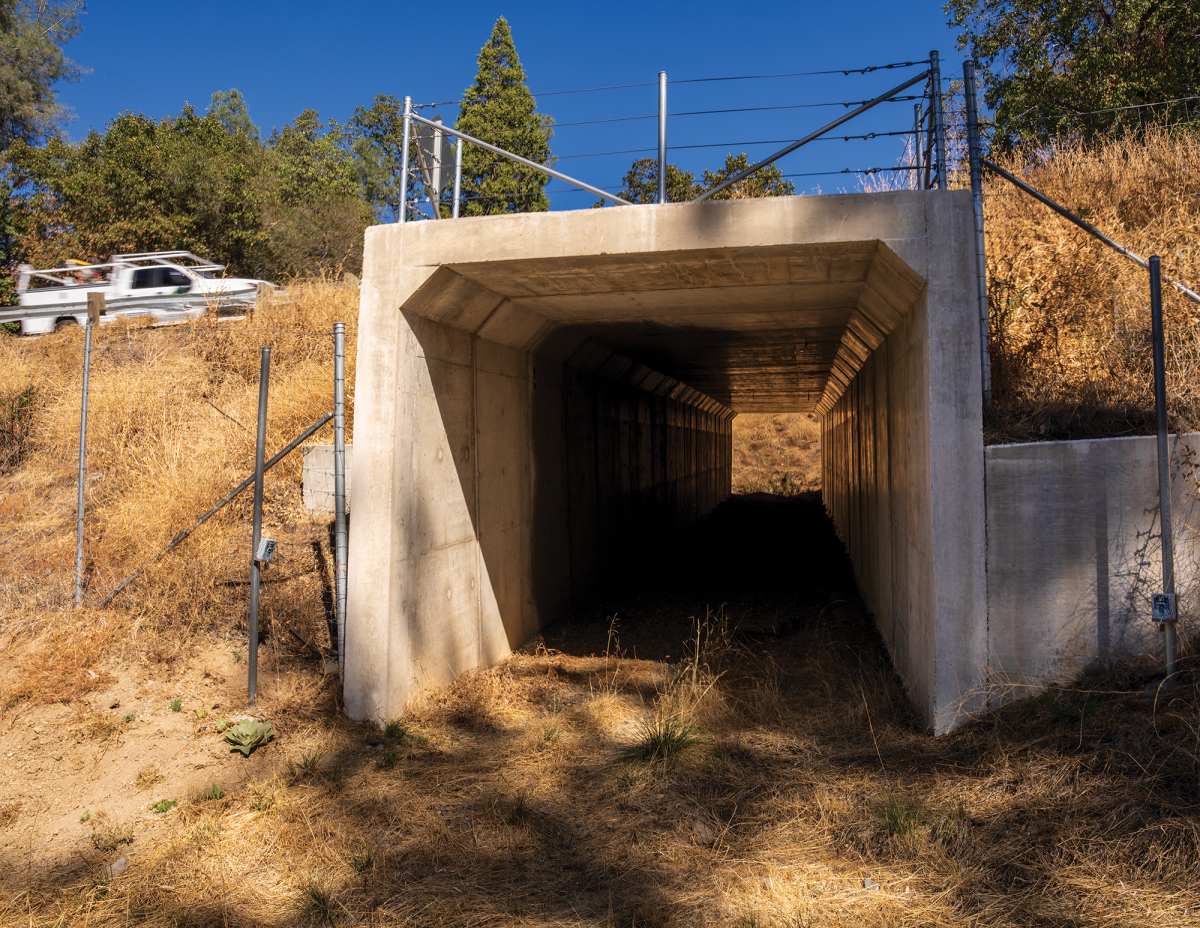
A wildlife crossing on U.S. 50 at Camino is one of two on the
highway in the Sierra foothills, one of the deadliest locations
for animal-vehicle crashes in the state. The underpass is located
on an especially busy section of the highway that attracts
motorists going to and from Apple Hill and Lake Tahoe. (Photo by
Brad Branan)
Few animals recover well enough from vehicle crashes to be released back into the wild. From the start of this year through mid-September, the center received 213 animals that were hit by vehicles, and only 63, or 30 percent, survived. Animals with permanent injuries that would stop them from surviving in the wild are euthanized, McCartney says.
Animals face another set of problems if they don’t cross roads, says Sara Holm, one of six wildlife connectivity biologists working for the California Department of Fish and Wildlife. Holm is based in Rancho Cordova and responsible for the Sierra foothills, among other areas.
“The highways are breaking up the habitat and separating the wildlife from reaching what they need to keep living,” says Holm. Some animals have more problems than others with restricted habitat. Mountain lions, for instance, need a lot of territory to roam. Some deer migrate from the higher elevations to take advantage of warmer weather and “to find food and survive,” Holm says.
A mountain lion named P-22 helped make divided habitats an international issue. P-22 crossed two highways before taking up residence in Los Angeles’ Griffith Park, where National Geographic photographer Steve Winter shot what would become an iconic photo of P-22 in front of the hillside Hollywood Sign. P-22 was essentially penned into an urban area without mating partners or enough room to roam naturally. He helped spur support for construction of the Wallis Annenberg Wildlife Crossing, named after a philanthropist and daughter of a media magnate who donated money to help get the crossing built. The crossing is scheduled to open on Highway 101 in December. P-22 was euthanized in 2022 due to illness and multiple injuries, including those believed to have come from a vehicle strike.
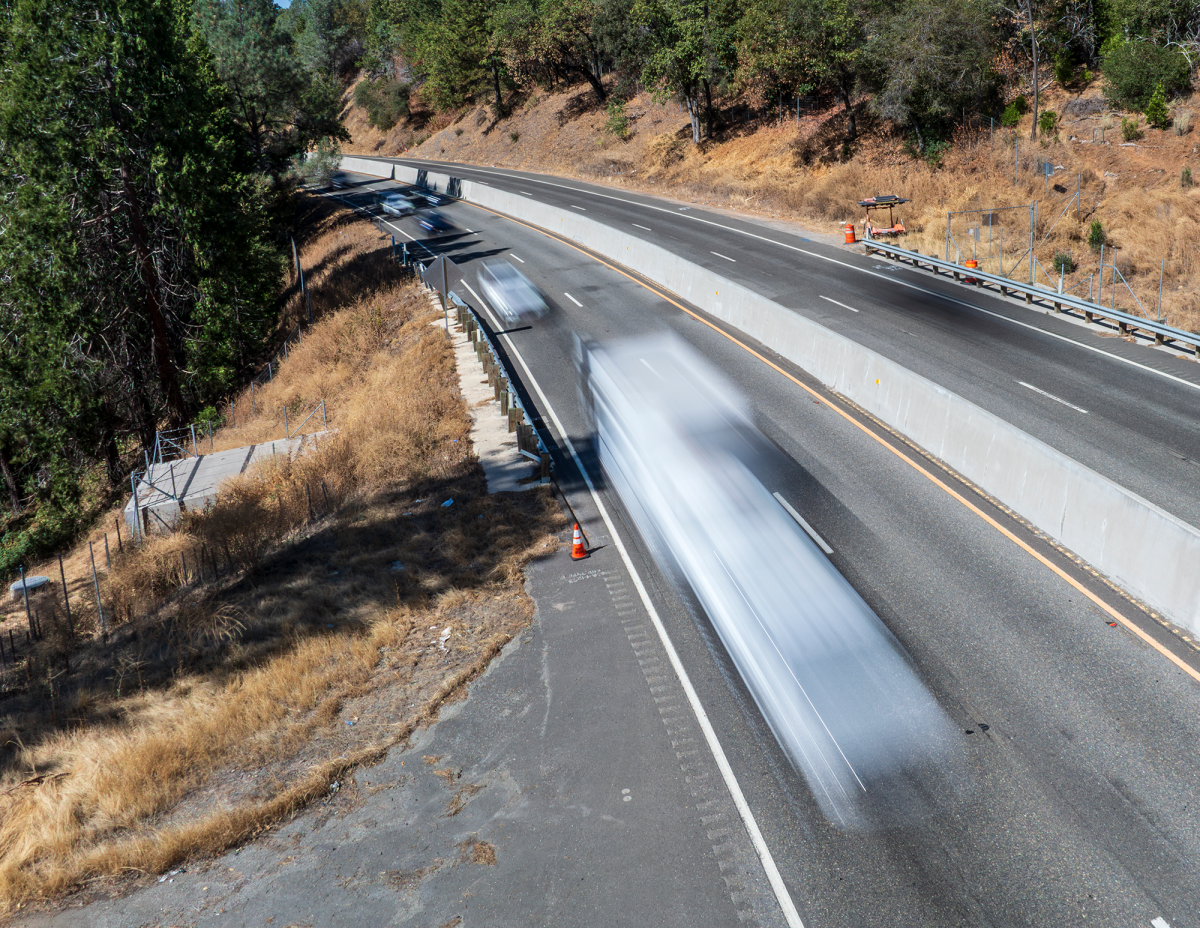
Caltrans generally sets speed limits using the 85 percent rule,
meaning the limit is set at or below the speed 85 percent of
motorists drive. (Photo by Brad Branan)
Mountain lions continue to face life-threatening conditions in Southern and Central California. The state’s Fish and Game Commission voted this year to list mountain lions in those parts of the state as threatened due to “habitat loss, habitat fragmentation and isolation of small populations as a result of expanding human infrastructure,” among other reasons, according to a commission news release. Some mountain lions have been inbreeding because they are essentially blocked from finding non-related mates.
The state Department of Fish and Wildlife is taking steps to protect mountain lions and other animals from habitat fragmentation and vehicle crashes. AB 2344 required the agency to identify animal barriers on the state highway system, and Caltrans to use the information to come up with a comprehensive inventory of wildlife crossing needs in the state. The bill was watered down from its original conception, which would have required Caltrans to design at least 10 wildlife crossings a year.
Fish and Wildlife has completed two lists of wildlife barriers since the law passed. The agency identified 204 segments of the highway system as needing improvement to help wildlife movement, including 22 miles of Interstate 80 in the foothills, 33 miles on Tahoe Basin roads, 30 miles on U.S. 50 and 20 miles of Highway 49. In the foothills, an animal crossing was built on Highway 49, and two were constructed on U.S. 50 before the law passed. Work has started on a handful of others in the foothills that were planned before the law was approved.
In recommending road segments for improvement, Fish and Wildlife considers wildlife-vehicle crashes but also locations that simply limit animals’ movement. The agency makes that determination when it has radio-collared animals on both sides of the highway, and the animals aren’t crossing it, Holm says.
Caltrans has not implemented most of the recommendations from Fish and Wildlife. In July, the transportation agency published its second inventory of wildlife crossings since AB 2344 passed. One crossing has been built in Siskiyou County. Caltrans is actively developing or planning to develop 31 wildlife crossings statewide, with 22 of those from the Fish and Wildlife priority list.
The Caltrans report listed another 93 “priority wildlife connectivity locations” needing funding. Of those, 73 are in Fish and Wildlife priority areas, meaning Caltrans excluded 132 locations identified by the wildlife agency, or 58 percent of Fish and Wildlife’s recommendations, including all of its recommendations for Sierra foothill locations with high crash rates.
“There’s a long way to go in terms of how CDFW and Caltrans are communicating to produce this inventory,” says Neal Sharma, director of the California Wildlife Program at the Wildlife Conservation Network, which supported AB 2344. “There’s a good consensus around what the priorities are for the most part, but that’s not coming through clearly in the inventory. So that’s one of the big things that I see as an area for necessary improvement.”
Sharma and other wildlife activists hope that happens with passage of SB 1250 in September. The law requires Caltrans to formally make wildlife barriers a part of its planning process, so the agency must consider wildlife connectivity when deciding which highway projects should receive funding. The law is similar to what AB 2344 required, but makes wildlife crossings more integral to the process for planning and funding roadway improvements.
–
Stay up to date on business in the Capital Region: Subscribe to the Comstock’s newsletter today.
Recommended For You
Is Sacramento Ready for ‘Super El Niño’?
Sacramento Valley authorities are bracing for big storms in a region prone to flooding
With a so-called “Super El Niño” already intensifying, some
residents are worried, and state and local officials are gearing
up for what might come.
What the Life and Death of a Great Tree Teaches Us About Forest Management | Opinion
A forester’s case for rethinking how California lives with wildfire
Here in Sacramento, we celebrate “Farm to Fork,” a connection to the land that touches our bellies. But when it comes to forestry, the enthusiasm fizzles.
Rattlesnake Wrangler Has a Steady Hand in Shaky Situations
Len Ramirez confronts the venomous snakes in rocky dens and even classrooms
Between March and October, Len Ramirez spends nearly every day
responding to frantic rattlesnake removal requests, from Nevada
City to the Napa and Sonoma wine country.
California’s Giant Sequoias Are at Risk. Prescribed Fire Is Helping Save Them
Giant Sequoia Lands Coalition intentionally burns forests to save endangered trees
Giant sequoias evolved to survive fire. As wildfires grow more
destructive, carefully managed burns could help safeguard their
future.