


In 1962, nature photographer Ansel Adams captured a striking vision of the boulders that stud South Placer County’s woodlands — granite slabs knuckling up from brittle grass and lifting into the thick branches of live oaks. Adams’ monochrome still-frames of the landscape are bucolic and tranquil. But what isn’t obvious about these rocky outcrops is that for eight months out of the year, they are teeming with venomous rattlesnakes.
They were a threat when Adams was hiking around them, and the threat remains today.
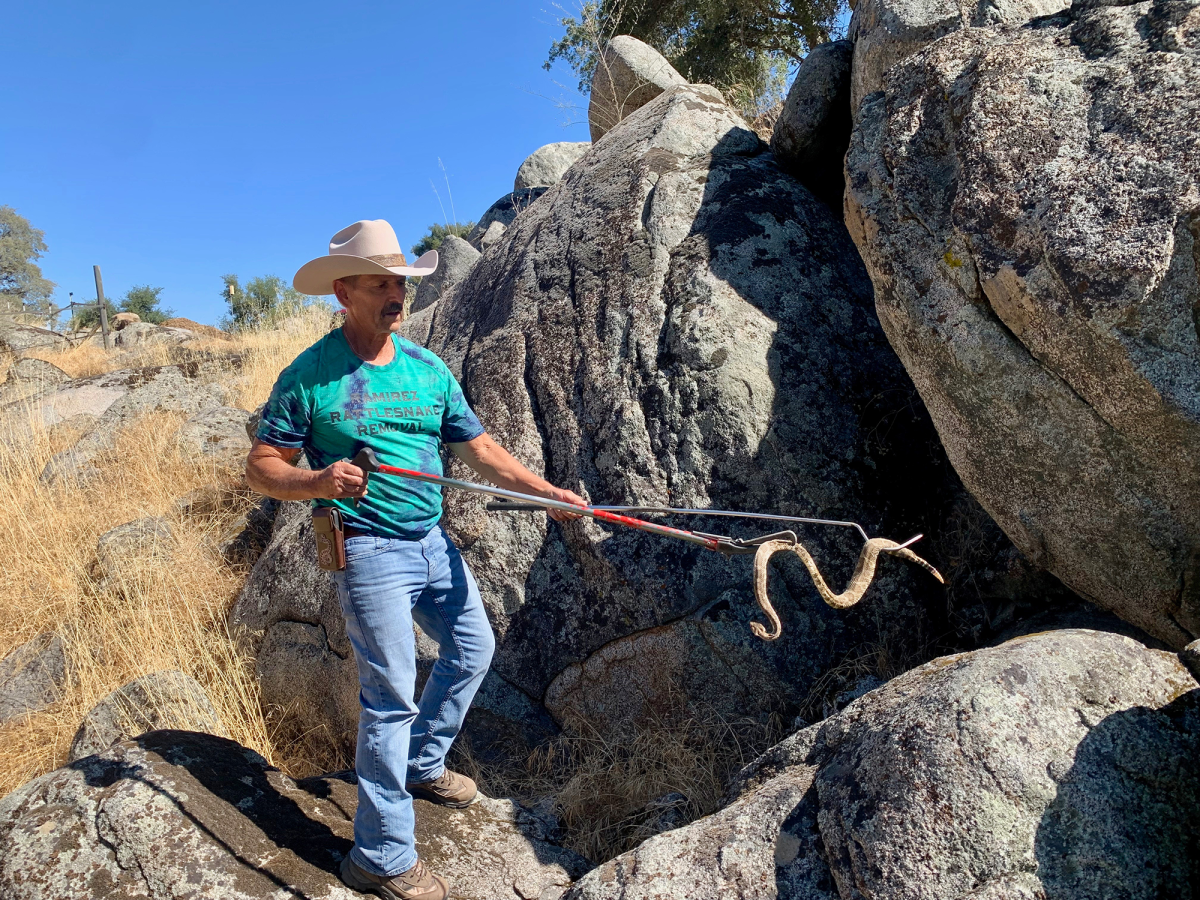
Few understand this more than Len Ramirez, who’s now leaping from boulder to boulder on a massive granite crest at the back of a Loomis horse ranch. Ramirez is a 40-year veteran of wrangling dangerous serpents. Between March and October, he spends nearly every day responding to frantic rattlesnake removal requests, from Nevada City to the Napa and Sonoma wine country.
When Ramirez isn’t answering distress signals, he’s engaged in scheduled “hunts” for clients who have him on retainer. That’s what Ramirez is doing on this August morning as he hops across elevated stone landings with the precision of a mountain goat.
“This is about being proactive and making sure the animals are safe,” he says. “I’ve got to find the snakes before the horses do.”
The peril is real. Ramirez keeps track of known rattlesnake bites each season. So far, 2026 has been a bad year in California, with three human fatalities, along with 38 dogs, two horses, four ponies and a llama, according to his tally. Given that, it’s not hard to see why the owner of these corrals on a granite-decorated hill near Folsom Lake has Ramirez here as a precaution. As he shimmies along another steep outcrop in simple work boots, the snake-wrangler notes that he’s already taken “many” rattlers off this ranch during his hunts. Maneuvering to the next set of crevices, Ramirez turns in a way that makes the sun catch his cowboy hat, illuminating its rattlesnake-skin band and small rattle pointing back like a feather.
The hat could easily give someone the wrong impression about how Ramirez views his work. His entire business has been built on removing snakes without killing them. When someone calls Ramirez, it’s because they know the rattlers will be relocated to a lonely place that’s far from people, pets and livestock.
“I like providing a service, but I also like being a voice for rattlesnakes,” he reflects. “I capture them alive and reintroduce them to an area where they can continue their existence. In this business, we promote all living things. The rattlesnakes play a valuable role in our ecology. I look at this service as an opportunity to take care of a problem without someone cutting the snake’s head off with a shovel.”
It feels like they’re everywhere
A leaping jackrabbit fires ahead of Ramirez’s boots as he approaches the next jagged, natural obelisk. He likes to remind clients that they live in rattlesnake country, and no one is immune to a run-in. Ramirez hasn’t only caught snakes at semi-rural dwellings and agricultural operations; he’s found them in skate parks, on golf courses and next to swimming pools.
Last month, he was called to deal with a rattlesnake that was discovered inside a classroom at Sierra College (the school’s Rocklin campus stands not far from where Adams took his granite portraits). But this Loomis horse ranch where Ramirez is working today presents ongoing challenges: It’s been home in the past to a large, active rattlesnake den. Ramirez suspects there’s something about the relationship these massive rocks have to sunlight, water and shade that makes them ideal for mustering rattlers.
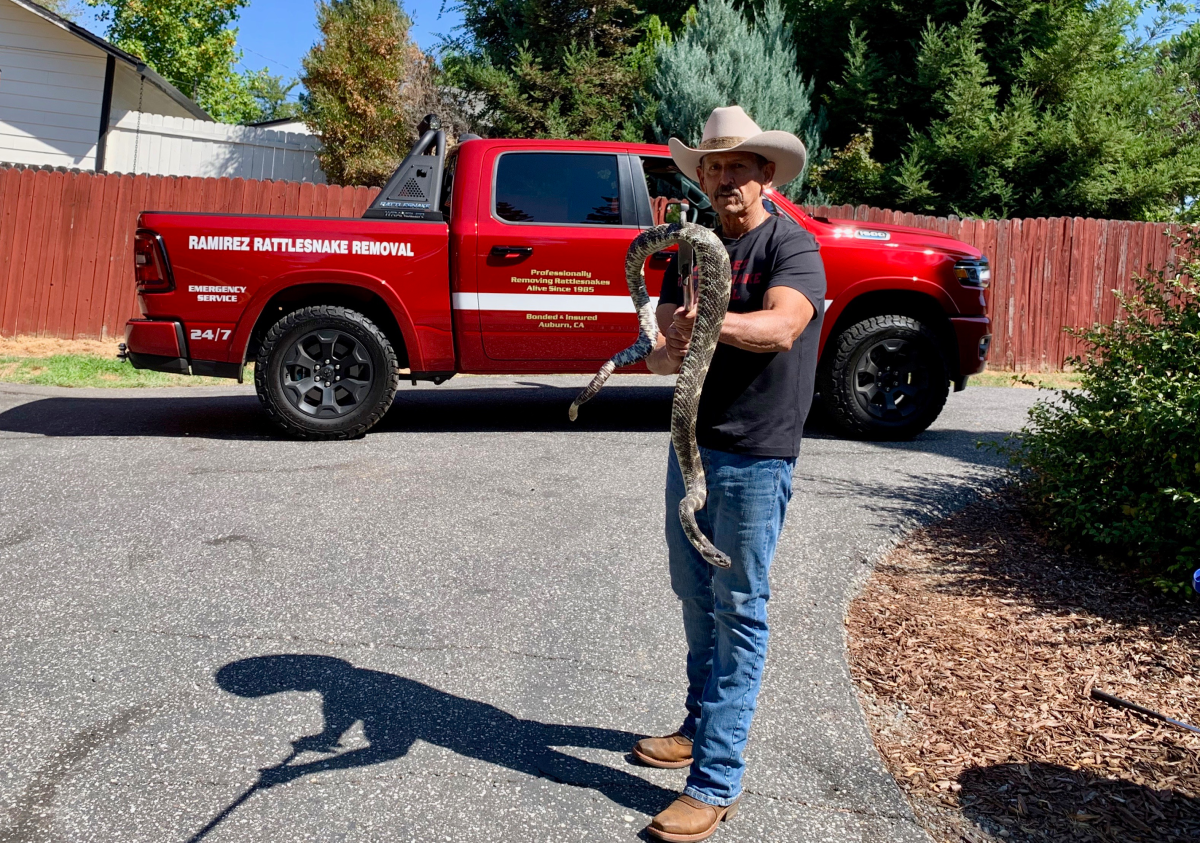
Ramirez handles a large rattlesnake he captured in Nevada County.
(Photo by Scott Thomas Anderson)
He climbs down to the grinning mouth of shadows between two boulders. Aiming a lance of sunlight into it with a small, round mirror, the wrangler mumbles, “I see one.” Then, as if calmly conducting an orchestra with both hands, he carefully works two long, metal snake rods until he’s hoisted a 3-and-a-half-foot-long rattlesnake up from the darkness.
Ramirez has done this more times than he can count, so he immediately knows that something is wrong. He studies the snake closely under the morning sky. It becomes clear that this creature has just died — probably right before Ramirez found it. There’s a huge bulge in the snake’s center, meaning it recently swallowed prey. And that’s when the light bulb comes on for Ramirez. When he first arrived at the ranch, an overseer mentioned that the property owners next door had been baiting vermin with poison. Ramirez suspects the snake swallowed a poisoned vole and then died from secondary exposure.
“It’s just not normal to find them dead like this,” he says.
The wrangler is not happy. He would have liked to have relocated the rattler to a place where it could spend its days hunting without threatening livestock.
Later that afternoon, Ramirez arrives at a house in south Auburn where the residents are confronted with a fat rattlesnake that’s very much alive. He finds it moving along the bottom of a wooden fence near a walkway. The 4-foot rattler is slithering at a swift clip when Ramirez grabs its center with a rod, lifting it into the air. This unwanted houseguest is now bound for a brief stay inside one of Ramirez’s holding aquariums before being given a new range somewhere far away from here.
The wrangler is licensed, bonded and insured for this work, with a corporation that’s in good standing with the state, but he doesn’t reveal the trade secrets involved in navigating all the various local ordinances across California that come with handling and moving snakes.
The making of a snake handler
Ramirez grew up in Cupertino. His first career was as a professional tennis competitor, squaring off with various legends in the sport, including two matches against John McEnroe when Ramirez was a teen. He was still working in professional tennis in Los Gatos when he started handling rattlesnakes in the Santa Cruz Mountains in the early 1980s.
“I’m self-taught,” he says of his reptile-mastering skills. “I’m just an explorer. I’ve absolutely been interested in snakes from an early age.”
When Ramirez launched his business for rattlesnake solutions, there were plenty of skeptics on the sidelines.
“When I first started doing this, there wasn’t a soul in this line of work,” he recalls. “Everybody would tell me ‘there’s no such thing’ and ‘no one’s ever going to pay you.’”
Those predictions were clearly off, especially after several newspapers in the South Bay Area published features about Ramirez. Over time, he built a successful corporation on the unsettling sounds of rattling in the grass. Ramirez has since been featured on shows for SPIKE TV, Animal Planet and National Geographic Explorer. He moved his business to the Sierra foothills in 1998, settling in a house with a shop on the edge of North Auburn.
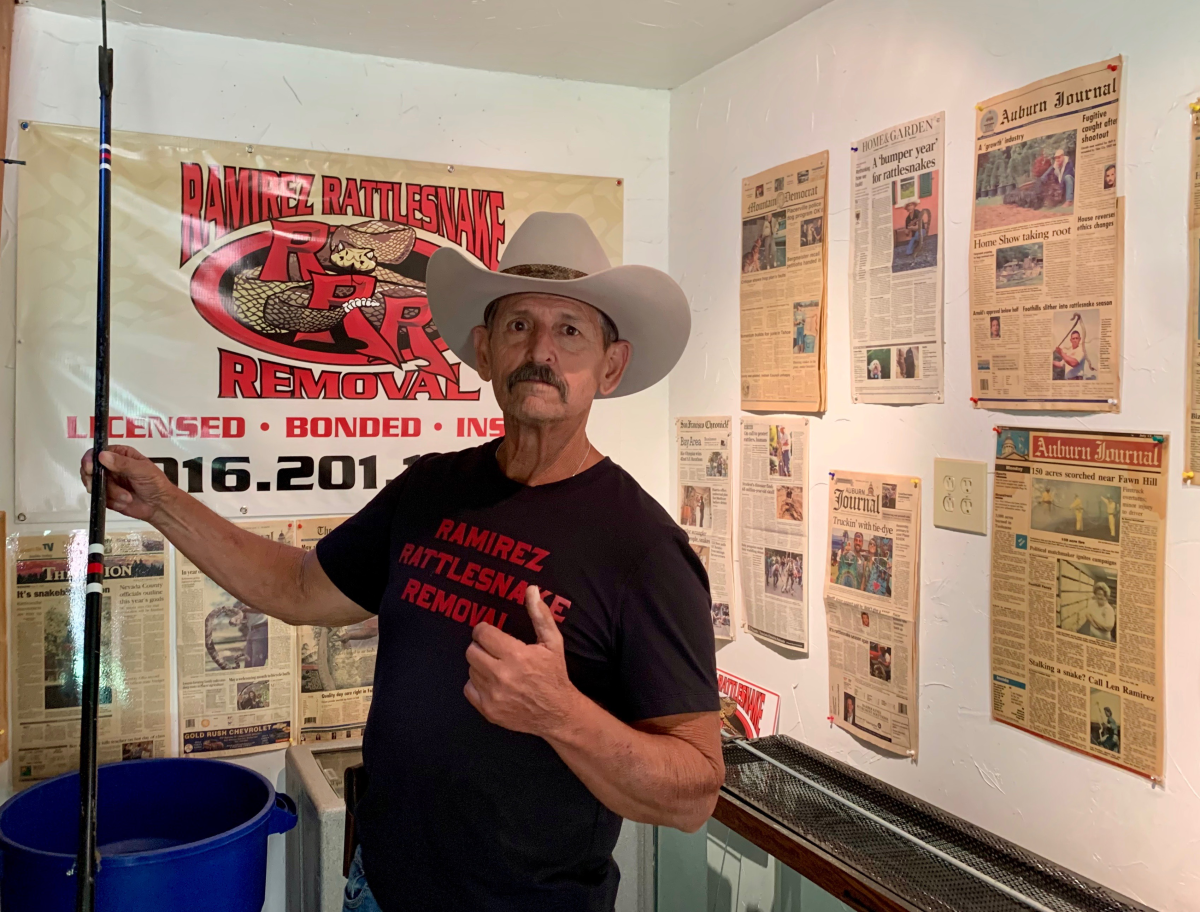
After four decades in the rattlesnake removal business, Ramirez’s
workshop is papered with newspaper and magazine articles about
him. (Photo by Scott Thomas Anderson)
The biggest rattlesnake Ramirez has captured in his career so far was a 6-foot-long western diamondback in Palm Springs. The largest active den he’s ever been confronted with had more than 340 snakes in it. It was stumbled upon during a Caltrans construction project near Red Bluff (the fate of those snakes ended up in the hands of the state of California rather than Ramirez, though the wrangler says he spent three full days helping deal with the problem).
In four decades of working in proximity to some of the most feared creatures in the Golden State, Ramirez has only been bitten once. Asked how he survived that ordeal, he smiles coyly and says, “I’m saving that one for my book.”
According to UC Davis Health, if someone is bitten by a rattlesnake, they need immediate medical attention since “severe or even life-threatening symptoms” can begin within minutes of the fangs making contact. In other cases, it can take a couple of hours for the venom to start working on the victim.
“Do not apply ice, do not use a tourniquet or constricting band, do not try to suck out the venom, and do not use any device to cut or slice the bite site,” UC Davis Health warns on its website. “Constricting blood vessels near a rattlesnake bite can lead to amputation. Wash the wound with soap and water, and remove wristwatches, rings on fingers or anything constrictive.
Keep calm and try to avoid exertion until you can be transported to a medical facility.”
The California Department of Fish and Wildlife notes that rattlesnakes typically avoid humans, though the encounters that do lead to bites often happen between April and October, especially in situations where a snake feels threatened. The department recommends avoiding contact with rattlers by staying alert outdoors, wearing sturdy boots and loose-fitting long pants in snake-prone areas, staying on well-used trails when hiking, avoiding tall grass, weeds and heavy underbrush, checking rocks, stumps or logs before sitting down, and shaking out sleeping bags and tents before using them.
“Let others know where you are going, when you plan to return, and carry a cell phone,” the CDFW advises on its website. “Hike with a companion when possible.”
All of these points are similar to the advice Ramirez gives clients.
“When we’re talking about safety, it’s a good idea to always be a scout for the kids or the grandkids,” he says. “That’s walking the property where they play.”
And if one does come across a rattler, Ramirez is usually just a phone call away.
“This doesn’t even feel like work because I love it so much,” he admits. “It’s opened so many doors and taken me so many places I would have never gone otherwise.”
–
Never miss a story: Get Comstock’s weekly newsletter delivered to your inbox.
Recommended For You
Dropped Your Phone In the American River? Don’t Worry, Not All Is Lost
Veteran treasure hunter has recovered car keys, wallets and wedding rings from the churning depths
Treasure hunter Karl Bly has had a passion for connecting people
with objects lost in and around the water for nearly half a
century.
The Sacramento ‘Weeds’ You Can Actually Eat
Local foragers say the Capital Region is filled with edible plants hiding in plain sight
With the rising cost of living, a little free nutrition can
always offer a boost, but the benefits of foraging go beyond
saving money.
Hunting Near the Farm-to-Fork Capital
Driven by a desire to eat ethically and connect with nature, more people are discovering the Capital Region’s wealth of hunting opportunities
Alongside deer, upland game like turkeys and pheasants, and invasive wild pigs, Sacramento offers some of the best wildfowl hunting anywhere in the U.S., and hunters come from across the state and country to enjoy it.
Fighting for Land
We need more housing, but we also want to protect wildland
The region has been suffering through a housing shortage for several years. But environmentalists worry about the impacts of greenfield development: It increases greenhouse gas emissions as people commute longer distances and causes the loss of habitat and open space, which gives the region its character and makes it a good place to live.