


This story is part of our January 2026 issue. To read the print version, click here.
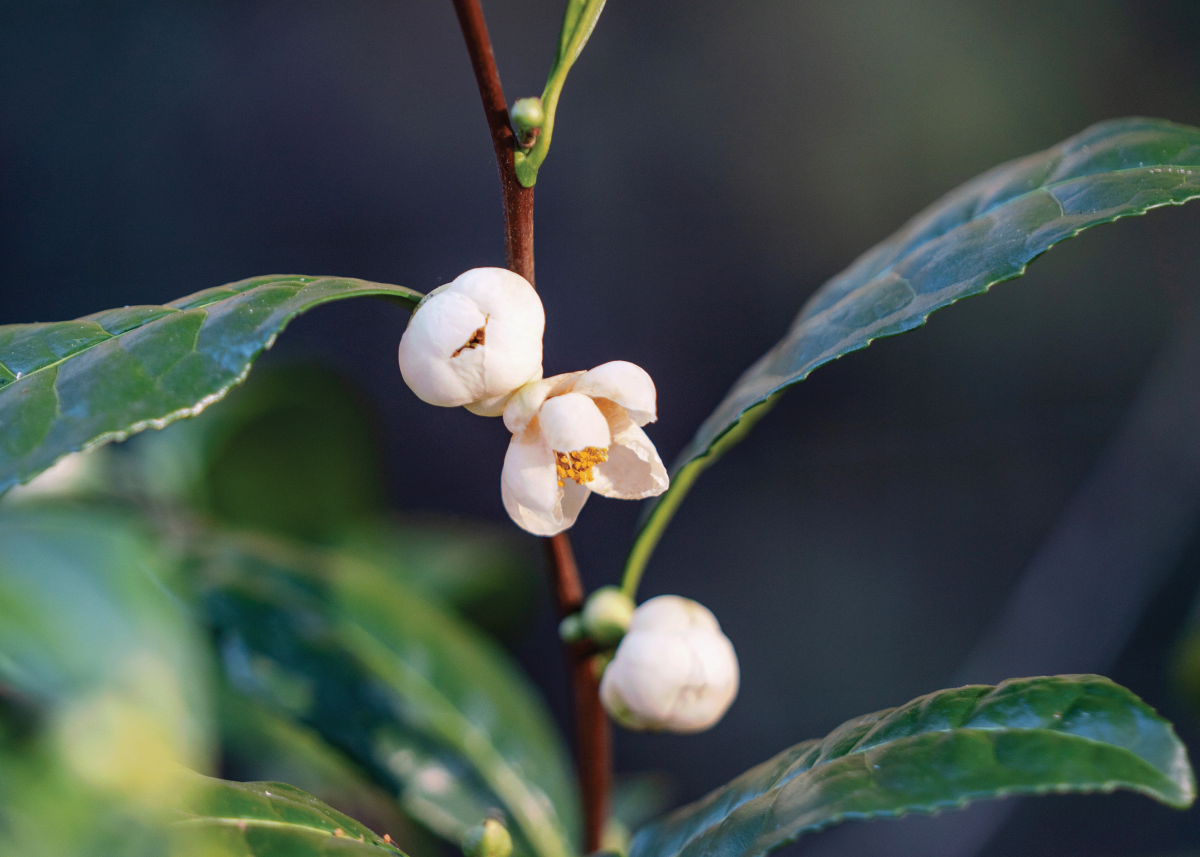
Patrick Sunbury, cofounder of Redwood Tea Estate, examines a tea plant on his farm near Stockton. From its two leaves and a bud, he can produce white, green, black or oolong tea. Even for a fifth-generation farmer like Sunbury, growing tea in California is rare and challenging due to the state’s climate, water availability and soil quality. But once mastered, Sunbury says California-grown artisanal tea is an “accessible luxury” that is healthy for consumers and beneficial for the local economy.
Tea is the world’s second most popular beverage after water, and the United States is currently the second-largest importer of tea globally, according to the trade publication World Tea News. In 2024, the U.S. imported between $550 million and $578 million of tea, according to The Observatory of Economic Complexity and the Global Trade Algorithmic Intelligence Center. Though California-grown tea is currently a small industry, it may be poised to take on some of that demand.
Redwood Tea Estate
Sunbury, previously a landscape architect, started his tea farm in 2020. After developing trigeminal neuralgia in the ophthalmic branch, a rare condition that causes shock-like pain in the eye, scalp and forehead, he found it difficult to stare at a computer for long periods. Around the same time, his grandmother passed away, leaving his father her home, which had a half-acre of “empty dirt.” “You have a half-acre of dirt, you can leverage it to try to support yourself,” Sunbury recalls his father, Eric Sunbury, telling him. He moved from Laguna Beach to explore what he could do with the land.
Camellia sinensis, the plant behind all varieties of true tea,
has over a century of history of cultivation in California.
(Photo by Kial James)
That’s when his father read an article in UC Davis Magazine on the Kearney Station Tea Project in Parlier, a research project that tea giant Lipton funded at UC Agricultural and Natural Resources’ Kearney Agricultural Research Extension Center beginning in 1967. Twenty-one varieties of tea are now growing at the station, according to Jacquelyn Gervay Hague, professor emerita at UC Davis’ chemistry department. The article gave the Sunburys the idea to grow California tea on their own land.
They soon realized that they would need to stand out in a market dominated by imported tea. “American teas are typically more expensive than imported ones,” Sunbury says, due to “issues like exchange rates to controversial ones like labor laws, environmental practices and economies of scale.” In addition to competing with cheaper imports, he says domestic tea farmers depend on equipment and packaging sourced from abroad, which are now subject to tariffs. Meanwhile, tariffs on tea and over 200 other agricultural products were halted in November 2025, which means domestic tea producers do not benefit from the increased prices on other imported goods.
Related: Is Tea the New Happy Hour?
However, many tea drinkers’ preferences have shifted toward high-quality, locally sourced, sustainably produced products, says Sudbury. “If we try to make premium tea, really high quality, beautiful tea, then we are relatively competitive.” He now sells premium tea under brand names such as Malibu White Tea, Yosemite Green Tea and Big Sur Black Tea.
In addition to his “mother lot” near Stockton, Sunbury planted tea plants in Lodi last year and is experimenting to see what works for the tea plants at each site. “We go through a lot of pain and struggle to grow tea in California, but it has a remarkable terroir that you really can’t find anywhere else,” he says, using a wine term to describe the impact of the natural environment on flavor.
Golden Feather Tea
Before the 2018 Camp Fire in Butte County, Michael Fritts, CEO, co-owner and producer of Golden Feather Tea in Concow had 800 tea plants. Concow, along with the nearby communities of Paradise, Magalia and Butte Creek County, were nearly destroyed by the fire. Fritts lost his house and the tea barn where he served tea to people all over the world. He has since rebuilt and replanted and has about 200 plants. A visit to his farm and a tea tasting costs $25, but he waives the fee if the visitor purchases tea.
A portrait of John Henry Schnell in samurai attire, circa 1865.
(Public domain photo from El Dorado Arts Council via Wikimedia
Commons)
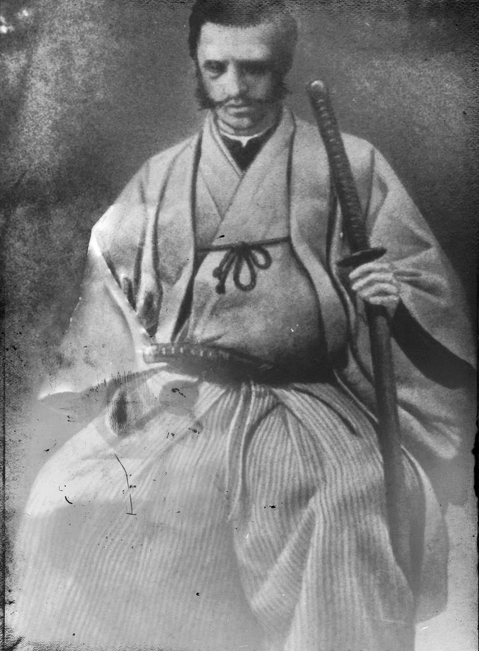
Fritts says he bought 780 tea plants from Nuccio’s Nurseries in Altadena that Julius Nuccio, the nursery’s late co-founder, claimed were descendants of Schnell’s plants. He says he had a letter from Nuccio confirming these origins, but the letter, along with documentation he planned to use to write a book about Wakamatsu, were destroyed during the Camp Fire. Later, the remaining plants at Nuccio’s Nurseries burned during the 2025 Eaton Fire. Fritts therefore claims that he is one of the last farmers growing plants descended from Wakamatsu.
Fritts has served as a consultant for UC Davis’ Global Tea Institute and worked with Hague of the chemistry department, who had her students test sample Fritts’ tea leaves and found they were high in amino acids, EGCG (a powerful antioxidant), polyphenols and other beneficial compounds. Fritts says the students also performed a DNA analysis of the tea plants but didn’t find a match with any plant in the world. “It’s a California cultivar now,” Fritts says. “They’ve been growing here for over 150 years.”
This year, Fritts harvested 8 pounds of tea. He still hand-processes and sun-dries his single-origin loose-leaf oolong tea, selling an ounce for $100 or a pound for $1,000. His clients include Michelin-star restaurants in the North Bay area, and he plans to also sell his tea blossoms to restaurants. “I want to show its rarity and uniqueness,” he says.
Jade Mountain Tea
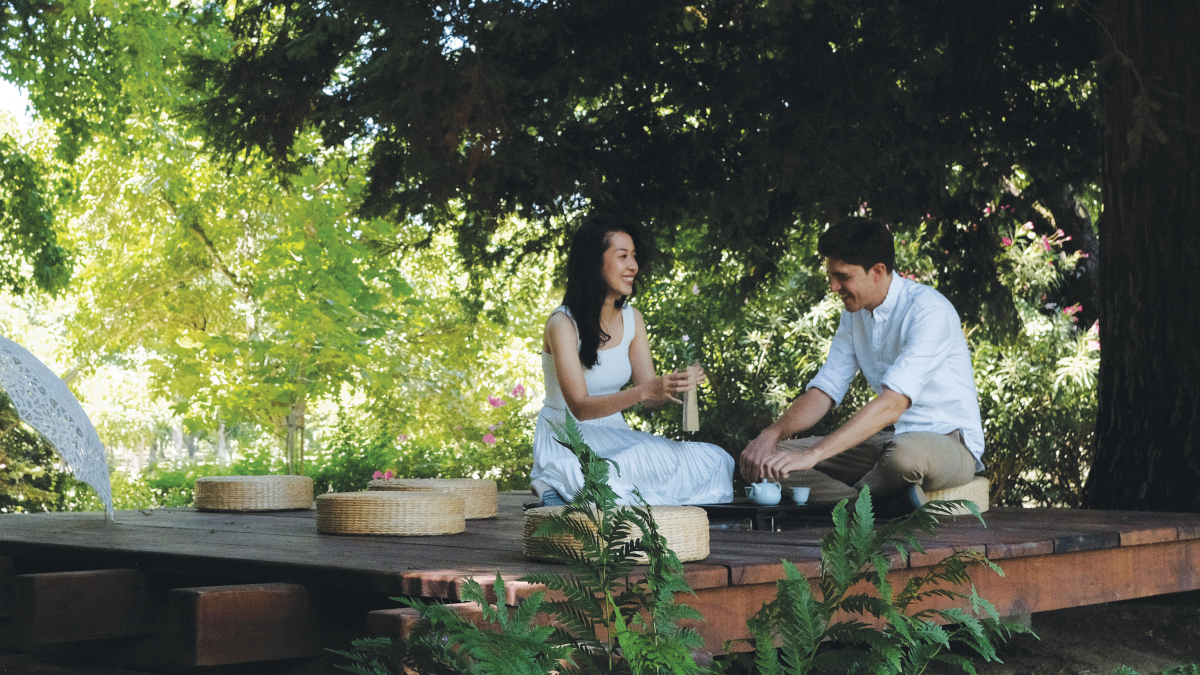
Near Nevada City, nestled in a nature-immersed sanctuary adorned with lush greenery and Asian-inspired aesthetics is Jade Valley, the private estate of Jade Mountain Tea CEO and founder M.J. Greenmountain. The estate boasts a thriving tea “test farm” that Greenmountain has successfully acclimated to the Sierra Nevada climate over the last eight years.
M.J. Greenmountain pours tea at Jade Valley, his estate and farm
near Nevada City. (Photo by Kial James)
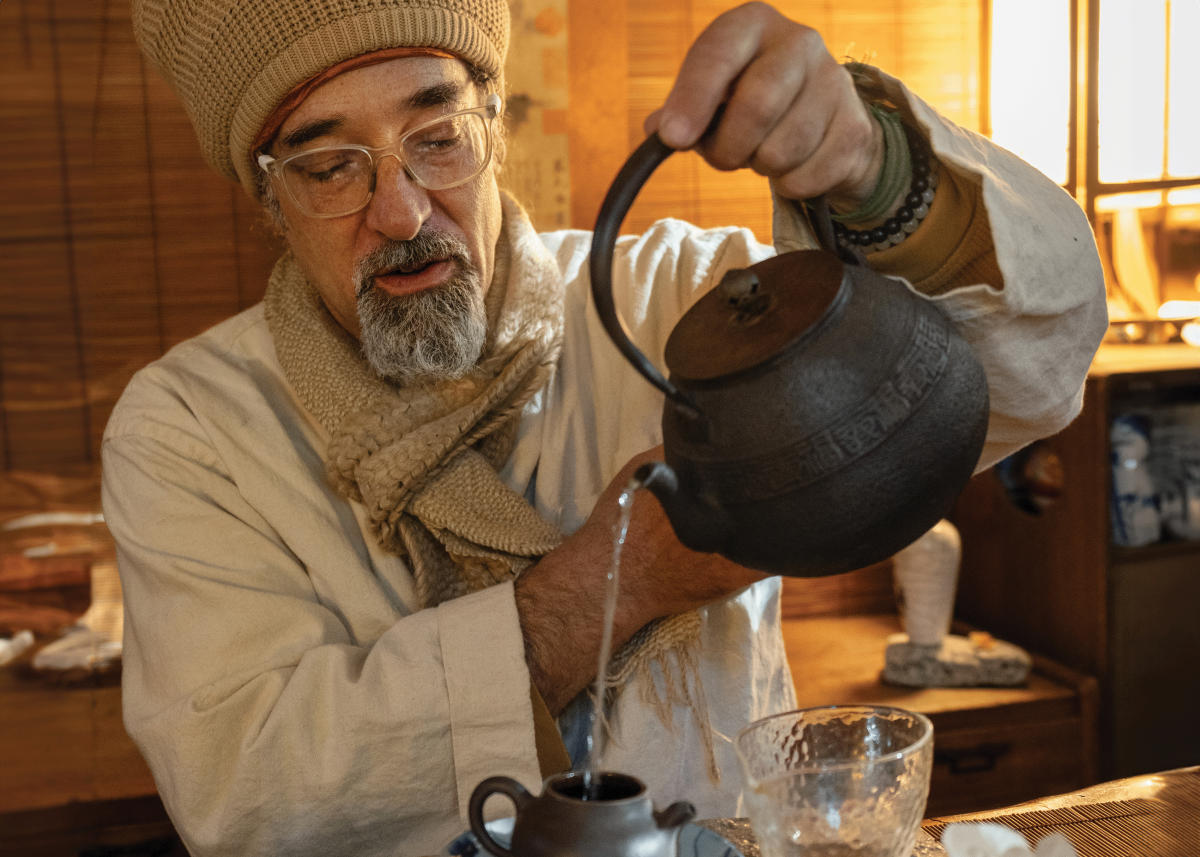
Greenmountain, who has been a Zen and tea teacher for 15 years, says the soil, wind, bees, bamboo and trees, including oak, pine, cedar and Japanese maples, work symbiotically to help the tea plants flourish. He was inspired to grow tea by a winter visit to a tea garden outside Kyoto, Japan, where he observed foliage and landscape similar to that of the Sierra Nevada. Although he’s not yet ready to propagate tea as a cash crop, he hosts a special, invite-only tea tasting each year when the leaves are ripe for picking.
Greenmountain has been practicing Zen and Chadou, a Japanese method of tea preparation influenced by Zen Buddhism, for 27 years. Zen, for him, is a practice, not a religion. He says it has helped improve the quality of his life, incorporated with daily meditation, tea ceremony, poetry writing and singing.
Related: The Chinese Art of Tea Takes Hold in the Sacramento Region
Greenmountain’s goal is to develop a lifestyle brand, and he needs the right investors to bring his vision to fruition. “With the right people involved, partnering with us, there’s no limit to what we can do,” he says. Greenmountain says he will be able to create jobs, processing facilities, distribution channels and sustainable practices, resulting in a new system of self-sustainability where products are manufactured locally.
The economics of tea are complex. Sunbury says the “silver lining” of tariff discussions is education. “It encourages tea drinkers to consider where their tea comes from,” Sunbury says. “It prompts questions like: Are there fair labor practices? Is this tea free of pesticides? How fresh is it? This mindset helps people choose teas that align with their values, supporting products that are good for the planet and local communities, which is exactly what we strive to present at Redwood Tea Estate.”
–
Stay up to date on business in the Capital Region: Subscribe to the Comstock’s newsletter today.
Recommended For You
Is Tea the New Happy Hour?
These Capital Region tea rooms bring a California twist to an English tradition
Afternoon tea evokes something people have always sought — “a feeling of rarely experienced elegance and class,” Mueller says.
The Chinese Art of Tea Takes Hold in the Sacramento Region
Practitioners say gongfu cha encourages mindfulness and presence
Gongfu cha, which means making tea with effort in Chinese, is a method of preparing and appreciating high-quality tea in small amounts, through repeated pours. Many are turning to the art form as another way to find balance and harmony.
Tea Time
Consumer education is key for Capital Region tea shops
When Leo Hickman returned in 2003 from an eight-month tour in Kuwait as a combat engineer in the U.S. Air Force, he wanted a way to spread peace. With no idea how, he set out on a journey of self-discovery and backpacked through 27 countries.

From Farm to Glass
They’re just miles apart, but Capital Region wine regions are distinctively different based on their climate, terrain and soil
Each of our four wine regions has its own unique terroir, a French term describing the soil, climate and sunshine that give wines their distinct character. These winemakers want consumers to consider their wines farm-to-fork — that is, farm-to-glass.