


This story is part of our April 2026 issue. To read the print version, click here.
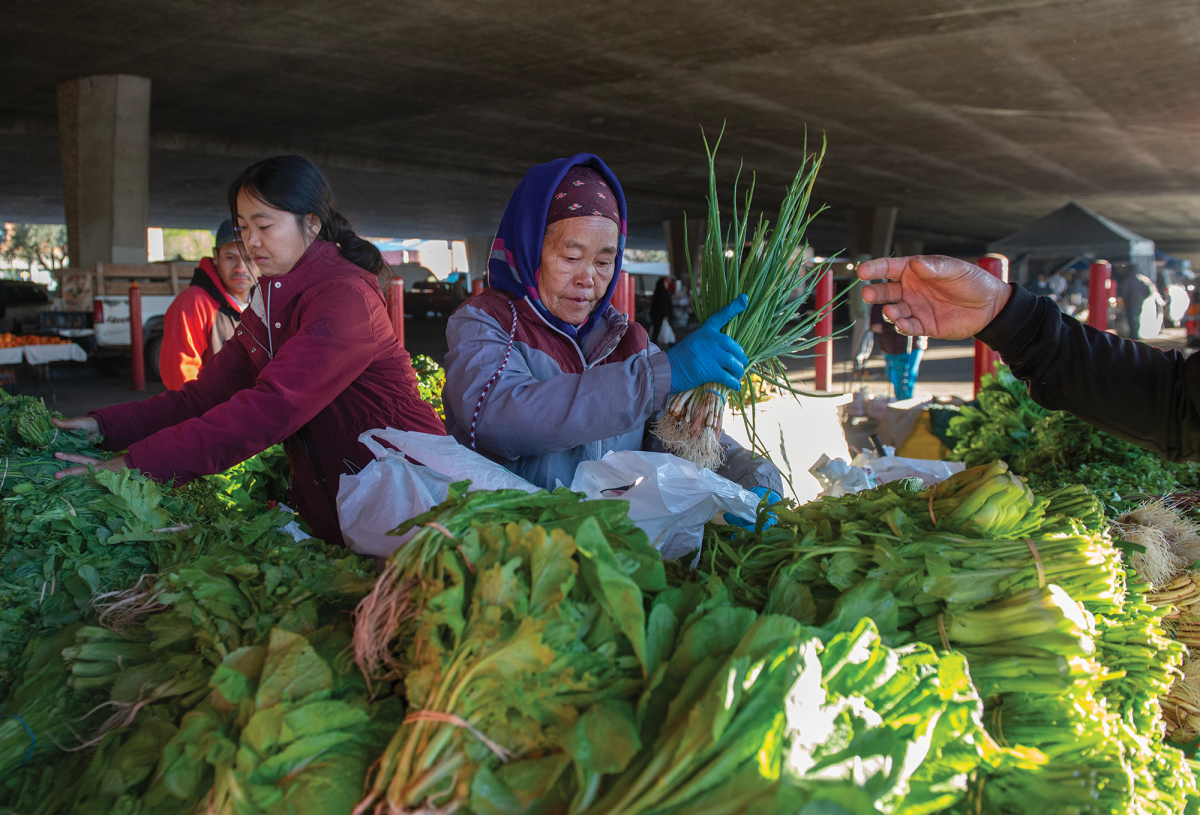
At Stockton’s Saturday Golden Villa Farmers’ Market, Hmong farmers sell bountiful stacks of mustard greens in various stages of growth, flame-orange winter squash, lime-green bitter melons, and large bunches of cilantro and moringa. Though most of the species originate in Asia, they are grown just miles away from the market, many in small plots that Hmong families run around Stockton.
Hmong farmers also display their homegrown vegetables on Saturdays, Sundays and, occasionally, throughout the week at Angel Cruz Park. Food vendors sell Hmong and Lao sausage, Khmer stuffed chicken wings, sticky rice, skewers of grilled beef and chicken, and beef tripe laab. On busy weekends in this neighborhood park, one can smell grilled meats and fried sweet rice treats, hear children playing and adults talking about their week, and dance to DJ music broadcast on large speakers.
These farmers are part of Stockton’s large Hmong community — about 6,000 people, according to the research firm Neilsberg. Add in the communities in and around Sacramento and Fresno, and the Central Valley is home to close to 60,000 Hmong. Some members of this community say that Hmong food, now served primarily in homes and at markets, is poised to gain broader attention in the food scene.
A Central Valley refuge
The Hmong, originally from northern and central China, were forced into the mountainous areas of Laos, Vietnam, Myanmar and Thailand in the mid-19th century due to persecution from the Imperial Chinese. When communism threatened Laos, from 1961 to 1975, many Hmong sided with and fought alongside the U.S. in what became known as the “Secret War.” As a result, Hmong villagers faced death and destruction at the hands of the communist Lao People’s Liberation Army, and between 30,000 and 40,000 Hmong soldiers were killed.
The Hmong were granted refugee status under the Indochina Migration and Refugee Assistance Act in 1975 and allowed to immigrate to the U.S. While dispersed around the United States upon immigrating, many refugees later moved to join friends and family in the Central Valley, where there were opportunities in agricultural work and a warm climate. Since the Hmong were subsistence farmers in the mountains of Laos, they easily took to farming in the fertile land near Stockton.
Related: Strawberry Fields Forever? California’s Iu Mien strawberry farms face a succession crisis
Despite the large Hmong population in Stockton and Sacramento, neither city has a restaurant dedicated to Hmong cuisine.
Xee Moua, a young woman in her late 20s, helps her family run a stand at Angel Cruz Park. Moua describes Hmong food as “mostly plain and simple food. Each dish usually has just two ingredients. For example, we have ground pork and mustard greens, and that is all that is in the dish. We don’t add MSG; we just use salt. Our food is clear, simple. We are people from the mountains, and just had what we grew to work with.”
Xee Moua of Moua Farm helps a customer with a bundle of mint
during the Saturday Golden Villa Farmers Market in Stockton.
(Photo by Bea Ahbeck)
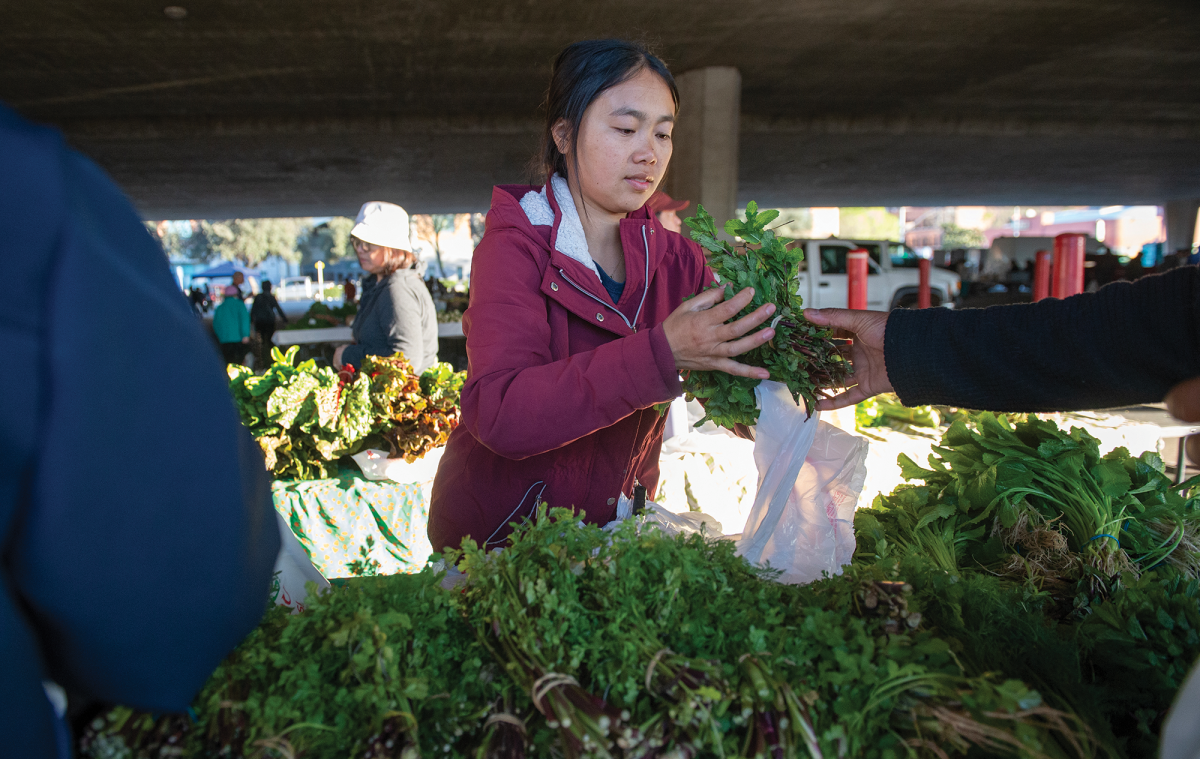
Moua’s family’s stand floods with verdant cabbages, ivory daikon radishes just plucked from the earth and large, hearty bunches of cilantro. The family came to the States 50 years ago from Laos. They have a garden plot in North Stockton, close to Lodi. Moua says her uncle and aunt are “so hard working. They get up early and work late, lift heavy things, and they are old — they’re amazing.”
Beyond the farmers markets, one can find Hmong delicacies at local Asian markets. AJ Market off Hammer Lane in Stockton has some Hmong items such as Hmong sausage, the base ingredients for several dishes that the Hmong cook such as laab, papaya salad, khao piak sen noodle soup, and a red curry chicken noodle soup the Hmong refer to as khaub poob.
Related: Neighborhood Favorite: South Area Market
Thamkrabok Market off West Lane offers prepared Hmong, Thai and Lao dishes. Thamkrabok opened about 30 years ago and has been owned and managed by Chou Her for 12 years. Thamkrabok’s freshly prepared green papaya salad offers tangy depth of flavor, spicy mouth flare and delightful crunch. The market has classics like chicken laab (also spelled laap), grilled sausage with rice, BBQ chicken and beef, shrimp spring rolls and soup kits ready to take home and heat up. Thamkrabok boasts a plethora of sweet rice, as well as glutinous and jasmine rice in bulk sizes.
In addition to Hmong and Lao sausage, Thamkrabok offers almost every kind of Asian food condiment one could desire, from papaya salad dressing to mudfish sauce to yanang leaf extract. The store cultivates local culinary talent by featuring Stockton-made hot sauces and chili dips, one standout being the Smack! brand jeow bong chili dip.
At Thamkrabok, one can find the basic ingredients for Hmong dishes like laab and kabyaub. Laab is composed of ground meat like pork, chicken or beef, toasted rice ground into a powder, onion and aromatic herbs like mint, Vietnamese coriander and Thai basil. Kabyaub is a Hmong egg roll made from glass noodles, vegetables, ground meat and Thai bird’s eye chili peppers.
A home-cooked cuisine
Why is there no restaurant in Stockton focused on Hmong food? Local chef and food writer Yia Vang says that “Hmong people don’t see our cuisine as something that others would want to glorify because of the simplicity of it. Stockton has a huge Hmong population, but there’s no strict Hmong restaurant, and when our food is offered it is usually fused with Thai and Lao cuisine.”
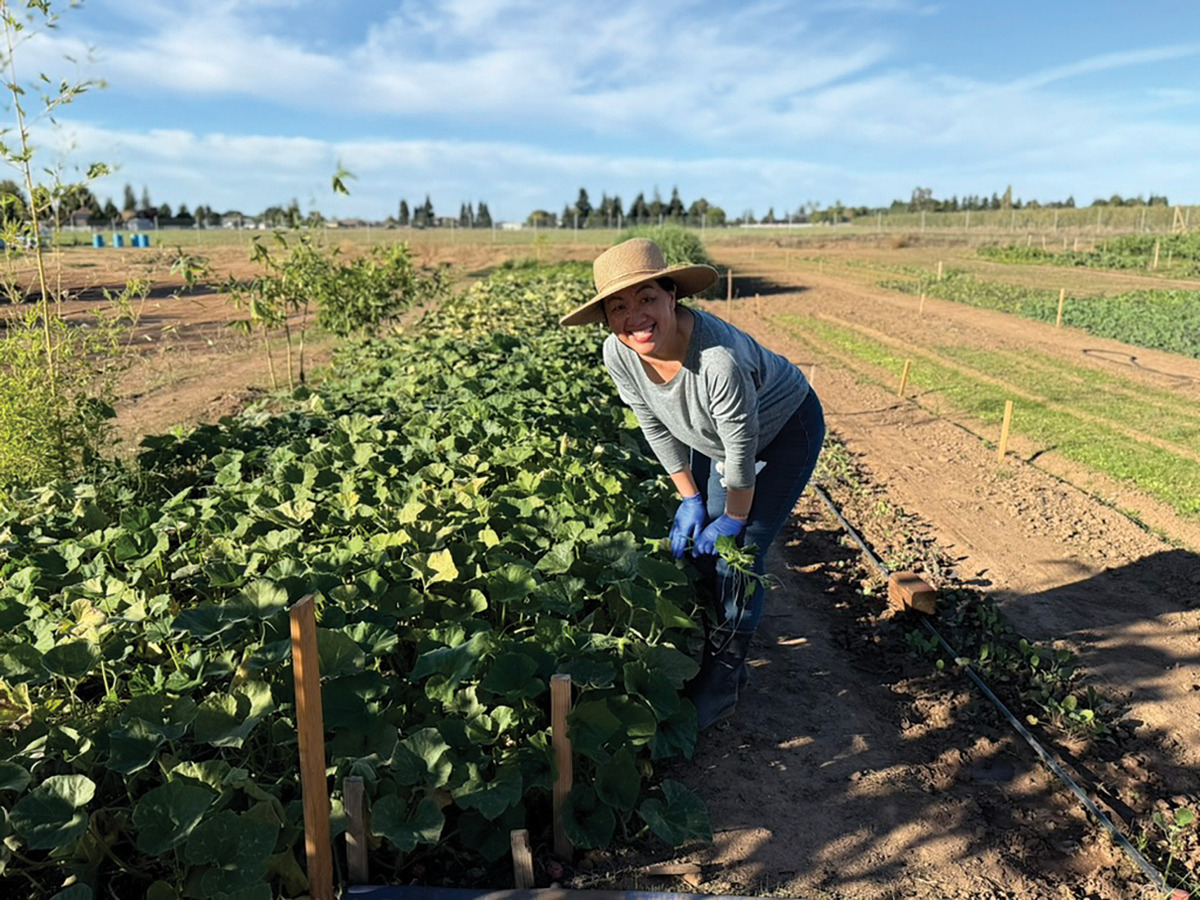
Author Yia Vang poses at her sister’s farm in Lodi, where she
grows vegetables alongside other Hmong farmers. (Photo courtesy
of Yia Vang)
Vang mentions that the restaurant Lao, Der! in Stockton stands out in its representation of kao poon and khao piak sen noodle soups as well as several varieties of laab, including duck, chicken, pork, beef, fish and shrimp.
Green Papaya, a less formal, quick-service spot off Pacific Avenue, offers kao poon as well as beef and pork belly laab and a refreshing, tangy green papaya salad.
Related: For Food Trucks, a Road to Success
Vang offers a window into Hmong home cooking in her memoir, “In Yer’s Kitchen.” She describes the Stockton kitchen where she grew up, filled with the aromas of fragrant squash shoot soup and chicken broth with healing herbs made from produce grown in her mom’s garden.
In her memoir, Vang investigates her relationship with her mother, her parents’ past as refugees, and her Hmong culture by describing dishes that her mom taught her in their Stockton home. Interspersed within the narrative are luscious descriptions of Hmong dishes such as sticky rice cakes, fermented sweet rice, mung bean sesame balls, pork boil with mustard greens and minced smoked beef.
Hmong food is defined by fresh, simple ingredients without too many conflicting flavors in the form of sauces. The diet mostly consists of vegetables, rice and occasional meat. This attention to fresh, unadulterated ingredients arose from the mountainous and remote terrain the Hmong lived in.
“In the mountains of Laos, there was no such thing as canning or refrigeration,” Vang says. “We would have these large pantries where all of the squash, peppers and corn would be stored, and we would use them until they were done.”
The Hmong grew and processed most of the food that they cooked with and ate. While the group has made changes to their diets upon immigrating, Hmong people are well-known for their talents in raising vegetables and fruits.
Vang’s mom, Yer, would grow all of the vegetables, herbs and fruits she could for her family. Even when moving from apartment to apartment in south Stockton, Yer would have large garden pots filled with lemongrass, peppers and mustard greens.
According to Vang, “a lot of Hmong people in the San Joaquin Central Valley are farmers, and so when you go to a farmers’ market, you’re always guaranteed to find at least one Hmong vendor.”
The Stockton Hmong maintain close ties with their community. “There’s a sharing of knowledge, a passing down of recipes from women to women. If they eat something amazing and learn how to do it, they’ll teach each other how to make it,” Vang says. “It’s a very strong-knit community in that you share what you have — you don’t hoard it for yourself.”
–
Stay up to date on business in the Capital Region: Subscribe to the Comstock’s newsletter today.
Recommended For You
How Dubai Chocolate Found Its Way to Sacramento
A global TikTok trend brings long lines and repeat customers to local businesses
Dubai chocolate, filled with pistachio and kataifi, is made for our image-obsessed social media culture. To understand how the trend is playing out locally, Comstock’s visited bakeries and cafes across the region and spoke with the people behind the counters.
Strawberry Fields Forever?
California’s Iu Mien strawberry farms face a succession crisis
Dust kicks up in a cloud and the sound of gravel crunches as cars and trucks pull into what’s become a summer staple in the Capital Region — fresh strawberry roadside stands. The ramshackle wooden stands, with bright red hand-painted strawberry signs and makeshift awnings to shield workers from extreme summer heat, are typically open seven days a week in peak season.
Family Farmers
Family business close-up: Otow Orchard extends its family farm in Granite Bay to the community
The Granite Bay farm was established in 1911 by a Japanese
immigrant and is still run by his descendants, including his
104-year-old daughter.
A New Year for a Changing Community
Iu Mien American leaders and entrepreneurs celebrate Lunar New Year
The Capital Region is home to the country’s densest concentration of Iu Mien people, part of a Southeast Asian nomadic tribe with roots in Southern China. Immigrant and American-born members of the community come together to celebrate the holiday and support each other.