


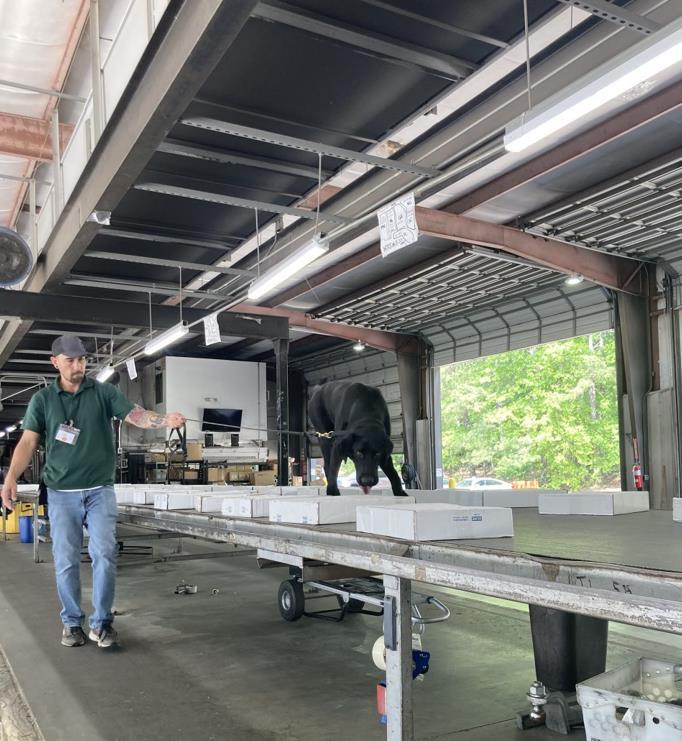
On a weekday shift at a parcel hub in San Joaquin County, a black Lab mix named Waylon works his way along a conveyor belt, sniffing the boxes as they pass. When he catches a scent he has been trained to flag, he paws at the package, and his handler, Erik Baxter, pulls it off the line to open it.
The USDA trained Waylon as an agricultural detector dog after he was abandoned twice, and he now sniffs out fruit and plant material shipped without the permits meant to keep invasive pests out of California. Those pests can ruin crops, a significant hazard in a county where the farm economy was worth about $3.4 billion in 2025, according to its latest crop report.
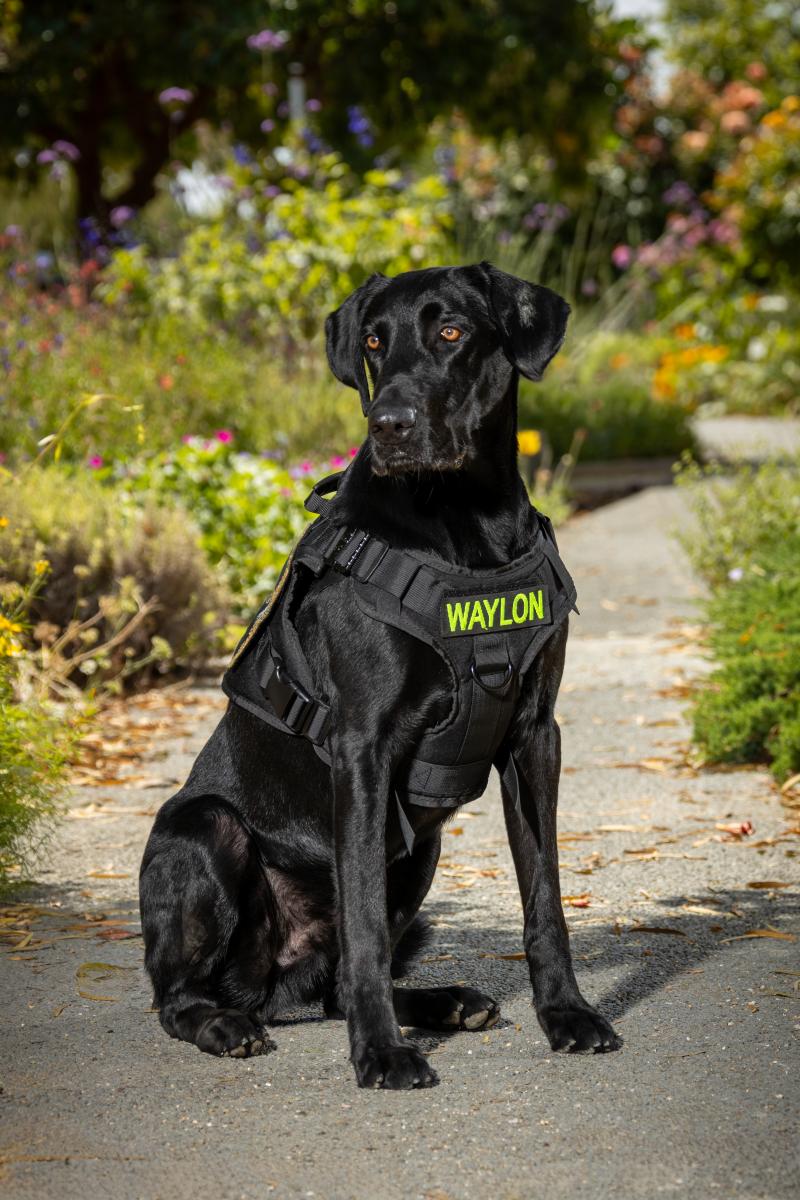
Waylon, a black Labrador mix, is San Joaquin County’s only
agricultural detector dog, trained to sniff out fruit and plant
material shipped without the permits meant to keep invasive pests
out of California. (Photo courtesy of Kamal Bagri)
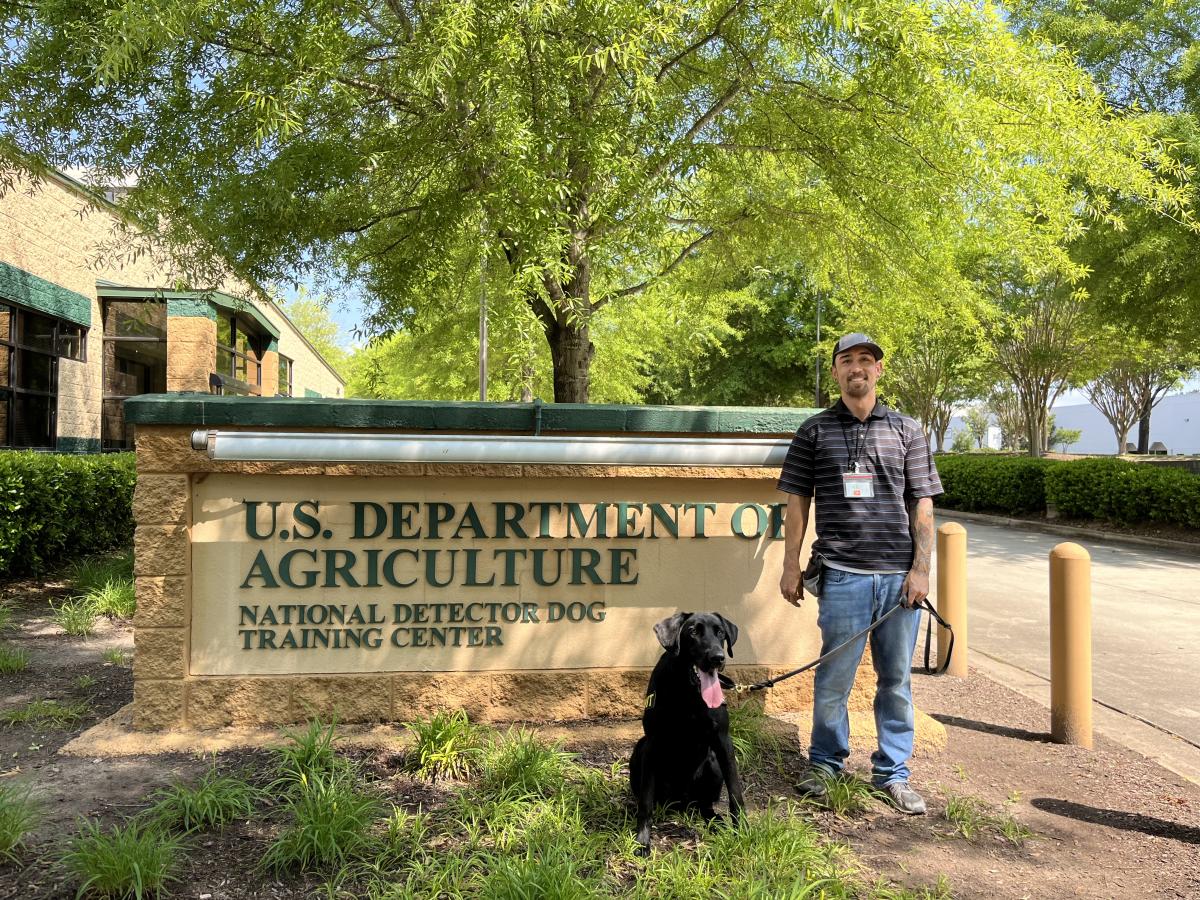
Waylon is the only detector dog in San Joaquin County, and that scarcity is the problem the county is trying to solve. A detector dog and its handler work as a fixed pair, and the USDA trains every one of these teams at a single site, the National Detector Dog Training Center in Newnan, Georgia. Baxter made that trip to train with Waylon.
A county that needs a new detector dog has to send its handler across the country and wait for an opening. Kamal Bagri, the county’s agricultural commisioner, says that wait can take as long as a year and a half. If a county misses the USDA’s April deadline for the year, Bagri says, the request moves to a next fiscal year.
To end that dependence, county officials want the USDA to build a second training center in San Joaquin County. The push began in 2025, when U.S. Representative Josh Harder’s office took up the cause and pressed the USDA to consider a West Coast site. That pressure, written into the House’s 2027 agriculture spending bill, is expected to produce a USDA feasibility study in November. Bagri, meanwhile, says the county is “ahead of the game,” having “already identified a piece of land close to the Stockton Airport.”
Opening a center would also require new authority from Congress. The 2023 Beagle Brigade Act wrote the national detector-dog program into law but didn’t provide for additional training sites. A provision in the House farm bill would amend that act to let the USDA secretary establish new centers and off-site training programs.
Bagri’s argument for putting that facility in San Joaquin County rests on location and cost. California handles heavy international cargo and passenger traffic through its ports and airports, where many invasive pests arrive. In addition, property in the county costs far less than a comparable parcel in Los Angeles or the Bay Area. “The biggest, biggest thing is we have major international entry pathways here,” she says.
Waylon works a line of parcels, pawing at any package carrying a
scent he has been trained to flag. (Photo courtesy of Kamal
Bagri)
The Newnan center in Georgia sits on 17 acres and can house up to 100 dogs. The USDA pays more than $3 million a year to run its training there, Bagri says, while the county property near the airport would cost a small fraction of that to lease. It also meets the minimum acreage that USDA and state officials have discussed for a working center.
A center built to pay for itself
Operating a training center costs millions a year. Bagri wants the San Joaquin County center to train police and Border Patrol dogs alongside the USDA’s so that the fees those agencies pay help cover the running cost. “It is not going to be only for agriculture detection dogs, but also facilities which can service and help out our law enforcement partners,” she says. The county sheriff has backed the plan, and the Western Growers association has shown interest in helping fund it.
Bagri is also firm that a new center cannot be built with the farm-bill money that already keeps dog teams in the field. That funding has to stay in place, and a center would need its own funding on top of it. “It has to be extra dollar figures,” she says. He is just as plain that nothing is decided. “It’s not like USDA has told me or anybody that yes, we are bringing it to California,” she says. “That’s not the truth.”
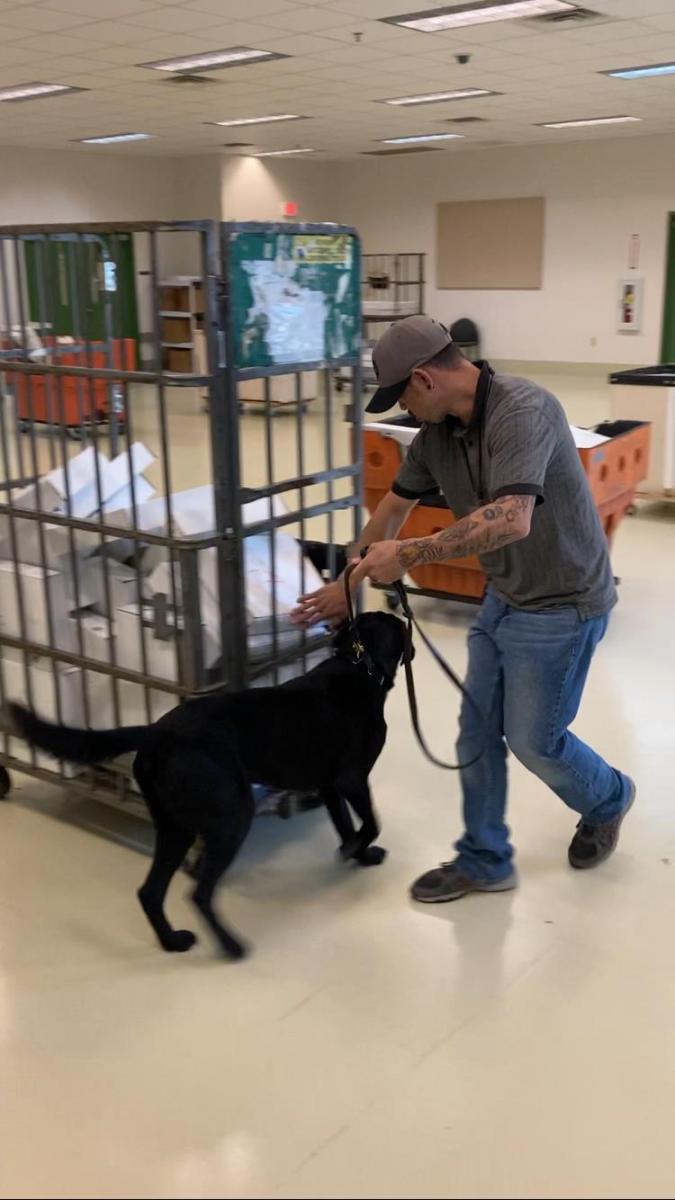
Baxter guides Waylon over a cart of packages. When the dog
detects a trained scent, he alerts and the parcel is pulled for
inspection. (Photo courtesy of Kamal Bagri)
Additionally, Bagri argues the state already needs more detector dogs than it can train and that pressure is set to rise. In fact, by his count, California wants 30 county detector-dog teams but has only 18 across 11 counties today.
Then, pressure-wise, a slew of upcoming events could create problems these dogs could address. For instance, the 2028 Los Angeles Olympics will draw a surge of international travelers who can carry pests in. Yet the money to answer those threats is shrinking, he warns, with the state putting $3 million a year into its high-risk pest program against the $5.5 million it is supposed to put in.
For now, the work still depends on dogs like Waylon, who went operational in 2024 and can serve for about ten years. However, when he and others like him retire, the county cannot just reassign the role, because each dog and handler pair forms in training and holds. “Dogs pick the trainers. Trainers don’t pick dogs,” Bagri says. A replacement means starting that pairing over, and today that still happens in Georgia.
Whether the next one starts closer to home is what the county’s bid will settle. “I am very confident that we will be able to keep pests out,” Bagri says, as long as the money holds.
–
Never miss a story: Get Comstock’s weekly newsletter delivered to your inbox.
Recommended For You
New Arts Council on Horizon for San Joaquin County
Organizers aim to unite the creative sector, provide equitable access countywide
San Joaquin County — with its rich cultural and historical heritage in both rural communities and city centers — may soon have a unified creative and cultural front. For the first time since 2001, the county will again have an arts council.
Can a $597 Million Water Project Refill the Aquifer Beneath Sacramento County’s Farms?
Harvest Water aims to bring recycled water to local farms while easing pressure on groundwater
A nearly $597 million public project promises to help the
Sacramento Valley’s struggling aquifers to recover.
Can Technology and Innovation Keep California’s Family Farms Alive?
From robots to drones, the Sacramento region is a hub for ag innovation
Technology and innovation offer rare solutions for family farms in tough economic times and fuel Sacramento’s status as “America’s Farm-to-Fork Capital.”
Can the Next Generation Afford to Farm in California?
California has the biggest farming economy in the country, but small farmers still struggle and often leave the business
In a state known for its huge farming economy, small farms earn just a sliver of the revenue, and many struggle to stay in business.