


This story is part of our September 2026 issue. To read the print version, click here.
The lore of the small family farm runs deep in American culture, with Thomas Jefferson making it an organizing principle for the then-young country. But the reality has long been that large-scale agribusinesses dominate the industry, including in California.
Small farms — those with annual gross income under $350,000 — accounted for 74 percent of farms in California in 2022, the last year data are available, according to the U.S. Department of Agriculture. The state lost almost 9,000 small farms between 2017 and 2022, going from 55,605 to 46,804, a 16 percent drop in just five years. While small farm statistics are not available at the county level, similar statistics show the same trends in the Sacramento Valley, and experts say the dynamics causing the decline are happening across the state.
Industry leaders and experts point to a variety of reasons for the decline of small farms in California, including water shortages, labor challenges and real estate costs. Small farms often don’t have the capital needed to handle the ups and downs inherent in agriculture, especially in California, with its unreliable rainfall and shifting regulations. Small farms are also less likely to grow high-value crops like nuts and citrus, which are a big reason for the state’s farming success. Small farms can’t afford the high investment cost and risk associated with them.
“There is no single reason farms are disappearing in California, but the trend is undeniable. It continues to be very tough to farm in California,” says Steven Fenaroli, a spokesman for the California Farm Bureau, in a written statement. “For many family operations, these pressures have proved to be unsustainable. Some are forced to sell. Others have consolidated with larger operations, and too many have left agriculture altogether.
“These businesses,” he added, “are the foundation of our rural communities, our food security, and the state’s agricultural leadership. Ensuring they can survive and thrive is essential to California’s future.”
Daniel A. Sumner, a professor of agricultural economics at UC Davis and a former agricultural economist at USDA, says farming has become more complicated, and the rewards have not grown, at least for the small farm operator.
“It takes more resources to make a living. For a long time, farmers were poor people and doing all the work themselves,” Sumner says. “These days you are a smart, hardworking person and those people can do something else. Could be a banker or trust fund manager.
“It’s a tough business. It’s risky. It goes up and down. Prices go up and down. Water availability goes up and down.”
— Daniel A. Sumner, professor of agricultural economics at UC Davis and a former agricultural economist
at USDA
“It’s a tough business. It’s risky. It goes up and down. Prices go up and down. Water availability goes up and down,” says Sumner, who grew up on a family farm. “You have to be smart and have a cast-iron stomach. It sorts (selects) for people who can tolerate long hours, hard work and no vacation.”
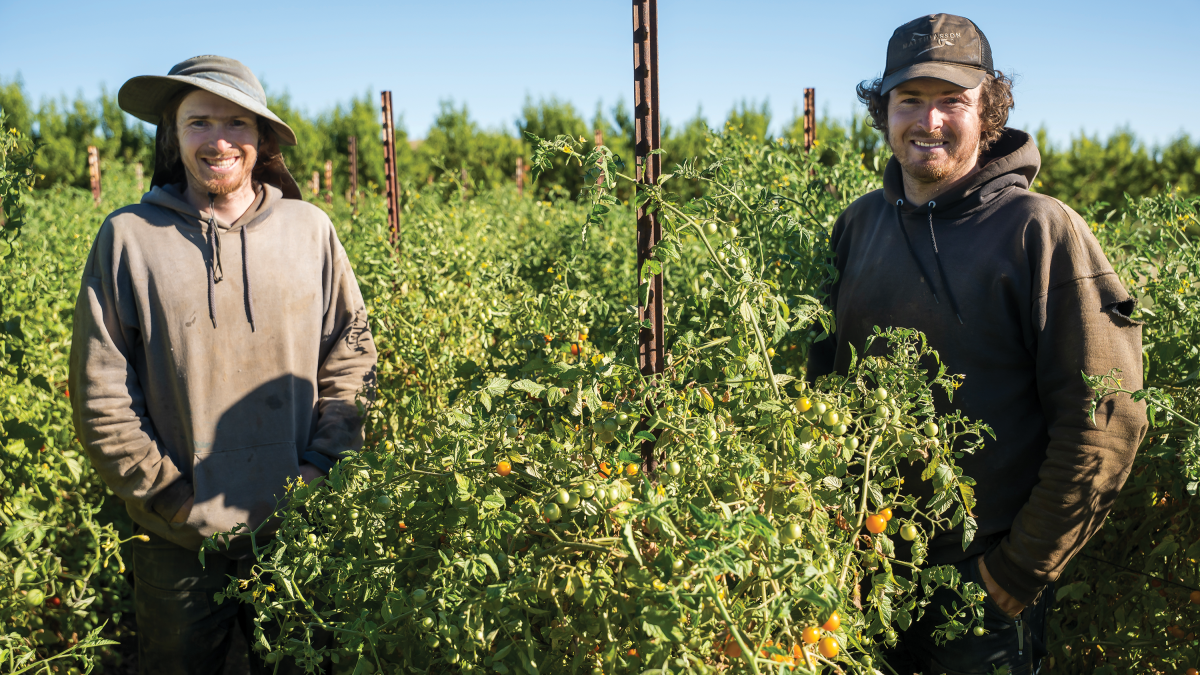
Eric and Andrew Walker, 29-year-old identical twin brothers, didn’t initially plan to become farmers, even though they grew up on a small farm run by their parents. Andrew studied sports management, and Eric pursued journalism when they were in college. Yet, when the opportunity came to farm a 5-acre tract in Winters because another farmer was retiring, they jumped at it.
The Walkers say the property is well suited to their business because it is small with a barn, greenhouse and tractor, which made the property ready for them to farm. Their parents farmed the same property before the twins were born. Since starting Farmboy Organics in 2022, Eric and Andrew have leased three additional small properties and hired two part-time employees.
The work is hard: six days a week, 10 hours a day, year-round. They wear three layers of clothes, even in triple-digit heat, to avoid getting stabbed by plants. But they enjoy the work, particularly going to markets in Davis and Marin County three days a week, where they can see how customers appreciate the food they grow — 20 varieties of tomatoes and other fruits, vegetables and herbs.
The seed for such interest was laid when they were children, helping their parents on weekends at the Ferry Plaza Farmers Market in San Francisco. “It’s awesome when people tell us our tomatoes taste great,” Eric says, noting that customers are used to bland-tasting tomatoes from grocery stores.
The Walkers say they’ve been successful so far. The business has grown, and they have never had to take out a loan to cover operating expenses, a common industry practice. Yet uncertainty looms over the business. Because the Walkers lease the land, they can’t be certain the owners won’t sell it for housing or some other development. If the property went up for sale, they couldn’t afford to buy it.
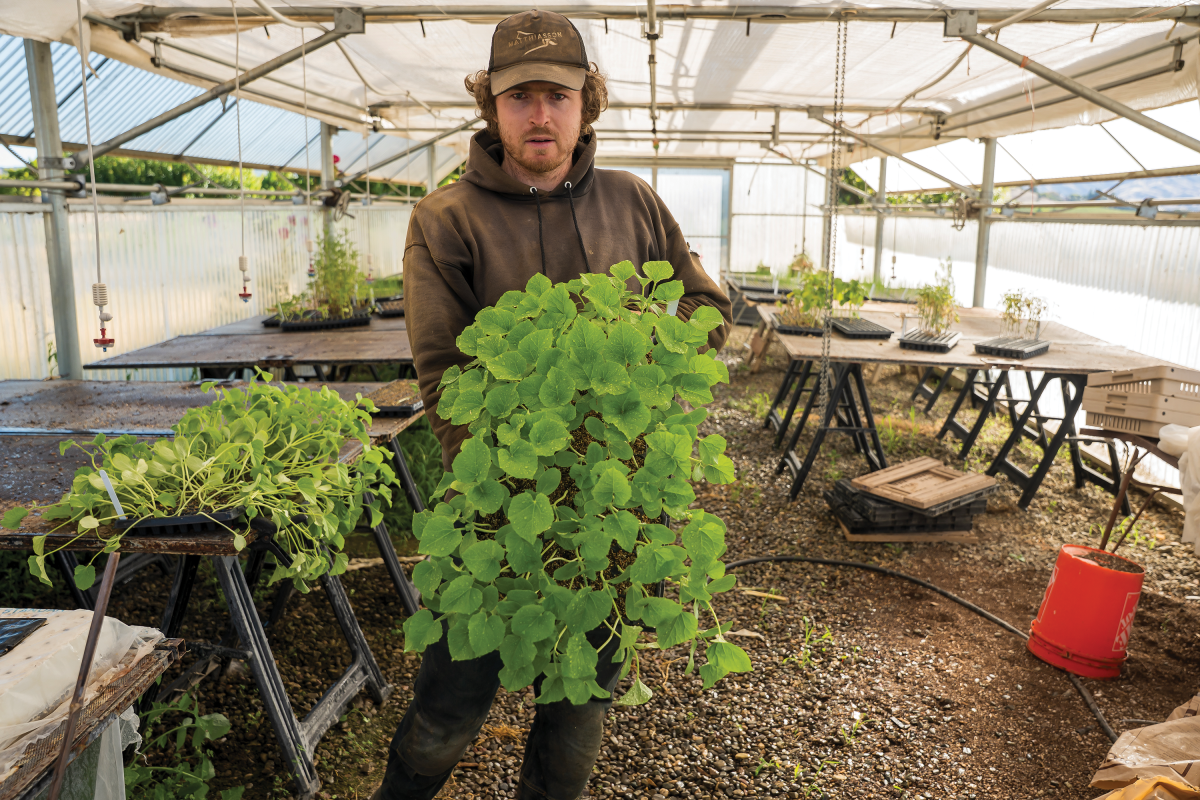
Eric Walker shows produce grown on his farm in Winters. (Photo by
Brad Branan)
“It’s pretty hard to own land. It’s hard to convince banks to give you a loan,” Andrew says, adding that a bank employee actually came out to the farm to ask questions before approving a $20,000 loan for a used van. The uncertainty of farming can make it difficult to provide banks with the information needed to evaluate credit risk. “I don’t know how much I’m going to make each year,” Andrew says.
Brian Park, 44, runs Park Farming Organics in Sutter County. He credits his bank with saving his farm from the vicissitudes of the market. He says he has had to take out operating loans more than once. Park grows similar crops to the Walkers’, a wide variety of fruits and vegetables, among other things, with a heavy emphasis on keeping the soil healthy. Along with his bank, Park credits soil conservation and constant innovation with making his farm a success. Park took over the business in 2021, buying the farm from his parents.
Park is fortunate in that he has excellent water rights located a short distance from the Sacramento River. The flipside is that his farm is in a floodplain, and a big winter storm could spell disaster. Such is the topsy-turvy world of California farming, particularly when it comes to water.
The Sacramento Valley — which runs north from Sacramento County to Tehama County — gets more rain than the San Joaquin Valley. The two valleys make up the Central Valley and the heart of California farm country. But because most of the rain falls in the winter, Sacramento Valley farms are still heavily dependent on water deliveries and irrigation in summer months. To keep the state’s farming industry strong, the state and federal government built an elaborate system of dams, reservoirs and canals.
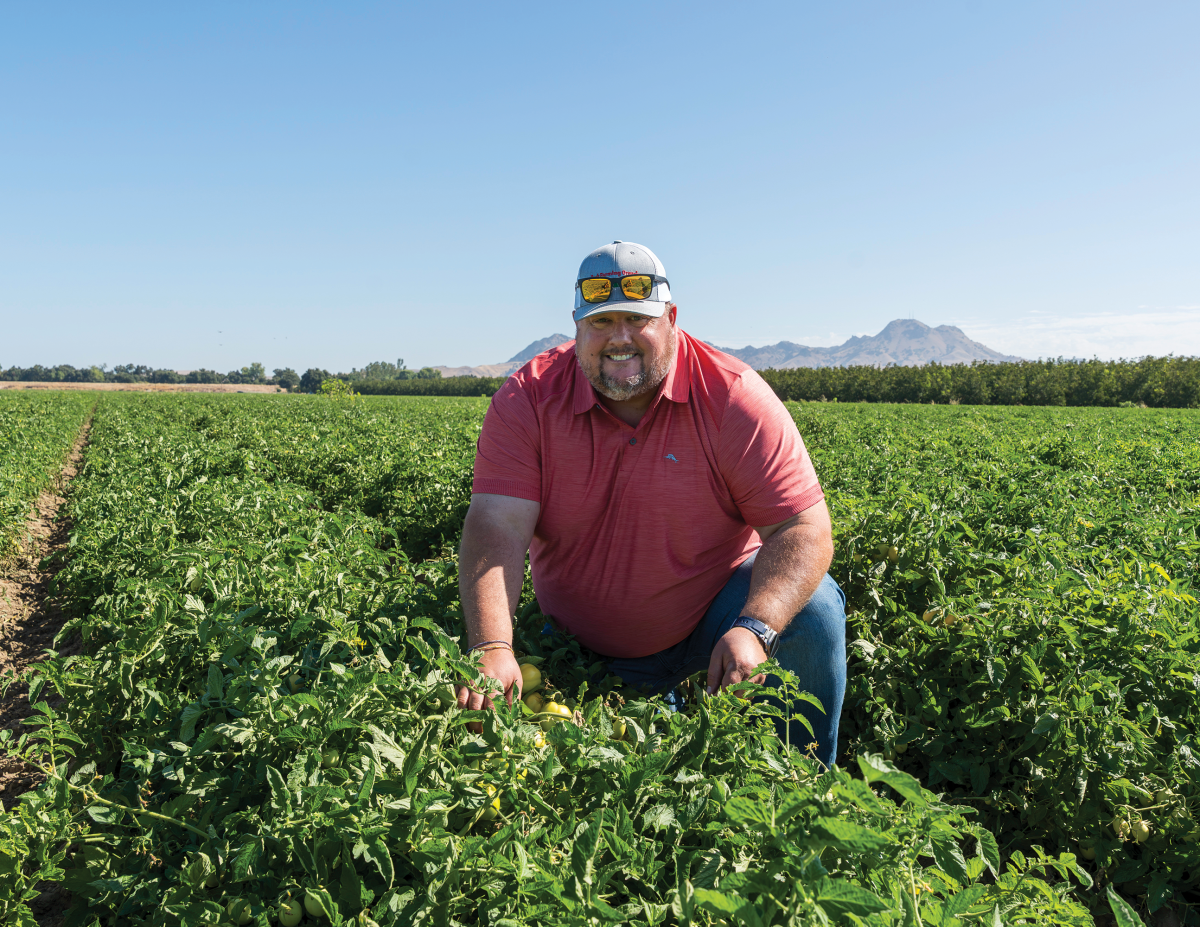
Brian Park has made tomatoes the centerpiece of his farm in
Sutter County near the Sutter Buttes.
From 2002 to 2022, when small farms experienced great stress, the Sacramento Valley was subject to severe drought for more than half the years, and water deliveries were reduced significantly. Since 2022, rainfall across the Sacramento Valley has increased considerably, and allocations have returned to normal for most of the delivery system. However, the recent dry winter has raised concerns, and another water problem looms on the horizon.
The future concern for farmers is groundwater management regulations. Historically, farmers have turned to groundwater during droughts. The state largely ignored the practice and allowed for critical overdrafts of the aquifer, causing parts of the state to sink, a process called subsidence. The state began to rein in the practice of overdraft with the passage of the Sustainable Groundwater Management Act in 2014, which required new local agencies to develop groundwater management plans. The agencies can restrict pumping, impose fees and require meters.
Small farms have fewer resources to meet the new demands than corporate farms. The law’s demands are expected to be greater in the San Joaquin Valley than in the Sacramento Valley, where access to surface water and irrigation is greater.
The Yolo Subbasin Groundwater Agency is responsible for the well water heavily relied upon by the Walkers at their farm in Winters. The agency’s plan says the area’s groundwater use has been historically sustainable, but future use will be monitored to prevent chronic draining.
Another pressure on small farms is wage laws. Even small farms typically have seasonal workers to handle harvests and other work, says Sumner of UC Davis. In 2016, the state passed a law that eventually required farmers to pay workers overtime — one and a half times the normal wage — after eight hours of work in a day or 40 hours in a week. For small farms, with 25 or fewer employees, the law kicked in last year, with less stringent overtime requirements for the three previous years.
Park says the law creates a disincentive for farm managers to provide as much work as they can. Employees, who often want to work as many hours as possible, also lose, Park says. “They should leave it up to the employee to decide how many hours they want to work” at a standard wage, he says.
Higher wages are a major reason why farming in California costs one-third more than in other states, Park says. Some studies have put agricultural costs in California even higher relative to other states. While neither Park nor the Walkers report any problems keeping their farms staffed, U.S. Immigration and Customs Service raids on farms in Southern California this year have created widespread concern among undocumented farmworkers. Some workers are not showing up for work due to fear of arrest, according to news reports.
Park says he has worked hard to establish a strong relationship with his employees, recognizing the importance of their work on his farm. For instance, he took an immersion learning class in Spanish in Monterey so he could talk to them in their native language.
“They are a super, super important and critical part of our operation. We try to treat them and take care of them as best as we possibly can,” Park says. “And there’s a selfish reason for that — I don’t want to have to retrain workers when they leave.” He says most of his workers have been there for over two decades, working for his parents before he took over.
Asked why he continues farming despite the high costs and other demands of the industry, Park says he loves working outside, being his own boss and producing high-quality food. Most of his income comes from selling to major manufacturers like Pacific Foods and Morning Star. Unlike the Walkers, he doesn’t sell directly at markets.
Park hopes one day his children, ages 10 and 13, might be able to take over the farm, although they have expressed no interest yet, and he isn’t sure it will be an option when they’re old enough.
“Will we be able to farm in California then?” he asks. “I honestly don’t know.”
–
Stay up to date on business in the Capital Region: Subscribe to the Comstock’s newsletter today.
Recommended For You
The Central Valley Tradition of Cattle Ranching Faces an Uncertain Future
Do California ranchers still have a home on the range?
Ranching has been a central part of California’s economy and its cultural traditions since pre-statehood. Comstock’s spoke to three Central Valley ranchers about what they have done to stay in ranching and why they continue to work in such a demanding industry.

Inside California’s Small but Growing Artisanal Tea Industry
Farmers in the Sierra Nevada and Central Valley are discovering a distinct California tea terroir
Tea is the world’s second most popular beverage after water.
Though California-grown tea is currently a small industry, it may
be poised to take on some of that demand.
A New Chapter for Lundberg Family Farms
A pioneer of organic farming passes the torch to the fourth generation
Lundberg Family Farms is the largest organic rice grower and
producer in the state of California, with operations in Richvale
in Butte County. Lundberg’s third and fourth generation family
members now work together, each bringing their unique skills to
farming practices such as soil analysis.

The Industry Is Struggling, but Regional Vintners Think Wine Can Still Win
How lower demand, generational shifts in alcohol and potential Trump tariffs are affecting winemakers
After three decades of growth, the industry has seen three years of negative sales. Grape farmers are being severely undercut by cheaper bulk wine from abroad. Sudden, unpredictable tariff shock is knocking exports and profit margins off kilter. And there’s been studies of late suggesting that Gen Z, those born between 1997 to 2012, is abandoning the wine life and maybe even alcohol altogether. But local growers are optimistic nevertheless.