



Few since Mark Twain have done more to propel Calaveras County’s reputation than the Kautz family, owners of Ironstone Vineyards. Their winery, nestled in the oak woodlands near Murphys, combines the best of Sierra foothill vino traditions with museum-like estate tours, a wedding-ready venue, and a vibrant amphitheater hosting national acts like Willie Nelson, Alison Krauss and Lynyrd Skynyrd.
While Ironstone exports its award-winning chardonnays, zinfandels and cabernet francs to 50 countries, Canada was by far its largest export market until a trade war broke out between the North American neighbors last year. Now the winery is suffering from major revenue losses that even its diversified business model may not keep up with.
Ironstone Vineyards hosts music acts at its on-site venue. (Photo
courtesy of Ironstone Vineyards)

In March 2025, in response to 25 percent tariffs that the Trump administration placed on most Canadian goods, all but two Canadian provinces halted the sale of American alcohol products within their borders. This ban was especially hard on California winemakers, which long sent a large portion of their goods north of the border.
Trade talks resumed between the U.S. and Canada in late June that year, with a deadline to set a trade deal deadline by July 21, 2026. As that date approached last summer, optimistic murmurs began to spread among American alcohol producers, as well as among the Canadians who missed them.
However, negotiations collapsed in August, and the U.S. imposed 50 percent tariffs on about $20 billion USD worth of Canadian goods. Canada retaliated with 15 to 50 percent tariffs on an equivalent value of American goods. According to the Associated Press, trade talks are currently “moving,” but the ban on American alcohol remains in place. Only Alberta and Saskatchewan allow the sale of U.S wines, beers and distilled spirits, with Saskatchewan adding a 50 percent markup.
After the collapse of the trade talks, we checked in with Northern California winemakers to see how they were dealing with the whiplash.
A crisis compounded
“Canada represented about 15 to 20 percent of our business for export,” says Joan Kautz, Ironstone’s head of global sales and marketing. “It’s a significant amount, and Canada has always been a solid, profitable and continuous market. So, there is definitely an impact. … There’s this feeling that there’s nothing we can do about it.”
Just north, in Amador County, Terre Rouge and Easton Wines are facing similar challenges. Last May, founder Bill Easton spoke to Comstock’s about his exports to Toronto, Montreal and Quebec City evaporating overnight due to the trade war. Recently, after having his elbows deep in grape harvest, Easton gave the magazine an update.
“It’s actually gotten worse,” he says of his Canadian sales. “I don’t know if I will ever get my business back there. It’s tempting to look down the road, with a different presidential administration, and wonder if maybe I could build it back. But — no, I don’t think so.”
Shelves that usually hold American liquor stand empty at a Liquor
Control Board of Ontario store, the government-operated retailer
that has a quasi-monopoly on alcohol sales in the province.
(Photo by Hannah Clover, licensed under CC BY-SA 4.0)
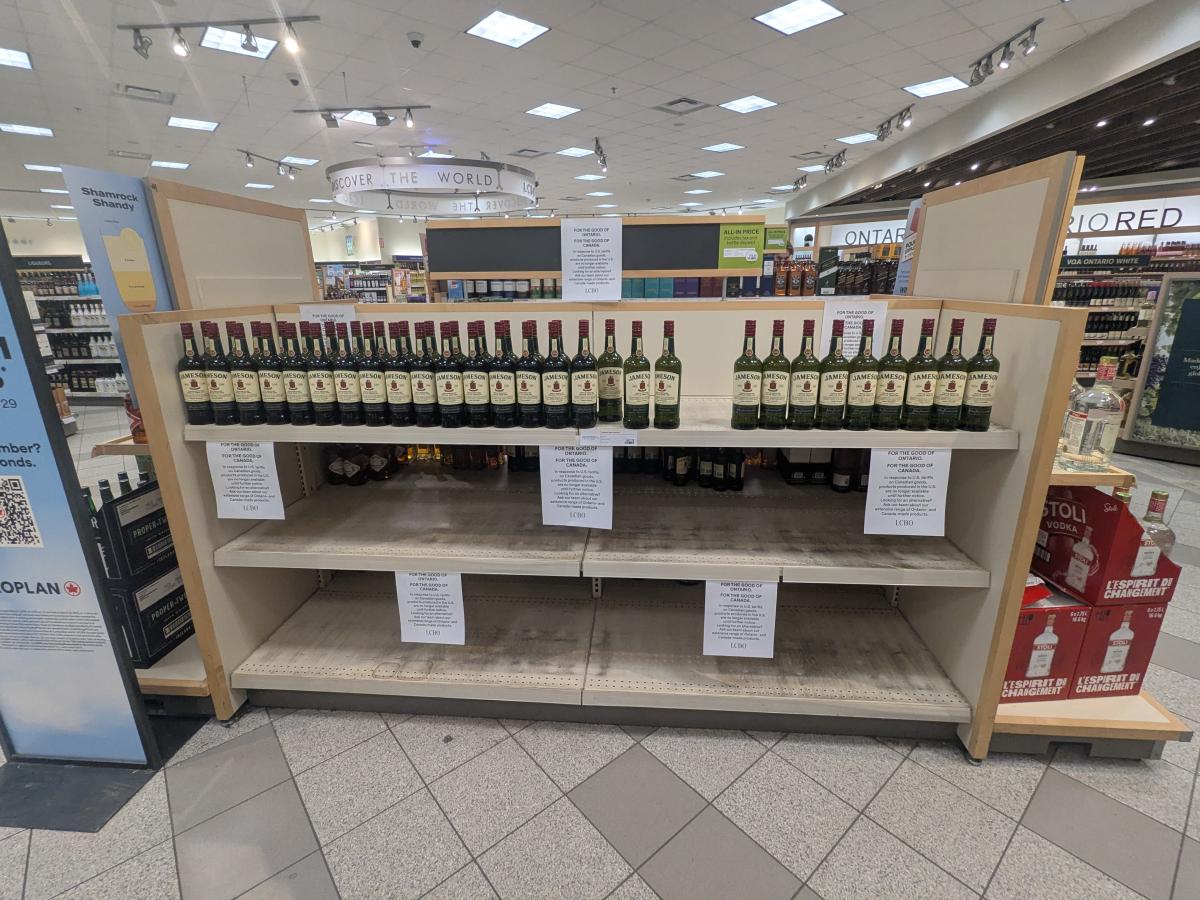
The Wine Institute, a trade association representing nearly a thousand California wineries and wine-related businesses, says the headwinds that Easton and the Kautz family are dealing with continue to impact the entire state.
“Unfortunately, these stories are not anomalies,” says Julie Berge, the Wine Institute’s vice president of communications and member relations. “This is a really common problem that we’re hearing about from many of the wine producers here in California. And in many cases, the amount of time they’ve spent creating these business relationships in Canada is decades.”
According to the Wine Institute’s analysis, in 2024, Canada accounted for 35 percent of U.S. wine exports, representing $434 million in shipments and $1.1 billion in retail sales — a figure larger than exports to the European Union, the United Kingdom and China combined. Berge stresses that as big as those numbers sound, they largely represent the plight of small- and medium-sized, family-owned operations.
“That makes it even more difficult to navigate these changes,” Berge says.
The timing of the international trade war also couldn’t have been worse for regional vintners. Their industry was already experiencing several years of negative sales before the tariff upheaval began. Additionally, a flood of cheap grapes into the U.S. market from overseas has threatened the farming side of California’s industry, while studies continue to show that younger people are gravitating to cocktails and distilled spirits over wine options — if not walking away from alcoholic beverages altogether.
The culminating power of these forces is real. Since February, newspapers in the Golden State have repeatedly led with headlines about longtime wineries closing their doors for good.
“There is not just one pressure-point on the wine industry right now,” Berge says. “There are multiple factors, and they’re all building and compounding on one another — and the bans on wine in Canada have added to that in an absolutely profound way. It’s the biggest disruption to U.S. wine since Prohibition. It’s just a perfect storm.”
Easton agrees.
“In all the decades I’ve been in the wine business, this last year represents the most challenging market I’ve ever seen,” he says.
Hoping for a return
California winemakers also point out that the current de facto blockade is also harming Canadian alcohol distributors. Meanwhile, Canada’s domestic wine and spirits industries are not large enough to fill the gap.
Mélanie Gore, executive director of the Quebec Wine Council, says that while winemakers in her own province haven’t been negatively affected by the trade war, that doesn’t mean they are in a position to fill the hole left by California producers.
“Quebec’s wine industry is quite small,” Gore told Comstock’s in an email. “Quebec wine therefore represents only about 2 percent of our provincial market, and Quebec remains primarily a wine-importing market.”
Unable to penetrate Canadian markets, Ironstone Vineyards has been putting a stronger emphasis on trying to export into emerging markets within Africa and Eastern Europe. Its owners know that success in those zones still can’t replace the sales lost in Canada, though it could soften the blow a little.
Guests walk through one of Ironstone Vineyard’s caves. (Photo
courtesy of Ironstone Vineyards)

“We still have really good relationships with our Canadian partners; it’s just that we can’t do anything together right now,” Kautz says. “We have to make do, and we have to figure out what our options are.”
In the meantime, the Wine Institute has been lobbying on the state, federal and international levels for recognition that this trade war was largely sparked by steel and automobile concerns, thus making the wine industry an unnecessary hostage to the situation.
“Our message is that we just hope both governments can come back together at the negotiating table and find a path forward,” Berge says. “Wine is a beverage that is meant to bring people together, and we have become a pawn in this dispute.”
From Kautz’s perspective, American officials need to recognize that time is of the essence, not just because the loss of sales are hurting wineries’ bottom-lines, but because other countries are trying to permanently replace California wine’s former dominance in the Canadian market.
On that front, however, Kautz is optimistic.
“California has a very special terroir,” she says. “You can’t duplicate it or replicate it. So our hope is that when things change and the market is open again to us, that their consumers will come back to our wines.”
–
Never miss a story: Get Comstock’s weekly newsletter delivered to your inbox.
Recommended For You

The Industry Is Struggling, but Regional Vintners Think Wine Can Still Win
How lower demand, generational shifts in alcohol and potential Trump tariffs are affecting winemakers
After three decades of growth, the industry has seen three years of negative sales. Grape farmers are being severely undercut by cheaper bulk wine from abroad. Sudden, unpredictable tariff shock is knocking exports and profit margins off kilter. And there’s been studies of late suggesting that Gen Z, those born between 1997 to 2012, is abandoning the wine life and maybe even alcohol altogether. But local growers are optimistic nevertheless.
Trump’s Tariffs Hurt Some Local Businesses, but Prompt Others to Shift Gears
What impact are tariffs having on the economy of California's Capital Region?
Conversations with Sacramento-area business owners show tariffs aren’t affecting all companies the same way. At least one is expanding fast because of them. But almost everyone is seeing some effect.
Tariffs Are Everywhere — But They’re Not the Whole Story
Comstock's Talks: Steven Yoder explains how tariffs are affecting the Capital Region, unevenly and often unexpectedly
PODCAST EPISODE: Comstock’s contributor Steven Yoder discusses his January cover story on how tariffs are affecting local businesses and why they aren’t necessarily the biggest factor shaping the economy in 2026.

After Supreme Court Tariff Ruling, Sacramento Businesses Brace for What Comes Next
Clarity helps, but shifting trade policy, energy prices and consumer spending still complicate planning
We checked in with business owners and industry experts in and around Sacramento to understand how local businesses are navigating this complex moment.