


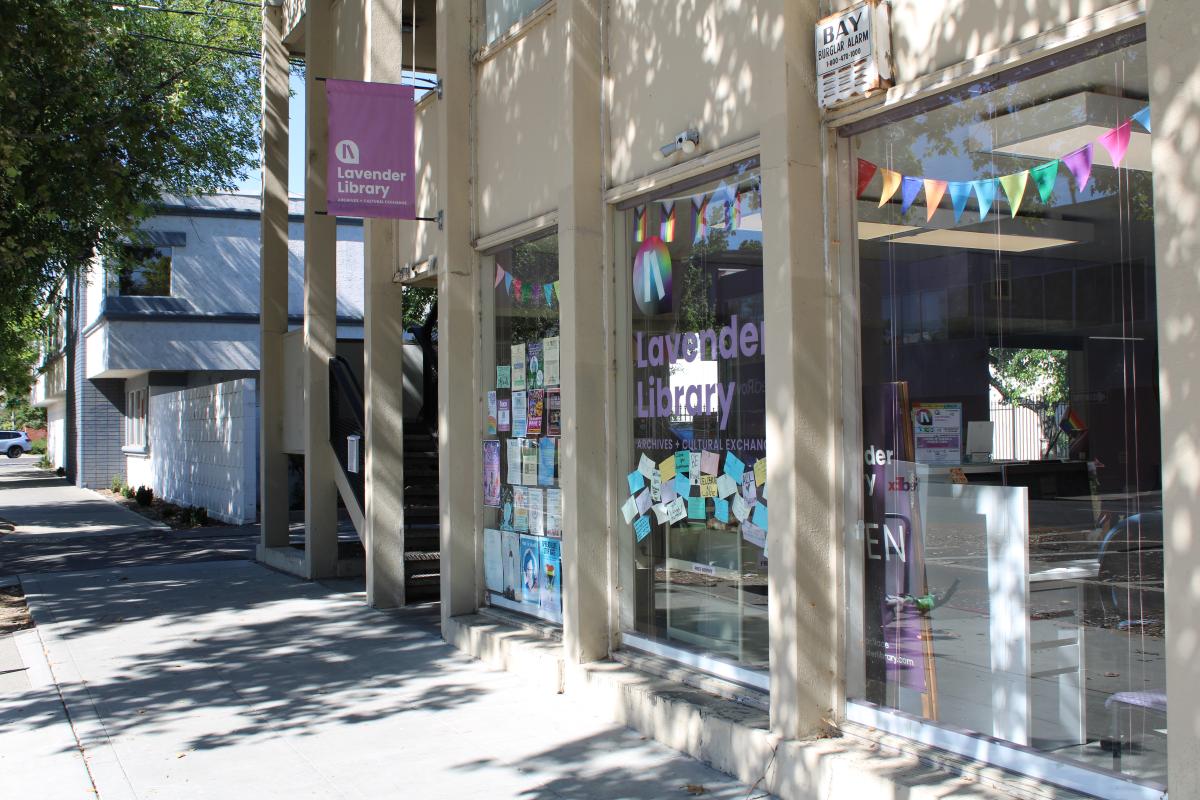
Walking past the Lavender Library on 21st Street, you could easily mistake it for one of Sacramento’s many bookstores. But as soon as you walk inside it becomes apparent that what you’re actually seeing is a treasure trove of the city’s local LGBTQ+ history.
Originally opened in 1998, the Lavender Library, Archives and Cultural Exchange, or LLACE, has spent the nearly three decades building an archive of local LGBTQ+ media. Clint Vigen, one of the original founders of the library, says the decision to open LLACE was primarily due to the seemingly imminent closure of the Lambda Center, now the LGBT Community Center, that same year.
“At that time the Lambda Community Center was on rapid decline and was about to go out,” says Vigen. “They rented out three spaces in the Jackson Building, which is now Big Brother Comics, and they were eventually brought down to three rooms in that building, and they couldn’t rent all three rooms.”
One of those rooms was the Jayne Rountree Commemorative Library in the Lambda Center, now renamed the Sacramento LGBT Community Center, and the community center made the decision to throw away the collection there. Vigen says that Michael Bennet, the librarian of the space, alerted Gail Lang of The Open Book about the disposal.
“Gail rounded up everybody that she could that would pay attention and listen to what was happening,” Vigen remembers. “We took back that Jayne Rountree library, and we moved it temporarily into Gail’s basement.”
The library would find a home at 2727 B St near the B Street Theater for two years before moving to its current location on 21st Street in 2000. Nancy McKernan, who has served on the board since 2012, did the painting for the new location and says she’s amazed by how much it has grown.
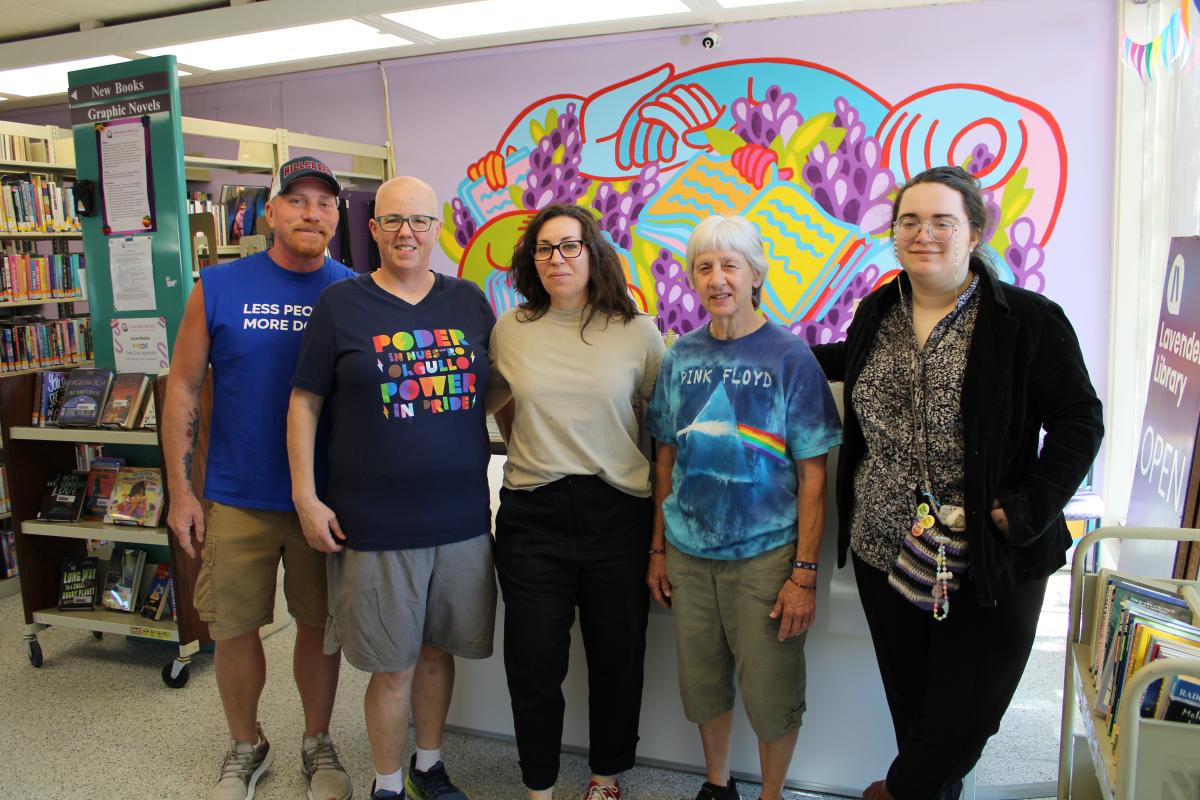
Clint Vigen, Kerry Parsons, Michelle Trujillo, Nancy McKernan and
Rayna Sheftman stand at the opening counter at the Lavender
Library on 1414 21st Street. (Photo by Jacob Peterson)
“The library was just a three-shelf A-frame in the very beginning,” McKernan says. “There were mostly VHS tapes; we didn’t have DVDs and stuff like that back then.”
That small collection has expanded quite a bit in the following years. Kerry Parsons, the director of the archives and collections department, says there is a wide variety of different media available to the public there, including a variety of serialized material.
“We focus on local magazines and publications, and we also have some national publications on our shelves and DVDs people can check out,” Parsons says.
While much of the material in the library is available to check out, there are items in the archive that can only be used for reference material. Michelle Trujillo, the lead archivist, says many of these reference materials are works that would be difficult or impossible to replace if they went missing.
This distinction is “one of the big differences between library and archives,” Trujillo says. Archives “deal primarily with unpublished material, unique materials and photographs that are on site, and people can’t check them out to take home.”
The library is in the process of digitizing its collection, working with the group California Revealed, a state-funded initiative, to convert much of the material there into a digital library. Parsons says this digitization allows more people to use LLACE’s archives for “serious research.”
“There are people doing more articles on LGBTQ+ history that are interested in coming in to do research on things,” Parsons says.
One of the challenges of digitization is cost. Previously, California Revealed offered the services for free, but Trujillo says federal cuts caused them to need to charge.
“This is the first year we’ll have to be paying for the digitization, because we want to keep going and we want to support California Revealed,” Trujillo says. “That’s a real tangible effect of what’s happening at the federal level and how it’s affecting us.”
The library is also working on cataloging its own history. Those duties fall on Rayna Sheftman, a volunteer historian. A Sacramento State student, Sheftman’s task is to go through the library’s documents and put that history together into an accessible format.
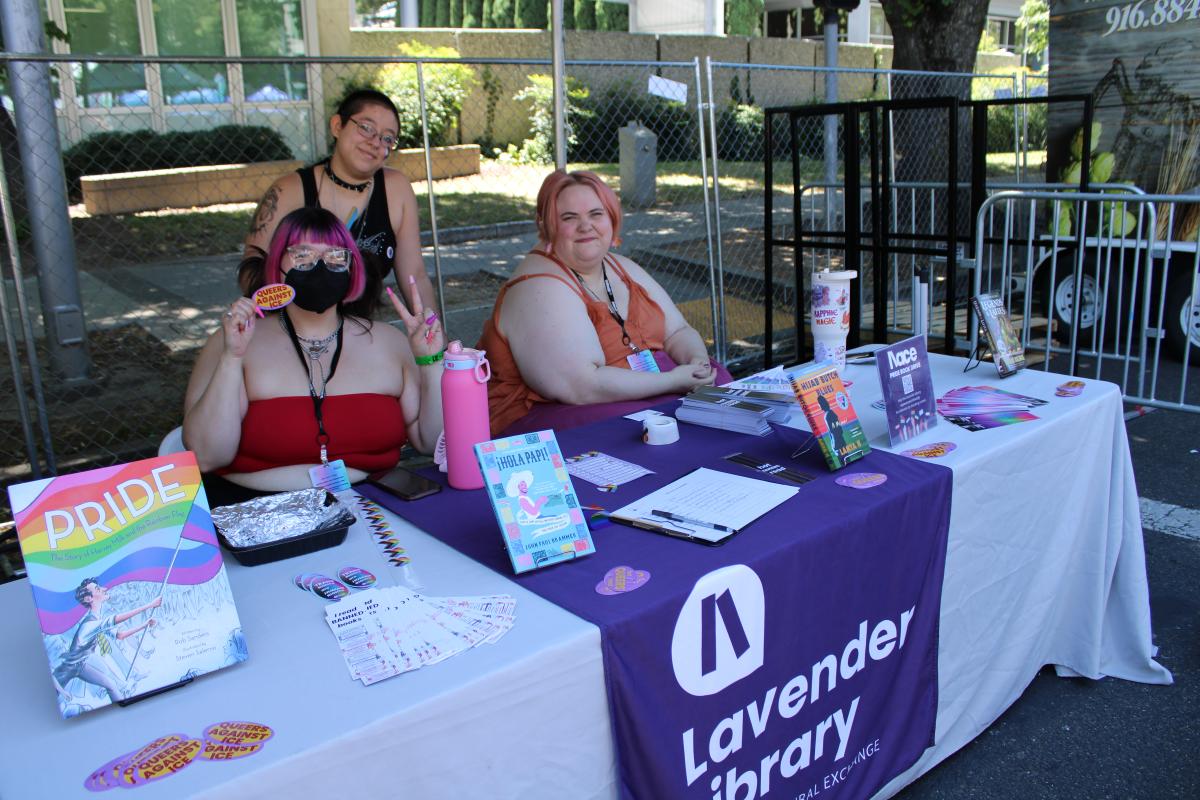
Volunteers for the Lavender Library table at the Sacramento Pride
Festival, giving out information to people interested in visiting
and supporting the library. Trujillo and Parsons estimated the
library had 80 to 90 volunteers, the highest number in its
history. (Photo by Jacob Peterson)
“We don’t have an accessible, documented version of our own history as an organization,” Sheftman says. “So my role has been going through internal documents, newspaper articles — anything I can find, basically — to document that history.”
Sheftman’s work fulfills one of the many roles needed to keep the library running. They note that in addition to archival work, volunteers help with day-to-day operations and outreach, including tabling at Sacramento Pride.
“We have a huge volunteer base that keeps the doors open at the library and keeps it a community space,” Parsons says.
Community support and donations are also a key part in keeping the library running. While LLACE does apply for grants, Parsons says the majority of financial and material support comes from individual donations.
“We don’t have any government funding; it’s just the public donating funds and material,” Parsons says. “It is tough in the current economic climate, but the LGBTQ+ community has been amazing. They give support when they can.”
Parsons says that, in her view, the local queer community offers strong support even when their own financial situations are not secure. Trujillo says this appears to have been the case historically as well.
“That speaks to historically marginalized communities being responsive and sensitive to those changes and knowing those challenges will be there,” Trujillo says. “There’s such a deep sense of belief and care in our space here, and that comes through in the time that our volunteers spend here and the projects that we do.”
On top of archival work, the library also acts as an important space for the local queer population. Trujillo and Parsons both found the library because they were looking for a community.
“Having a safe space for people to go and be amongst other people, their peers, their elders, is incredibly important,” Parsons says. “There are members of the community who don’t want to go to bars and have a place like the Lavender Library where they can hang out and be with other people.”
Trujillo says that it is also important for the library to be a free resource, as it allows people to participate in social events no matter what their economic situation is.
“People can come and be who they are here, but there’s also a sense of a shared something,” Trujillo says. “Everyone doesn’t have the same experience, but we have the same sense of mutual affirmation of others dignity no matter how you show up.”
Corrections June 25, 2026:
- A previous version of this article stated that LLACE opened in 1997. It opened in 1998.
- A previous version of this article stated that LLACE was previously located in the Jane Roundtree Library. It was located in the Jayne Rountree Commemorative Library in the Lambda Center.
- A previous version of this article stated that LLACE was previously located in the B Street Theater. It was located at 2727 B St, near but not in the theater.
–
Never miss a story: Get Comstock’s weekly newsletter delivered to your inbox.
Recommended For You
A Decade of Dazzle
Sacramento burlesque troupe The Darling Clementines celebrates 10 years of body positivity and inclusion
In November, Sacramento burlesque troupe The Darling Clementines celebrated its 10-year anniversary. To celebrate, it held a blockbuster show with visiting acts like Frankie Fictitious and Banbury Cross, both from the Bay Area.
Dennis Mangers Has Had 8 Careers — and Says He May Be Ready for Another Chapter
An audience with Sacramento’s go-to advocate for the arts, government, education and LGBT equality
Dennis Mangers, who says, “I’ve had eight careers in 83 years,” is known for unimpeachable credibility.
A New Era of Library Architecture Is Taking Shape in Northern California
From Truckee to Davis, the Capital Region's newest libraries foster community and a sense of place
We profile several libraries in the Capital Region and the
architects who designed them to reveal just how radically these
institutions have changed — and why they matter more than ever in
a digital age.
At the California State Library, the Pleasures and Treasures Are Yours
Six million items are available for viewing
There is much magic to discover at the California State
Library, whether you visit for research or pleasure.
The institution’s keepers take us on a tour of some of
its treasures.