


This story is part of our July 2026 Young Professionals issue. To read the print version, click here.
I’m 23 and work in a semi-creative field — we’re hybrid, only in the office two days a week, and it’s a pretty relaxed dress code where we can actually express our personal style. Nothing I do is client-facing either, so it’s not like I’m representing the company publicly.
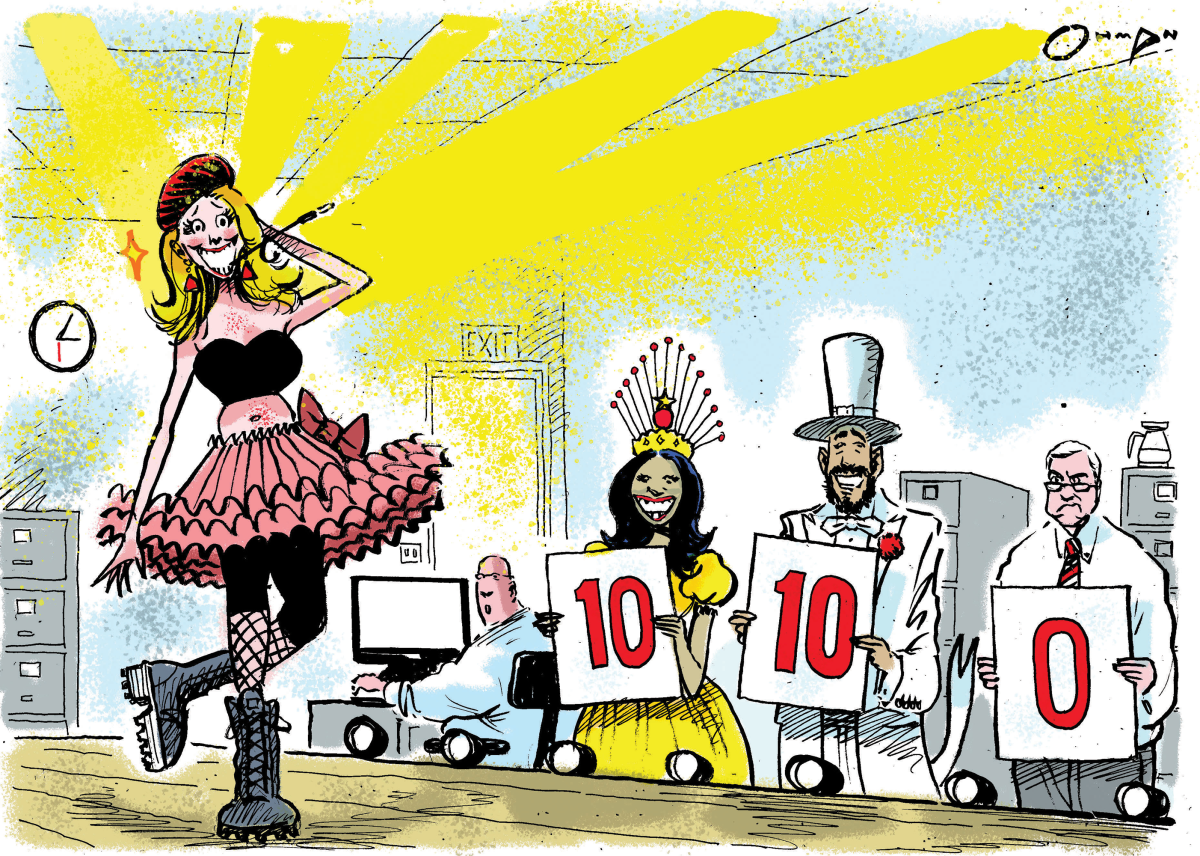
The other day, my boss (female, in her 50s) called me in and told me my outfit wasn’t appropriate for work. I was wearing low-rise pants and a blouse that showed just a little tummy. Note that I was channeling office siren, not club girl. I genuinely thought the look was stylish and pretty typical among women my age. Plus, some of my older coworkers regularly show cleavage, which — honestly, good for them! — has never been flagged. I don’t recall anything in my contract prohibiting a bit of midriff.
On top of that, a male coworker recently wore shorts, and no one batted an eye. Is there a double standard here? For women, styles and rules are constantly changing: in the ‘70s, it was standard to go braless; in the ‘60s, it was super-short skirts. So how do I know what is tasteful and what is inappropriate, while staying true to my personal style?
Expressing your style and showing your belly button are two very different things.
Sorry, I’m a woman in my 50s.
Which means I have a ton of workplace experience that you lack. And that experience has taught me that even pretty relaxed dress codes all want three things covered: boobs, butts and bellies.
So it doesn’t surprise me at all that your boss deemed your outfit unacceptable. It also doesn’t surprise me that cleavage was ignored, as cleavage is decidedly different than “boobs.” I’ll explain.
Every company needs a dress code
Whenever I’m in need of more visibility on LinkedIn, I’ll post “Every company needs a dress code” and get 100,000 views with people arguing that they “only hire adults, so no dress code needed.” They just tell people to “dress for their day,” and it’s no problem.
And it’s not a problem until a 23-year-old shows up in a midriff-baring shirt and doesn’t understand why it’s inappropriate.
Dress codes don’t have to be about suits, ties and pencil skirts. It is about the basics. Things like “no profanity on T-shirts” or “no underwear as outerwear” should be part of almost every dress code.
You say there is nothing in your contract, but you undoubtedly do not have a contract. Very few American employees do outside a union environment. Which means the company is free to change the dress code at any time, and your boss is allowed to have a dress code specific to her department. (Whether she should or not is another question, but she can.)
Every company has a dress code, and most have two
More important than the written dress code is the unwritten one.
This is how the senior team dresses. And you should pay close attention. Your official dress code may not mention footwear, but if the senior team isn’t wearing flip-flops, neither should you. The older women, as you said, are showing a bit of cleavage, so that’s going to be OK. And a bit of cleavage is OK under almost all dress codes, simply because if you’ve got a larger chest and aren’t wearing a turtleneck, cleavage will show.
What you probably don’t see is boobs hanging out, a la the red carpet and body tape. Take a look at how these older women who are probably higher on the corporate ladder dress, and let that be your guide.
Isn’t this just sexist?
It would be sexist if men were allowed to have their tummies showing and you weren’t. That doesn’t seem to be the case here. They were wearing shorts. If you get in trouble for wearing shorts (of comparable length), that would be a sexist issue.
While people often talk about dress codes as being ways to control women, it’s rare that women have less flexibility than men. Shorts are often prohibited, while skirts, even short ones, are allowed. On a 90-degree day, women can wear a short, flowy, sleeveless dress for maximum coolness, while men wear long pants and a button-down shirt. Both are considered business casual, but women definitely have more flexibility.
The most important thing for you to consider, though, is what you want to achieve in your career. If your sense of style is more important than moving ahead in your career, great! Fight for your belly button to be free. If you want to be branded as the person who pushes against the dress code and complains at every correction, you are free to do so! But it will hurt your career. Guaranteed. If you want to gain the respect of people in your industry and get ahead, follow the dress codes — written and unwritten.
–
Stay up to date on business in the Capital Region: Subscribe to the Comstock’s newsletter today.
Recommended For You
Is Beer at Work a Problem, or Is It a Sign of Something Bigger?
Dilemma of the Month: An HR manager's workplace battle exposed a bigger issue
After raising concerns about workplace drinking, an HR manager found herself questioning her relationship with the company president.
How Do You Terminate a Remote Employee? Do They Need to Come in if They Live Locally?
Dilemma of the Month: The Evil HR Lady talks reductions in force
First, I’m sorry you have to lay off these employees, but here are the things you need to think of.

Two Employees Are Clashing Over Loud Music in the Workplace. How Do We Keep the Peace?
Dilemma of the Month: The Evil HR Lady discusses 'toxic accommodations'
What should you do about an employee who likes music so loud it can be hard to hear customers — and accuses people of harassment if they ask to turn it down?
Why Am I Feeling So Burnt Out in HR?
Dilemma of the Month: The Evil HR Lady tackles the sometimes ruthless nature of HR
Yes, the majority of employees are great, but that 5 percent are not, and they can make your life a living hell. Add to that the heavy administrative and compliance burden and the utter disdain some people have for HR professionals, and it’s no wonder you’re burned out.